KYC & AML Compliance in Spain 2026: Banco de España and SEPBLAC Requirements for Fintechs
Spain KYC and AML compliance in 2026 is driven by how identity verification, due diligence, and ongoing monitoring are operationalized under SEPBLAC expectations. For fintech teams, the challenge is building a unified workflow that supports remote onboarding, cross-border users
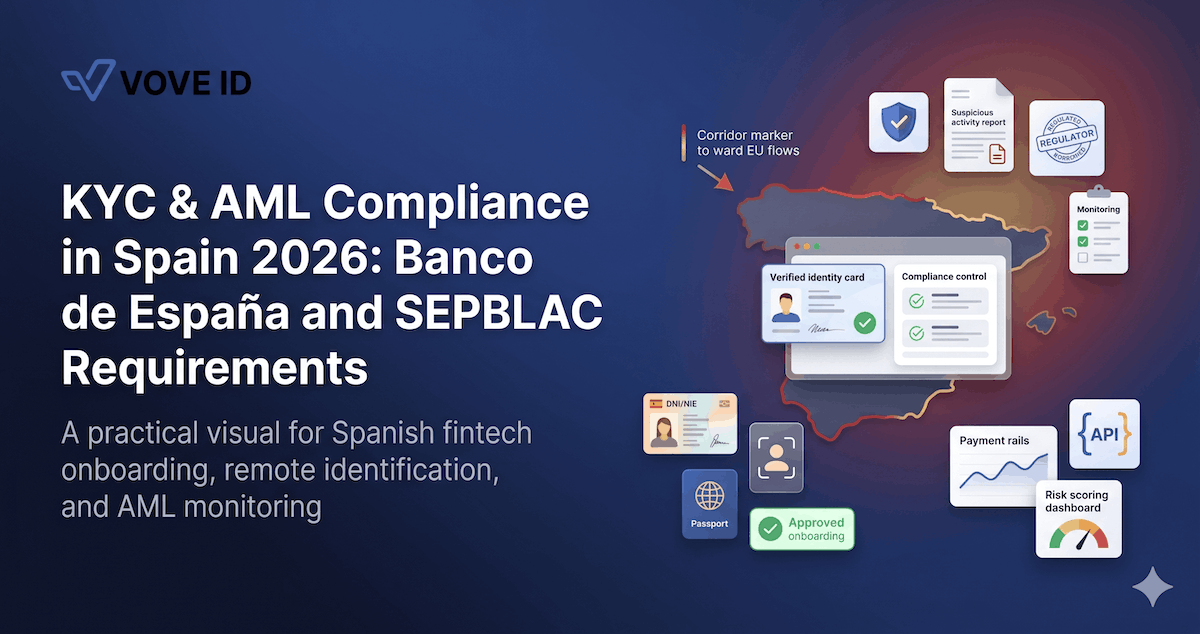
Spain compliance in 2026 is not about defining what KYC or AML is in theory. It is about how identity verification, due diligence, and ongoing monitoring are operationalized under Spanish regulatory expectations in real onboarding systems.
Spain remains one of the most active fintech markets in Europe, which makes compliance less about legal abstraction and more about execution across real customer flows.
Fintech teams operating in Spain must design onboarding and monitoring systems that work for residents, non-residents, cross-border users, and regulated supervisory expectations at the same time.
For more information about KYC:
 Anastasiia
Regulatory framework in Spain (2026 context)
Spain’s AML and KYC obligations are primarily based on:
- Ley 10/2010 (AML/CTF law)
- Real Decreto 304/2014 (regulatory implementation)
These define the core obligations for customer identification, beneficial ownership, risk-based due diligence, and ongoing monitoring.
Three supervisory and operational institutions shape enforcement:
SEPBLAC (core AML authority)
SEPBLAC is the central authority for AML supervision and suspicious activity reporting.
In practice, it expects obligated entities to:
- identify and verify customers
- identify beneficial owners where applicable
- understand the purpose of the relationship
- apply ongoing monitoring
- maintain secure and traceable identification procedures
For fintech onboarding systems, SEPBLAC is the primary compliance reference point.
Banco de España
For payment institutions and regulated payment-service providers, Banco de España oversees authorization and operational supervision.
Its role connects compliance directly to market access. In many cases, AML readiness is part of the licensing and operational approval process, not a post-launch requirement.
CNMV
CNMV supervises investment services, securities-related platforms, and regulated market participants.
This means compliance requirements may differ depending on whether the business operates in payments, investments, or other financial services, even under the same AML law.
KYC requirements in Spain (operational view)
KYC in Spain is not a single document check. It is a structured identity verification process that must remain defensible under regulatory review.
1. Customer identification
Common identity documents include:
- DNI (Spanish national ID)
- NIE (foreign resident identification number)
- passport for international users
- residence documentation where applicable
The key requirement is not the document type itself, but the ability to verify identity reliably and retain evidence for audit and regulatory review.
2. Remote onboarding requirements
Spain allows non-face-to-face onboarding, but only when supported by secure identification methods.
SEPBLAC requires that digital onboarding processes:
- reliably verify customer identity
- use secure identification procedures
- maintain traceable evidence of the process
- support later verification or audit requests
In practice, this creates a higher operational bar for fintech onboarding systems compared to simple document capture flows.
A compliant remote onboarding process in Spain typically requires not only document verification but also consistency checks between identity data, device signals, and behavioural risk patterns at the moment of onboarding.
This is especially relevant in cases where customers onboard from abroad or use digital-first banking or payment platforms. In these scenarios, identity verification cannot rely solely on document authenticity — it must also account for fraud prevention signals and the overall reliability of the onboarding context.
For fintech teams, this means remote onboarding is not a single verification step, but a layered process combining identity validation, risk assessment, and evidence generation for potential supervisory review.
3. Business customer verification (KYB element in Spain context)
When onboarding legal entities, Spanish AML obligations extend beyond entity registration.
Fintechs must identify:
- beneficial owners
- control structure
- relevant decision-makers
This is especially relevant for:
- B2B payment platforms
- embedded finance products
- cross-border business onboarding
- treasury and marketplace models
4. Purpose of relationship
Spanish compliance requires understanding why the customer is onboarding.
This includes:
- expected transaction behaviour
- intended product usage
- estimated volume and activity profile
This baseline becomes essential for later monitoring and anomaly detection.
AML obligations in practice (Spain execution layer)
AML compliance in Spain is not limited to sanctions screening. It is an operational system built around monitoring, escalation, and documentation.
1. Ongoing transaction monitoring
Transactions must be assessed against the customer’s declared profile.
If behaviour deviates materially, the system must flag it for review rather than assuming benign explanations.
In mature compliance systems, this monitoring layer is not static but continuously updated based on changes in customer behaviour and external risk signals.
For example, a customer’s transaction profile may remain stable for months and then shift gradually due to changes in business activity, geographic exposure, or counterparties. These changes are not always immediately suspicious, but they can indicate that the original onboarding assumptions are no longer fully accurate.
This is why ongoing monitoring functions as a feedback loop between onboarding data and real-world activity. When discrepancies emerge, they are treated as indicators that the customer profile may require reassessment.
In Spain’s regulatory context, this aligns with the expectation that customer due diligence is not a one-time exercise, but a continuous process tied to the evolving risk profile of the relationship.
2. Suspicious activity escalation
If, after internal review, activity indicates potential money laundering or terrorist financing risk, it must be escalated to SEPBLAC.
This requires:
- structured alert handling
- investigator review workflows
- documented decision-making
- escalation readiness
3. Risk-based due diligence
Not all customers are treated equally.
Enhanced due diligence is typically applied to:
- high-risk geographies
- complex ownership structures
- unusual transaction patterns
- politically exposed persons (PEPs)
- high-volume or cross-border flows
4. Internal controls and auditability
Compliance is not only about decisions, but about proving them.
A defensible system must retain:
- identity verification records
- screening results
- risk classification history
- monitoring logic and alerts
- escalation and resolution trails
Without auditability, compliance cannot be validated under supervisory review.
Spain-specific operational challenges
Beyond regulation, Spain introduces practical onboarding complexity.
1. Multiple identity pathways
Fintech systems must support different identity types:
- Spanish citizens (DNI)
- foreign residents (NIE)
- international users (passport-based flows)
Rigid onboarding systems often fail here due to lack of flexibility across document types.
2. Cross-border user base
Cross-border onboarding adds additional complexity because verification requirements do not map cleanly across jurisdictions.
A user onboarding from another EU country may present different identity standards, address validation mechanisms, and data availability compared to Spanish residents. Non-EU users introduce even greater variability in documentation and verification confidence.
This creates a challenge in maintaining consistent risk standards while adapting onboarding logic to different identity ecosystems.
As a result, Spain-based fintech systems require flexible onboarding rules that can normalize identity verification outcomes without weakening compliance standards.
3. Supervisory alignment complexity
The applicable compliance expectations can vary depending on whether the business operates under:
- payments regulation
- securities regulation
- other financial service categories
This affects how AML obligations are interpreted in practice.
Realistic failure case
A Spain-based fintech launches with a standard remote onboarding system.
Initially, the system performs well:
- identity documents are verified
- accounts are approved quickly
- early growth is stable
Over time, structural issues emerge:
- a growing portion of users are non-residents
- declared activity does not match transaction behaviour
- beneficial ownership for business users is not deeply verified
- monitoring rules are too generic to detect meaningful risk shifts
No single control fails completely.
The problem is that identity, purpose, and monitoring are not tightly integrated into a single compliance workflow.
As the product scales, these issues become visible not in isolated cases, but in systemic patterns across the customer base. Certain segments begin generating disproportionate compliance workload, and teams must manually interpret cases that should have been resolved through system design.
This creates a gap between theoretical compliance design and real operational behaviour, resulting in a reactive rather than preventive compliance model.
Closing this gap requires tighter integration between identity verification, customer profiling, and ongoing monitoring as part of a unified system.
How VOVE ID supports Spain compliance workflows
VOVE ID helps fintech teams operationalize Spain KYC and AML requirements as a unified workflow.
This includes:
- identity verification for Spanish and international users
- document handling for DNI, NIE, and passport-based flows
- beneficial ownership verification for business onboarding
- sanctions and PEP screening
- ongoing monitoring and alerting
- structured escalation workflows
- audit-ready compliance records
The objective is not isolated checks, but a continuous compliance system that holds up under operational and regulatory pressure.
Q&A
What documents are required for KYC in Spain?
Common documents include DNI for citizens, NIE for foreign residents, passports, and residence-related documentation depending on the onboarding case.
Can fintech companies onboard users remotely in Spain?
Yes, but only if secure identification procedures are used and the process is traceable and defensible under regulatory review.
Which authority regulates AML compliance in Spain?
SEPBLAC is the primary AML authority, while Banco de España and CNMV apply depending on the financial activity type.
What is the main challenge in Spain compliance?
The main challenge is integrating identity verification, customer purpose, and ongoing monitoring into a single operational workflow that works across diverse user types.
Conclusion
Spain KYC and AML compliance in 2026 is an operational discipline, not a theoretical framework.
Fintech systems must support secure identity verification, adaptable onboarding flows, risk-based due diligence, and continuous monitoring that aligns with SEPBLAC expectations.
A compliant system is not defined by isolated checks, but by how well identity, risk, and monitoring are connected throughout the entire customer lifecycle.
If you want to implement Spain-ready KYC and AML workflows with unified identity verification, monitoring, and audit infrastructure, you can explore how VOVE ID supports regulated fintech operations.