Perpetual KYB Monitoring: Why B2B Fintechs Need Continuous Business Verification
Perpetual KYB monitoring extends business verification beyond onboarding by continuously tracking ownership, control, and risk changes over the full customer lifecycle. In 2026, it becomes a core requirement for B2B fintechs and regulated platforms that need accurate, always-current KYB data.
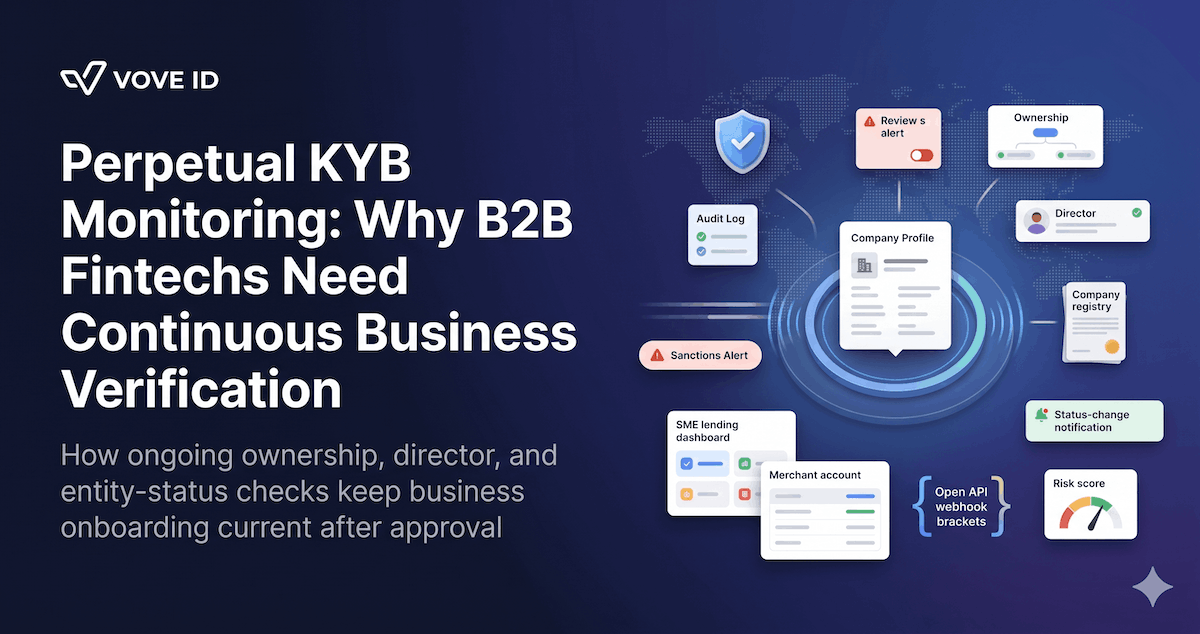
Perpetual KYB is the monitoring layer of the KYB lifecycle. It is the difference between verifying a business once at onboarding and maintaining an accurate, defensible view of that business as its ownership, control, and risk profile evolve over time. In 2026, this layer matters because core risk attributes can change long after onboarding is approved.
What is perpetual KYB monitoring and who needs it?
Perpetual KYB monitoring is the ongoing verification of a business customer after onboarding, including updates to ownership, directors, legal status, sanctions exposure, and risk profile. It is primarily used by B2B fintechs, SME lenders, marketplaces, payment providers, and any regulated platform with active business relationships over time.
Most fintech teams still treat KYB as a one-time onboarding process.
For more information about KYB, read our guide:
 Anastasiia
They verify the company at entry, confirm ownership structure, run sanctions screening, approve the account, and move on. At that moment, the file is considered “complete”.
The problem is that business entities are not static.
Ownership structures shift, directors change, companies expand into new markets, and risk exposure evolves through new counterparties or regulatory actions. The onboarding file remains unchanged, while the real-world entity does not.
This is where one-time KYB starts to break down.
Why one-time KYB is not enough
One-time KYB answers a single question:
“Was this business acceptable at onboarding?”
It does not answer what matters operationally:
“Is this business still acceptable today?”
Between those two points, several critical changes can occur:
- changes in beneficial ownership or control
- updates in company registry status
- new directors or authorised signatories
- sanctions or adverse media exposure
- shifts in transaction behaviour or business model
Corporate structures are particularly dynamic. Unlike individual KYC, businesses can change through holding structures, acquisitions, funding rounds, and internal reorganisations without triggering a new onboarding event.
Without ongoing monitoring, KYB becomes a snapshot instead of a living control.
How perpetual KYB fits into the KYB lifecycle
Perpetual KYB does not replace onboarding. It extends it into an operational lifecycle.
A typical KYB lifecycle for business customers looks like this:
1. Onboarding baseline
At entry, the business is verified:
- legal entity validation
- beneficial ownership identification
- sanctions and PEP screening
- initial risk classification
- expected activity profile definition
This creates the baseline reference for all future monitoring.
2. Continuous monitoring layer
After approval, monitoring becomes active:
- company registry data is refreshed periodically or event-driven
- directors and beneficial owners are continuously screened
- sanctions, PEP, and adverse media signals are tracked
- entity status changes are monitored
This layer ensures the KYB file does not become outdated.
3. Event detection
The system identifies meaningful changes such as:
- ownership or control updates
- changes in company legal status
- newly identified risk exposure
- behavioural mismatch with expected activity
Not every change is critical, but every change is visible.
4. Risk-based routing
Detected events are processed based on severity:
- low-risk updates are logged
- medium-risk signals trigger analyst review
- high-risk events escalate or restrict activity
This prevents alert overload while maintaining control integrity.
5. Re-verification and audit trail
When required, the KYB file is refreshed:
- ownership is reconfirmed
- documentation is updated
- screening is rerun
- decisions are logged for audit purposes
This ensures regulatory defensibility and internal traceability.
What triggers perpetual KYB monitoring
A well-designed monitoring system focuses on meaningful risk changes rather than constant noise.
Key triggers include:
1. Company registry changes
- liquidation, dissolution, suspension
- filing inconsistencies or status updates
- structural corporate changes
2. Ownership and control changes
- new beneficial owners
- changes in controlling shareholders
- layered ownership restructuring
3. Director or signatory updates
- appointment or removal of directors
- changes in authorised representatives
- shifts in decision-making authority
4. Risk exposure changes
- sanctions listings or updates
- PEP exposure
- adverse media signals
5. Behavioural mismatch
- transaction patterns inconsistent with declared activity
- unexpected geographies or corridors
- material volume changes
Regulatory expectation behind perpetual KYB
Regulatory frameworks do not always use the term “perpetual KYB”, but they consistently require ongoing due diligence.
Across major AML regimes, firms are expected to:
- identify and verify business customers
- identify and verify beneficial owners
- understand the purpose of the relationship
- apply ongoing monitoring
- keep customer information up to date
These requirements are typically defined at the framework level, but in practice they are implemented through continuous monitoring systems that operate after onboarding.
The direction is consistent: KYB is not a one-time check, but a lifecycle obligation.
Perpetual KYB checklist for fintech teams
A functional implementation should include:
- defined monitoring scope for business customers
- integration with registry and screening data sources
- continuous tracking of ownership, directors, and entity status
- sanctions, PEP, and adverse media screening over time
- configurable risk-based alert thresholds
- alignment with transaction monitoring signals
- audit-ready logs of all changes and actions
Without these components, monitoring becomes reactive instead of controlled.
Why perpetual KYB matters operationally
Perpetual KYB is often treated as a compliance requirement, but it also reduces operational risk.
Without it, teams face:
- delayed discovery of ownership or control changes
- manual re-checks triggered too late
- inconsistent customer risk profiles
- exposure to outdated onboarding assumptions
In business models with active financial relationships, a single outdated KYB file can affect credit exposure, payment flows, fraud risk, and regulatory reporting simultaneously.
Continuous monitoring reduces this dependency on static data.
How VOVE ID supports perpetual KYB
In practice, perpetual KYB requires connecting onboarding data, monitoring signals, and case management into a single lifecycle system.
VOVE ID is designed to support this model through:
- onboarding verification of business entities
- capture and validation of ownership structures
- continuous screening of directors and beneficial owners
- automated alerts for entity and ownership changes
- API-driven re-verification workflows
- unified audit trails across onboarding and monitoring
The objective is not just faster checks, but maintaining an always-current KYB view without rebuilding customer files from scratch.
Q&A
What is perpetual KYB monitoring?
It is the ongoing process of tracking changes in a business customer’s ownership, control, status, and risk profile after onboarding.
Why is one-time KYB insufficient?
Because business structures and risk exposure change over time, while a static KYB file does not reflect those changes.
Who needs perpetual KYB?
Primarily B2B fintechs, SME lenders, payment providers, marketplaces, and embedded finance platforms with active business relationships.
How is perpetual KYB different from onboarding KYB?
Onboarding KYB establishes the baseline. Perpetual KYB maintains that baseline as the business evolves.
Conclusion
Perpetual KYB monitoring is not a separate compliance concept, but the operational extension of KYB into the lifecycle of a business relationship.
In 2026, regulated fintech systems are expected to maintain continuous visibility into ownership, control, and risk changes — not just verify them once at onboarding.
This shift turns KYB from a static checklist into a continuous control layer that supports real-time risk awareness.
If you want to implement continuous KYB monitoring with unified onboarding, screening, and audit workflows, you can explore how VOVE ID supports end-to-end business verification systems.