KYC Compliance in Gabon: 2026 Guide for Regulated Businesses
Gabon operates under a COBAC-led KYC framework built on CEMAC directives. Here's what identity verification looks like in practice — documents, thresholds, and where onboarding breaks down.
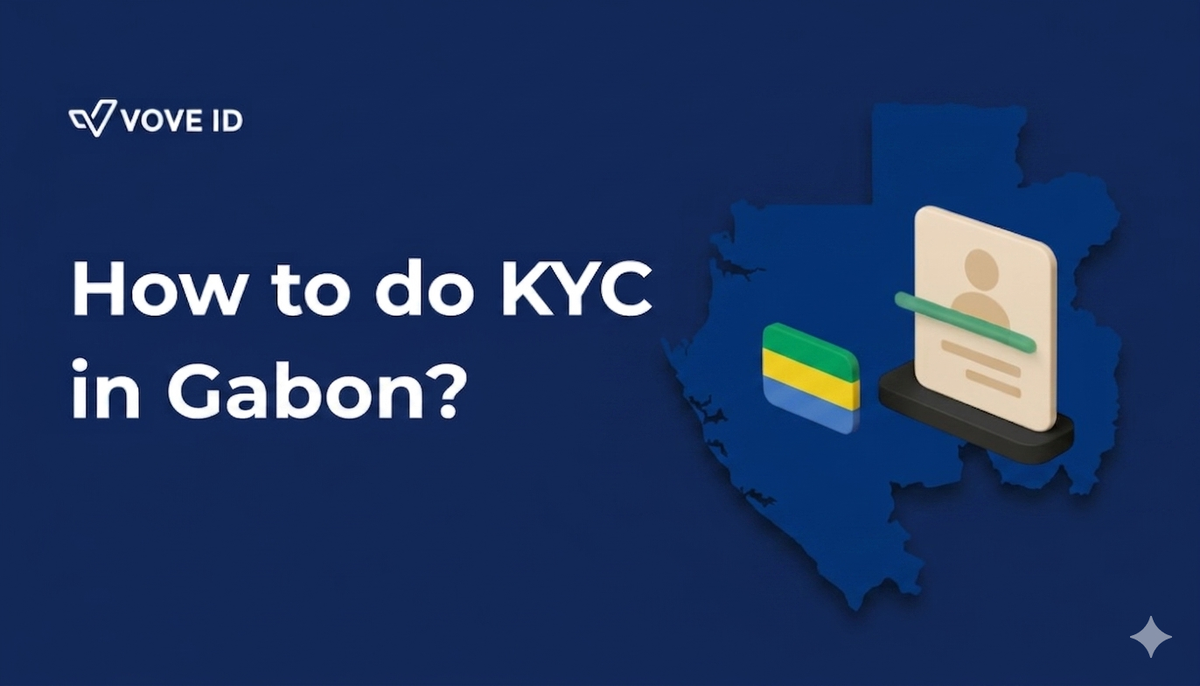
Gabon is a small, oil-dependent economy with a disproportionately complex compliance environment. The country operates inside the CEMAC monetary zone, which means KYC obligations flow from regional directives issued by COBAC — not from purely domestic legislation. For any business onboarding Gabonese clients or operating through a Gabonese entity, understanding that layered structure matters.
VOVE ID works with teams operating in CEMAC jurisdictions including Gabon, where document diversity, the prevalence of foreign nationals, and limited national digital identity infrastructure create real onboarding friction.
This guide covers what KYC looks like in Gabon specifically — regulators, documents, thresholds, digital onboarding constraints. For the underlying verification framework, see our KYC Requirements Explained: 2026.
The Regulatory Framework
Gabon's KYC rules derive from two overlapping sources. Regionally, COBAC (Commission Bancaire de l'Afrique Centrale) issues binding directives for all financial institutions operating in the CEMAC zone — covering banks, microfinance institutions, and increasingly, payment service providers. Domestically, the DGFIP (Direction Générale des Impôts et des Propriétés) and the Gabonese Financial Intelligence Unit (ANIF — Agence Nationale d'Investigation Financière) oversee compliance at the national level.
The primary legislative instrument is Regulation COBAC R-2005/01, subsequently updated through CEMAC Regulation No. 01/03/CEMAC/UMAC/CM on the prevention of money laundering and terrorist financing. Financial institutions are required to implement customer due diligence procedures consistent with FATF standards, which Gabon formally committed to as a member of GABAC (Groupe d'Action contre le Blanchiment d'Argent en Afrique Centrale), the FATF-style regional body for Central Africa.
Gabon is currently on the FATF grey list, having been added in February 2023 as part of a wave of sub-Saharan jurisdictions facing increased scrutiny. This means enhanced due diligence applies when dealing with Gabonese counterparties from outside the country, and internal compliance programs need to account for the elevated risk classification.
Who Must Comply
KYC obligations apply to:
- Licensed banks and credit institutions
- Microfinance institutions (MFIs)
- Insurance companies and brokers
- Money transfer operators and mobile money providers
- Real estate agents handling transactions above defined thresholds
- Notaries, accountants, and lawyers in specific transactional contexts
- Casinos and gaming operators
Non-bank financial institutions have seen increasing scrutiny since 2021, particularly mobile money providers operating through networks like Airtel Money and Moov Money, which dominate retail payments outside the formal banking sector.
Customer Due Diligence: What the Rules Require
Standard CDD
For natural persons, institutions must collect and verify:
- Full legal name
- Date and place of birth
- Nationality
- Residential address
- Profession and employer
- Purpose of the business relationship
- Source of funds (for higher-risk customers)
Verification is identity-document based. Gabon does not operate a centralized biometric national identity database accessible to private sector entities, so verification depends on physical document inspection or, increasingly, automated OCR with liveness checks for digital channels.
Accepted Documents
The primary accepted documents for Gabonese nationals are:
- Carte Nationale d'Identité (CNI) — the biometric national ID card, mandatory for citizens over 15
- Passeport gabonais — increasingly used for digital onboarding flows
- Titre de séjour — for foreign residents
- Laissez-passer — used in some border and rural contexts
For foreign nationals (a significant population in Gabon given the oil sector workforce), passports and residence permits are standard. Institutions dealing with expat workers, particularly in the extractive industries, frequently process documents from France, Lebanon, Senegal, Cameroon, and Equatorial Guinea.
Enhanced Due Diligence
EDD is required for:
- Politically exposed persons (PEPs) and their close associates
- Customers from higher-risk jurisdictions (including other FATF grey-listed countries)
- Non-face-to-face customer relationships established digitally
- Transactions with no apparent economic rationale
- Complex or unusually large transactions
There is no published single numerical threshold that automatically triggers EDD — the obligation is risk-based under COBAC guidance.
Digital Onboarding: Where It Breaks Down in Practice
Gabon does not have a national eKYC infrastructure or a government-issued digital identity system accessible to private sector operators. This creates friction at two points:
First, document verification quality varies. The CNI has gone through several generations of design, and older cards lack machine-readable zones (MRZ), which complicates automated OCR processing. Institutions onboarding older customers or those from rural areas are more likely to encounter pre-biometric documents.
Second, address verification is unreliable. Gabon has no functioning postcode system in most areas, and utility billing is inconsistent outside Libreville. Banks and fintechs frequently use GPS-based address capture or employer letters as proxies, which creates inconsistency across onboarding workflows.
For non-face-to-face channels, COBAC guidance requires that identity verification achieve the same standard as in-person verification. This means remote onboarding flows must include liveness detection and document authenticity checks — not simply a selfie submission.
Record-Keeping and Data Retention
Under CEMAC/COBAC rules, customer identification records must be retained for a minimum of 10 years from the end of the business relationship. Transaction records follow the same 10-year retention schedule. Records must be available for regulatory inspection on request from COBAC or ANIF.
Mobile Money and Financial Inclusion
Mobile money is the dominant payment infrastructure for unbanked Gabonese, particularly outside Libreville and Port-Gentil. COBAC has introduced simplified due diligence tiers for mobile money accounts below defined transaction ceilings — modeled on the CEMAC regional approach to proportionate CDD.
In practice, this means:
- Low-value accounts (monthly transaction ceilings roughly equivalent to XAF 100,000–300,000) may use simplified CDD with a national ID card only
- Accounts above those thresholds revert to full CDD requirements
- Wallet top-ups from cash agents are heavily used and present monitoring challenges
The informal economy is large. A significant share of Gabonese adults receive income in cash — particularly in artisanal mining, fishing, and domestic services — which makes source-of-funds verification genuinely difficult rather than merely inconvenient.
Sector-Specific Considerations
Oil and Gas: Gabon's economy runs on hydrocarbons, and the sector concentrates risk. Subcontractors, labor contractors, and service providers for majors like TotalEnergies, Assala Energy, and Perenco onboard through procurement flows that often bypass standard financial institution CDD. For banks financing these entities, understanding the beneficial ownership behind service company networks is material.
Forestry and Timber: The forestry sector has been flagged repeatedly by international bodies as a vector for financial crime. Permit fees, export duties, and logging concession payments create structured cash flows that require careful monitoring.
Real Estate in Libreville: Property transactions in Libreville have attracted scrutiny given the concentration of politically connected wealth and the absence of a functioning UBO register for real estate holdings.
For teams onboarding customers across these sectors, VOVE ID's document OCR covers French-language documents and handles the document diversity typical of a mixed-nationality workforce in an extractive economy.
What to Watch in 2026
Gabon is under FATF grey list observation, which creates pressure on COBAC and domestic supervisors to demonstrate measurable improvement in CDD and transaction monitoring standards. The Financial Action Task Force's mutual evaluation recommendations — focused on beneficial ownership transparency, STR reporting rates, and financial inclusion without CDD gaps — are driving a regulatory tightening cycle that is likely to extend into 2027.
Businesses operating in Gabon should expect:
- Increased supervisory visits and documentation requests from COBAC examiners
- Pressure on mobile money operators to upgrade their CDD frameworks
- Potential updates to ANIF reporting requirements
Preparing Your Onboarding Stack
Running KYC in Gabon without a reliable document verification layer creates audit exposure. The document variety (older CNI cards, French-language passports, multi-nationality workforces), combined with the regulatory pressure of the grey list period, means that "we checked a photocopy" is not a defensible position.
VOVE ID handles the document-side of this — OCR across document types, liveness detection, face matching against the document photo — and produces audit-ready logs that satisfy COBAC's record-keeping expectations.
Running KYC in Gabon without a reliable document verification layer creates audit exposure. The document variety, combined with grey list pressure, means that "we checked a photocopy" is not a defensible position.
This article is intended for general informational purposes only and does not constitute legal, financial, or regulatory advice. KYC/KYB/AML requirements may vary depending on jurisdiction, industry, and specific business circumstances. For up-to-date and binding compliance obligations, readers should refer to the relevant regulatory authorities or consult qualified professionals.