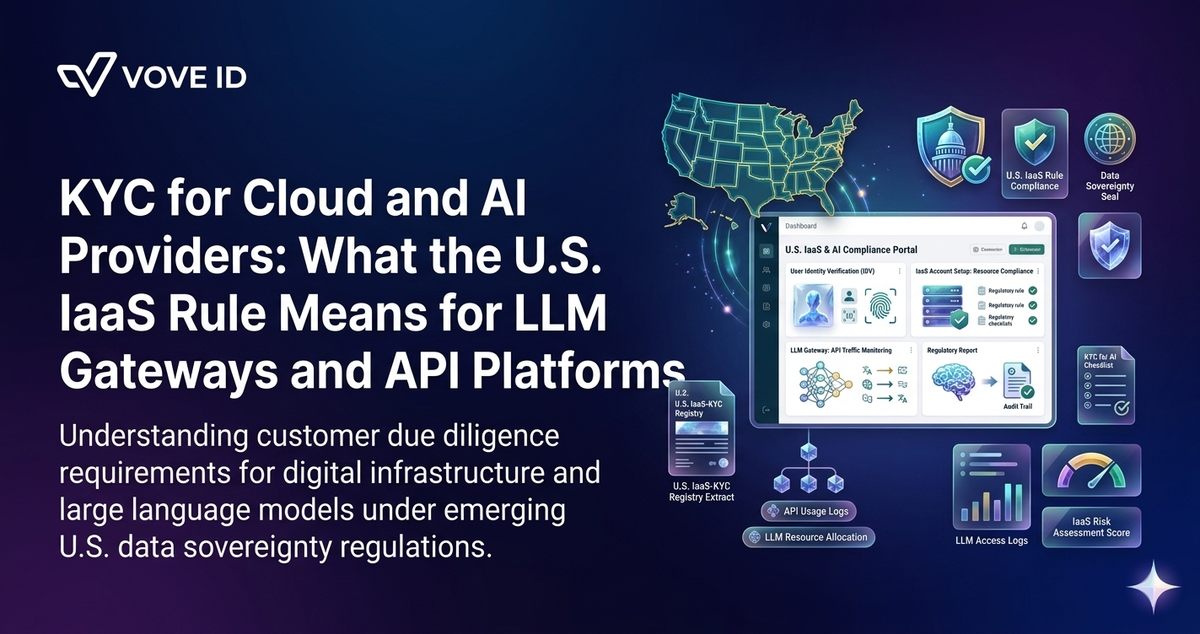
KYC for Cloud and AI Providers: What the U.S. IaaS Rule Means for LLM Gateways and API Platforms
The BIS IaaS rule could push KYC obligations onto cloud providers, GPU platforms, and LLM APIs as identity verification becomes part of AI infrastructure compliance.
KYC has been a financial services problem for decades. Banks verify identities. Crypto exchanges screen wallets. Payment processors check beneficial ownership. The compliance stack was built for institutions that move money.
That boundary is dissolving. The U.S. government is now pushing know-your-customer obligations onto a different category of infrastructure: the companies that provide computing power, AI model access, and cloud services. If your platform lets a foreign person run workloads, train a model, or call an LLM API, the question of who that person actually is has become a national security concern — and soon, a legal one.
For compliance teams at cloud platforms, AI gateway operators, and LLM API providers, this is no longer a distant policy discussion. The regulatory architecture is being assembled in real time, and the identity verification problem it creates is not conceptually different from what fintechs have been solving for years. The tooling exists. The question is whether AI infrastructure companies will move proactively or wait until enforcement makes the decision for them.
What triggered this: two executive orders and a proposed rule
The regulatory thread starts with Executive Order 13984, signed in January 2021, which directed the Department of Commerce to address malicious cyber actors' use of U.S. cloud infrastructure. The core concern was straightforward: foreign adversaries could rent U.S. computing capacity pseudonymously, use it to attack critical infrastructure, and leave no traceable trail. Cloud providers, unlike banks, had no obligation to know who their customers were.
E.O. 14110, the Biden administration's AI executive order from October 2023, extended that logic. It directed Commerce to require foreign resellers of U.S. IaaS products to submit reports when their customers engage in training large AI models with potential capabilities that could be used in malicious cyber-enabled activity.
In January 2024, the Bureau of Industry and Security (BIS) published its proposed rule implementing both orders. The rule would require U.S. providers of Infrastructure as a Service products to build and maintain written Customer Identification Programs — essentially the KYC equivalent of what banks have operated under the Bank Secrecy Act for decades. A comment period closed in April 2024. The final rule, when published, will give providers a one-year implementation window.
Separately, by January 2026, BIS finalized KYC requirements as part of its export licensing conditions for advanced AI chips — meaning KYC is already baked into the hardware layer of the AI supply chain, not just the software layer being targeted by the proposed IaaS rule.
The direction of travel is unambiguous.
Who is actually covered — and it's broader than "cloud"
The proposed rule defines "IaaS product" as any product or service that provides processing, storage, networks, or other fundamental computing resources, where the consumer can deploy and run software that is not predefined. The definition covers both virtualized multi-tenant environments (typical cloud) and dedicated infrastructure. Critically, it also captures foreign resellers of U.S. cloud capacity — anyone who bundles, packages, or intermediates access to underlying U.S. infrastructure.
Run that definition against the current AI ecosystem:
- LLM API platforms that sit on top of cloud compute and expose model inference to third-party developers — covered if their customers include foreign persons accessing substantial compute
- AI gateway providers that route requests across multiple foundation models — potentially covered as resellers of underlying infrastructure
- Managed AI services that abstract away the compute layer for enterprise customers — covered
- GPU-as-a-service platforms offering raw compute for model training — squarely covered
The rule is not limited to AWS, Azure, and Google Cloud. Any company in the chain between U.S. silicon and a foreign end-user training a large AI model is in scope if that model could plausibly be used for malicious cyber-enabled activity. The phrase "could be used" does a lot of work — it does not require actual malicious intent, only potential capability.
What a Customer Identification Program must include
The proposed CIP requirements mirror, structurally, what financial institutions have operated under for years. At minimum, providers must:
Collect and retain for each foreign customer: full name, address, means and source of payment, email address, telephone number, and IP addresses used for account access or administration with timestamps.
Verify beneficial ownership — identify the individual who exercises substantial control over a customer entity, or owns it. The beneficial ownership definition mirrors the Bank Secrecy Act framework used in financial compliance, which most fintechs know well.
Define procedures for unverifiable customers — the CIP must specify when to refuse account opening, when to apply restricted permissions during pending verification, and when to close accounts where verification failed.
Submit certifications to Commerce — initially upon implementation, then annually — attesting that the CIP is current, has been reviewed, and has been updated to reflect changes in the threat landscape.
Maintain records in a form accessible to the Department of Commerce on request.
The rule also allows for risk-based CIP design, meaning a small AI API startup with a narrow customer base can build a proportionate program rather than a bank-grade compliance operation. But the floor is real: identity verification of foreign customers is required, not optional.
The AI-specific reporting trigger
Beyond the baseline CIP, the rule adds a reporting obligation that is specific to AI infrastructure. U.S. IaaS providers must notify Commerce when they have knowledge that a transaction with a foreign person could result in training a large AI model with potential capabilities that could be used in malicious cyber-enabled activity.
This is the piece of the rule that most directly touches LLM gateway operators and AI API platforms. A foreign entity using an API to run repeated high-compute inference jobs or batch training workloads could trigger this reporting obligation — even if the provider has no direct visibility into what model is being built or how it will be used.
The definition of "large AI model with potential capabilities that could be used in malicious cyber-enabled activity" remains under development. BIS has explicitly said it will continue refining this definition as technology evolves. For now, providers need a process for recognizing when compute usage patterns suggest large-scale model training, and a workflow for evaluating whether the foreign customer has been identified and whether Commerce needs to be notified.
This is where the absence of an identity verification program becomes operationally dangerous. If you cannot verify who your customer is, you cannot make the required disclosure. And failing to disclose is itself a violation.
Where onboarding breaks in practice
The compliance problem for AI and cloud platforms is structurally different from what fintechs face, but it maps onto the same underlying friction points.
Anonymous API access. Most developer-facing AI APIs were designed for frictionless onboarding. An email address, a credit card, and an API key. No document verification, no liveness check, no identity verification against a government-issued ID. That model works commercially. It does not satisfy a CIP requirement that asks for identity verification of foreign beneficial owners.
International developer bases. AI platforms typically have global user bases from day one. A significant share of users are non-U.S. persons — the exact population the proposed rule targets. Verifying identities across 50+ countries, with different document formats, different ID types, and different data availability, is not a problem that can be solved with a name-and-address form.
Reseller and intermediary chains. The rule extends to foreign resellers of U.S. IaaS capacity. A company selling AI API access in Southeast Asia as a managed service, built on top of a U.S. cloud provider, sits squarely within scope. The compliance obligation passes up the chain: the U.S. provider must ensure its foreign resellers maintain compliant CIPs, which means identity verification requirements cascade through distribution relationships.
UBO identification for enterprise customers. When the customer is not an individual developer but a corporate entity, the CIP must reach through to identify the beneficial owner — the individual who controls or owns the entity. For foreign companies with complex holding structures, this is the same problem that corporate KYB verification was built to solve: registry lookups, UBO mapping, documentation of ownership chains.
This is where platforms building compliance programs for the first time tend to underestimate scope. They build a CIP that handles individual developers but breaks on the corporate customer with a Cayman Islands holding structure.
When foreign users hit a verification step that requires government-issued ID plus liveness confirmation, drop-off rates spike unless the process is fast and mobile-native. VOVE ID's document verification — covering 190+ countries — is built for exactly this coverage challenge: an LLM API platform cannot know in advance which countries its users will be coming from, and a verification stack that handles 40 document types but fails on a Moroccan CIN or a UAE Emirates ID creates compliance gaps the rule does not forgive.
Sanctions screening: the layer that sits on top of KYC
The BIS rule does not operate in isolation. Sidley Austin's analysis of the proposed rule notes explicitly that the Office of Foreign Asset Control will expect IaaS providers to use CIP-collected information for U.S. sanctions compliance — meaning providers must screen user information against relevant sanctions lists to ensure they are not providing services to sanctioned countries or persons.
For AI platforms, this means sanctions screening is not an add-on. It is part of the same workflow as identity verification. You verify who the user is, and then you check whether that person or entity appears on OFAC, UN, EU, or UAE sanctions lists before provisioning access.
The operational sequence: document verification → identity confirmation → sanctions and PEP screening → account provisioning. The same flow that regulated fintechs have run for years. VOVE ID covers this full stack — from OCR and liveness on the document side to sanctions screening across the major lists — which means AI platforms adopting the framework don't have to stitch together separate vendors for each layer.
The broader signal: KYC is becoming infrastructure-layer compliance
The IaaS rule is not an isolated initiative. It fits a pattern that has been building since 2021:
The GovAI paper proposing KYC for compute providers as an AI oversight mechanism preceded the BIS rule by years. Microsoft's public statement welcoming the proposed rule signals that major cloud providers are not fighting the direction — they are preparing for it. The January 2026 BIS final rule on AI chip exports to China explicitly includes KYC and remote access controls as conditions for case-by-case licensing, meaning KYC requirements are already active at the hardware procurement layer even before the IaaS rule is finalized.
The convergence point is clear: every layer of the AI compute stack — chips, data centers, cloud infrastructure, API access — is moving toward identity verification of foreign users as a baseline compliance requirement.
For AI platform operators, the practical implication is that a compliance investment made now — building a CIP, integrating document verification for foreign users, layering sanctions screening on top of it — does double duty. It satisfies the incoming regulatory requirement and it solves the existing problem of anonymous access that creates fraud, abuse, and terms-of-service violations regardless of regulatory pressure.
What the final rule will likely look like
As of May 2026, the IaaS rule has not been finalized. The comment period closed in April 2024, and BIS has been reviewing input from cloud providers, AI companies, and industry groups. Several factors are shaping what the final rule will look like:
Industry comments pushed back on the cost and complexity of full CIP implementation for smaller providers. The final rule may include more explicit risk-tiering that gives smaller AI API platforms a proportionate compliance path.
The definition of "large AI model with potential capabilities that could be used in malicious cyber-enabled activity" is still being refined. The final rule will need a workable definition that compliance teams can operationalize — likely tied to compute thresholds rather than model capabilities, which are harder to measure at the time of access provisioning.
The reseller provisions — which sweep in foreign intermediaries selling access to U.S. cloud capacity — will likely survive but may be scoped more narrowly to reduce compliance burden on U.S. providers who have limited visibility into their resellers' customer bases.
What will not change is the core requirement: identity verification of foreign customers, beneficial ownership identification, and reporting of large AI model training by foreign persons. These are statutory mandates from the underlying executive orders. They are not negotiable in the comment process.
What AI platforms should be doing now
Waiting for the final rule to build a CIP is operationally risky. A one-year implementation window sounds generous until it is measured against the actual work: designing verification flows for a global user base, integrating document verification across 100+ document types, building beneficial ownership identification for corporate customers, establishing sanctions screening against multiple lists, and creating the record-keeping and annual certification infrastructure the rule requires.
Platforms that already have identity verification in their onboarding — for fraud prevention, for terms-of-service compliance, for existing contractual requirements with enterprise customers — will have a shorter path to a compliant CIP. Platforms that have operated on anonymous API access will face a more significant build.
The compliance gap is not a technology problem. The identity verification tooling exists. VOVE ID's API stack covers the full sequence: OCR and document verification across 190+ countries, biometric liveness detection, face matching against document photos, beneficial owner verification for corporate customers, and sanctions screening against UAE, UN, EU, and OFAC lists — with audit-ready logging designed for exactly the kind of regulatory examination the BIS rule anticipates. The gap is organizational: most AI infrastructure companies have not yet treated identity verification as a compliance requirement, only as an optional product friction decision.
That framing is changing fast.
Conclusion
KYC is no longer the exclusive domain of banks, crypto exchanges, and payment processors. The U.S. government has drawn a direct line from financial sector identity verification to cloud infrastructure, and the logic extends naturally to LLM gateways, AI API platforms, and any company in the chain between U.S. compute and a foreign end-user.
The IaaS proposed rule — and the export control framework already in effect — establishes that knowing who your customers are is becoming a legal obligation for AI infrastructure, not just a best practice. The compliance framework this requires is not new. It is the same document verification, beneficial ownership identification, and sanctions screening stack that regulated fintechs have built over the past decade.
The difference is that AI platforms typically have global, developer-heavy user bases that were never designed with identity verification in mind. Retrofitting that is easier than building it from scratch — but it requires a verification infrastructure that can handle international documents at scale, reach through corporate structures to beneficial owners, and produce the audit-ready records a regulatory examination will demand.
The question for AI platform compliance teams is not whether this requirement is coming. It is whether the organization is building toward it now, or waiting to be the case study.
If you're building a Customer Identification Program for an AI or cloud platform — or pressure-testing an existing one against what the BIS rule will require — VOVE ID's verification infrastructure is designed for exactly this stack: international document verification, liveness, sanctions screening, and audit-ready logging in a single API.
This article is for informational purposes only and does not constitute legal advice. The BIS IaaS proposed rule has not been finalized as of the date of publication. Compliance requirements will depend on the final rule and your specific business structure. Consult qualified legal counsel before building or certifying a Customer Identification Program.