
KYB is the Real Bottleneck for Stablecoin Growth (Not KYC)
Stablecoin teams obsess over retail KYC metrics while enterprise growth stalls somewhere else entirely. The real bottleneck is usually KYB — and fixing it unlocks more revenue than another KYC optimization ever will.
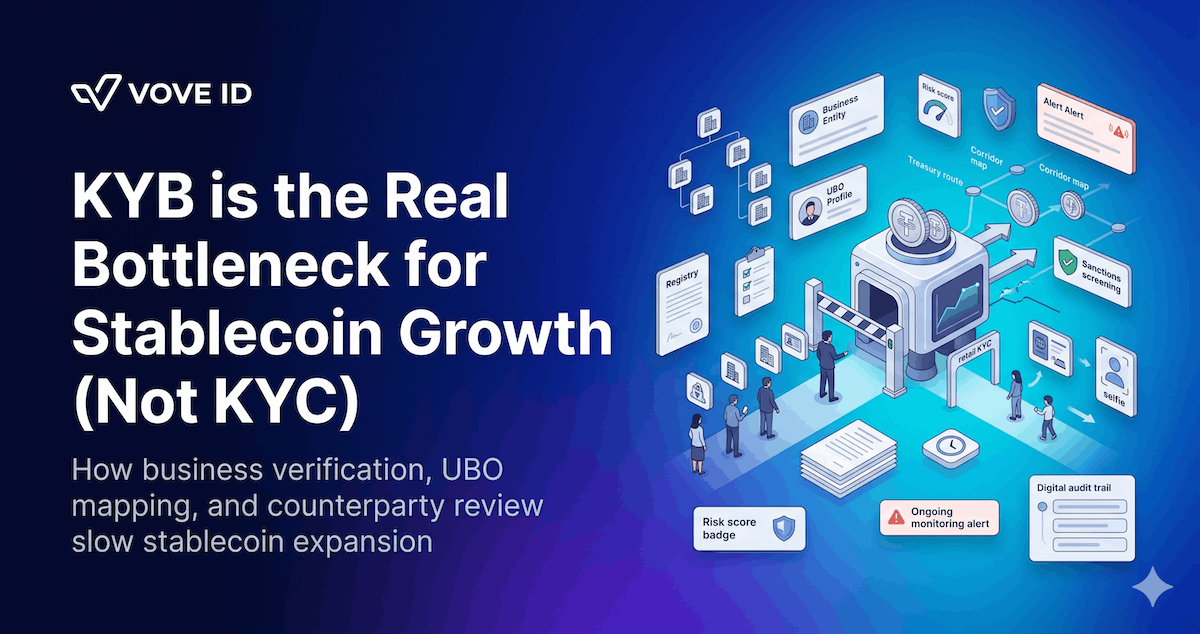
Stablecoin teams often spend months improving retail KYC while enterprise growth stalls somewhere else entirely. The real delay usually sits in KYB: verifying counterparties, mapping ownership, screening controllers, and maintaining enough evidence for treasury, banking, and compliance teams to trust the relationship.
Why is KYB the real bottleneck for stablecoin growth?
Because stablecoin businesses eventually grow through business relationships, not only retail sign-ups. Distributors, OTC desks, payment partners, treasury clients, and merchants all require deeper verification than individual users. If entity checks, UBO mapping, sanctions screening, and ongoing review stay manual, enterprise activation slows, corridor launches stall, and revenue waits behind compliance operations.
Retail onboarding is visible, so teams obsess over it.
They track:
- KYC completion rate
- liveness pass rate
- approval latency
- document coverage
Those metrics matter. But they stop telling the full story once a stablecoin product becomes more mature.
At that stage, the bigger commercial unlock usually comes from business relationships:
- treasury clients
- payment processors
- corridor partners
- merchants
- OTC desks
- distributors
- institutional users
That is where the bottleneck moves.
The business may be able to onboard ordinary users quickly, but expansion still stalls because enterprise activation takes too long. Legal entity documents go back and forth for days. Ownership structures are unclear. Sanctions review takes too much manual effort. No one is fully confident in the source-of-funds or control picture. A bank or compliance lead asks for one more clarification. Revenue waits.
That is not a KYC problem.
It is a KYB problem.
Why enterprise onboarding matters more as stablecoin firms mature
Stablecoin businesses usually start with user onboarding and transaction flow. Over time, growth depends more on counterparties and B2B relationships.
That shift happens because stablecoin products move toward:
- higher transaction values
- repeat settlement relationships
- corridor-based volume
- treasury workflows
- embedded distribution
- partner-led growth
Once that happens, enterprise relationships start controlling throughput.
One retail user who completes KYC may add some volume.
One business counterparty that clears KYB can unlock:
- a new payout corridor
- a new merchant segment
- a treasury relationship
- a new liquidity route
- a distribution channel
So if business onboarding slows, growth slows disproportionately.
Why stablecoin firms face harder KYB than ordinary fintechs
The compliance burden is not only about proving that a company exists.
Stablecoin teams often need to understand:
- who owns the entity
- who controls it operationally
- where funds originate
- which jurisdictions it touches
- whether its activity matches the stated business model
- whether banking, sanctions, or regulatory exposure sits behind the structure
This is why stablecoin KYB is more than registry lookup.
FinCEN's CDD framework remains a useful benchmark here. Its current guidance says covered institutions should identify and verify beneficial owners, understand the nature and purpose of the relationship to build a customer risk profile, and conduct ongoing monitoring to identify suspicious transactions and update customer information on a risk basis.
That logic maps directly onto stablecoin counterparties.
You cannot safely approve a business relationship if you do not know who is behind it, what activity to expect, and what would count as suspicious later.
Where KYB slows stablecoin growth in practice
1. UBO collection and ownership mapping
This is the most common failure point.
A business may provide:
- incorporation documents
- a registry extract
- a director list
But that still does not fully answer:
- who ultimately owns or controls the entity
- whether holding companies sit above it
- whether a nominee structure hides the real decision-makers
- whether politically exposed or sanctioned persons are involved
The FATF strengthened its beneficial-ownership standards in March 2022 and in February 2023 agreed guidance to help countries implement the revised requirements. Its stated objective is simple: competent authorities should have access to adequate, accurate, and up-to-date information on the true owners of companies.
For stablecoin operators, that is not abstract policy. It is an operating requirement for serious counterparties.
2. Registry checks across multiple jurisdictions
Many stablecoin relationships do not stay within one neat corporate geography.
A single counterparty can involve:
- one place of incorporation
- another operating market
- another banking jurisdiction
- founders or controllers in several countries
That turns verification into a multi-source exercise quickly.
If the team handles all of that manually, onboarding time expands with every new corridor.
3. Sanctions and controller screening
It is not enough to screen only the entity name.
Teams often need visibility into:
- beneficial owners
- directors
- authorised signatories
- parent companies
- related entities
That work becomes even harder when names are transliterated differently, documentation is incomplete, or the ownership graph changes during review.
4. Source-of-funds and business-model understanding
A counterparty may be legitimate and still sit outside the risk appetite of a bank, treasury team, or regulator.
Stablecoin firms frequently need to explain:
- what the counterparty actually does
- how it expects to use stablecoins
- where transaction volume will come from
- why its corridor mix makes sense
If that narrative is unclear, activation drags.
5. Ongoing refresh after approval
One of the biggest mistakes is treating KYB like a setup task that ends when the account goes live.
It does not.
The FATF's beneficial-ownership work emphasizes adequacy, accuracy, and timeliness. In operational terms, that means stale records are not good enough. Ownership changes. Directors change. Risk exposure changes. The activity originally described at onboarding may stop matching the live relationship.
Without refresh and monitoring, the company is scaling on expired assumptions.
Why fixing retail KYC alone does not unblock revenue
A lot of stablecoin firms keep improving the part of compliance that users see while underinvesting in the part that actually gates institutional growth.
That creates a common pattern:
- retail KYC gets smoother
- consumer activation improves
- partner activation still takes weeks
- bank or treasury approval remains slow
- enterprise deals slip because compliance evidence is incomplete
This is why KYB often becomes the real growth bottleneck.
Retail KYC helps users enter the product.
KYB helps the business add counterparties that materially expand volume.
Those are not equal constraints.
Why the market is moving toward stronger stablecoin KYB
The regulatory direction is clear even if rules differ by jurisdiction.
The FATF says virtual asset service providers should implement preventive measures comparable to other financial institutions, including customer due diligence and suspicious-transaction controls. The FCA says UK cryptoasset businesses providing in-scope services must register under the MLRs and are supervised on a risk-based basis. In Singapore, the MAS financial institutions directory showed 38 major payment institutions carrying on digital payment token service activity when checked on 8 May 2026.
The implication is straightforward.
This is no longer a niche corner of financial services where enterprise relationships can be explained casually. The market is becoming more institutional, more cross-border, and more scrutinized. That increases the value of business onboarding that can stand up to banking, regulatory, and internal-risk review.
What strong stablecoin KYB looks like
1. Entity verification is structured, not improvised
The team should know exactly which sources and documents are needed to establish:
- legal existence
- registration status
- directors or managers
- jurisdictional footprint
- operating purpose
2. Beneficial ownership is mapped early
If UBO work starts late, everything behind it slows:
- sanctions review
- banking comfort
- risk scoring
- contract approval
Ownership mapping should happen near the front of the workflow, not as a final surprise.
3. Screening covers the real control perimeter
Entity-only screening is too thin for many stablecoin counterparties. Review should reach the people and entities that meaningfully control the relationship.
4. Risk profiling feeds later monitoring
FinCEN's guidance on customer risk profiles is useful here too. Information gathered at account opening should create a baseline against which later activity can be assessed.
For a stablecoin business counterparty, that baseline can include:
- expected transaction size
- expected corridors
- product type
- funding pattern
- business model
- ownership and control notes
Without that baseline, later monitoring loses context.
5. Refresh and perpetual monitoring exist
Business verification should not freeze at activation. Ongoing registry checks, sanctions refresh, ownership-change monitoring, and review triggers are what keep the record useful as the relationship scales.
A practical enterprise-activation workflow
Below is a workable model for stablecoin teams:
| Stage | What should happen |
|---|---|
| Intake | collect entity details, market, product use case, and expected activity |
| Verification | confirm legal existence, registry status, directors, and authorisation context |
| Ownership | identify beneficial owners, control persons, and group structure |
| Screening | screen entity, owners, directors, and relevant counterparties |
| Risk scoring | assess geography, product, ownership complexity, and use-case risk |
| Approval | document decision, conditions, and required controls |
| Activation | apply limits, corridor permissions, and monitoring rules |
| Refresh | re-check ownership, screening, and status when risk changes |
That workflow is how stablecoin firms stop treating KYB like a document-collection chore and start treating it like revenue infrastructure.
How VOVE ID removes KYB bottlenecks
VOVE ID helps stablecoin and B2B fintech teams automate the parts of business onboarding that usually create delay:
- legal entity verification
- beneficial ownership and controller mapping
- sanctions and screening on business relationships
- risk scoring for counterparties
- ongoing business monitoring and refresh triggers
- workflows that carry business context into AML monitoring later
That matters because the goal is not simply to approve more businesses.
The goal is to approve the right businesses faster, with enough evidence that banks, compliance teams, and regulators do not become the next bottleneck.
Questions stablecoin teams should ask right now
- How long does enterprise activation take compared with retail KYC?
- Which part of KYB creates the most delay: documents, ownership, screening, or review?
- Can the team explain who ultimately controls its highest-volume counterparties?
- Are business records refreshed after activation?
- Does transaction monitoring use KYB context later?
- How many commercial launches are waiting on counterparty verification today?
If those answers are unclear, the firm probably has a growth constraint disguised as a compliance workflow.
Conclusion
Retail KYC is important, but it is rarely the only factor that determines stablecoin growth once the business starts scaling seriously.
At that point, the real constraint usually becomes business onboarding: verifying counterparties, understanding ownership, screening controllers, and keeping the record current enough to support monitoring and banking relationships later.
That is why KYB is often the real bottleneck.
The teams that solve it move faster not because they ignore compliance, but because they operationalize it better.
Need faster business onboarding for stablecoin counterparties, distributors, and treasury clients? Talk to the team.
FAQ
1. Why does KYB slow stablecoin growth more than KYC?
Because enterprise relationships usually unlock more revenue and more volume than individual users, but they also require deeper verification, ownership mapping, and ongoing review.
2. Is entity verification enough for stablecoin KYB?
No. Serious KYB usually also needs beneficial ownership, controller screening, business-model understanding, and ongoing refresh.
3. Why does beneficial ownership matter so much?
Because regulators, banks, and compliance teams need to know who ultimately owns or controls the business relationship, especially when cross-border value movement and sanctions exposure are involved.
4. What is the first KYB metric to improve?
Usually median time to enterprise approval. It reveals whether your onboarding stack is actually helping commercial activation or quietly delaying it.