
Why Most Stablecoin On-Ramps Lose 30–50% of Users at KYC — and How to Fix It
Most stablecoin on-ramps don't lose users because of regulation. They lose them because the KYC flow wasn't designed to separate mandatory controls from avoidable friction. Here's how to fix that without weakening compliance.
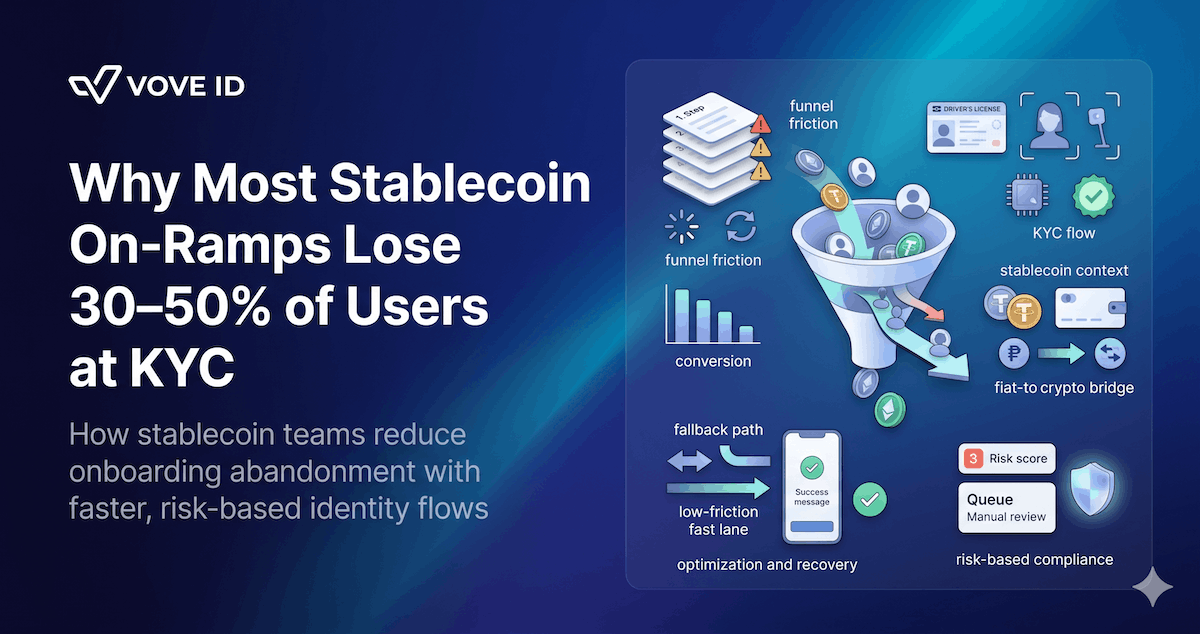
Stablecoin on-ramp teams usually do not lose users because demand is weak. They lose users because the KYC flow asks for too much, too early, with too little tolerance for bad cameras, document mismatch, slow review times, and cross-border edge cases.
Why do stablecoin on-ramps lose users at KYC, and how do you fix it?
They lose users when the onboarding flow creates avoidable friction before trust is established: extra fields, poor document handling, long latency, weak retry logic, and no risk-based step ordering. The fix is to design KYC like a conversion-critical risk workflow: collect only what is needed at each step, adapt checks to customer risk, resolve failures quickly, and carry clean identity data into later AML monitoring.
Stablecoin teams often blame user intent when conversion drops in onboarding.
The assumption goes like this:
- crypto users are impatient
- cross-border customers have messy documentation
- compliance is inherently high-friction
- drop-off is the unavoidable price of regulation
That framing is too convenient.
In most cases, the bigger problem is workflow design.
When a stablecoin on-ramp loses a large share of users at KYC, the issue is usually not that regulation makes growth impossible. It is that the product has not separated mandatory controls from unnecessary friction. Teams end up treating all users like the highest-risk case, forcing every applicant through the same slow path, and then wondering why activation stalls.
That is dangerous for revenue and for compliance.
If too many good users abandon the flow, growth slows. If the team responds by weakening controls indiscriminately, risk rises. The better approach is to remove friction that does not improve risk coverage while keeping the controls that actually matter.
Why stablecoin on-ramp KYC deserves special attention
Stablecoin on-ramps sit at an unusually sensitive point in the product.
They are often the first moment when:
- fiat enters a crypto or stablecoin workflow
- a user creates a regulated relationship
- sanctions and identity obligations become operational
- the product sets the tone for trust and speed
That matters because stablecoin activity is growing quickly. The FATF said on 3 March 2026 that stablecoins had expanded to more than 250 in circulation by mid-2025 with market capitalisation above USD 300 billion, while also highlighting illicit-finance risks linked to unhosted wallets and peer-to-peer activity.
That growth makes on-ramp quality more important, not less.
The FATF standards require virtual asset service providers to apply preventive measures similar to other financial institutions, including customer due diligence and suspicious-transaction controls. The FCA reinforced the enforcement risk on 22 April 2026, when it said there were no FCA-registered peer-to-peer crypto traders or platforms operating in the UK and warned that unregistered operators pose a financial-crime risk.
So the compliance obligation is real.
But compliance does not tell you to build a bad funnel.
Where KYC drop-off usually happens
Most on-ramp funnels do not fail in one dramatic place. They leak users across several smaller friction points.
1. Before document capture starts
Many products ask users for too much context before they have shown any progress:
- full profile forms
- unnecessary source-of-funds questions for low-risk cases
- duplicate email and phone verification steps
- wallet setup friction before identity trust is established
Users abandon when the flow feels bureaucratic before value is visible.
2. During document capture
This is one of the biggest failure zones.
Common issues include:
- unsupported local document formats
- low-light or low-bandwidth capture failures
- mismatch between country selection and accepted document type
- poor camera guidance
- edge-case rejection of worn but legitimate IDs
Stablecoin products targeting cross-border users often underestimate how many good applicants sit outside the narrow document assumptions built into a Western-market-first flow.
3. During liveness or face matching
Liveness is valuable, but it also becomes a conversion killer when:
- device performance is weak
- the app does not explain what the user should do
- low-end Android devices struggle with capture
- the retry path is confusing
- latency is too high
If the user cannot tell whether the system is working, trust falls fast.
4. During manual review
Nothing destroys momentum like silence after submission.
If review takes too long, users assume they were rejected, the product is broken, or they should try another provider. For stablecoin products, this is especially costly because many users arrive with immediate intent to buy, settle, or move value.
5. After a soft failure
Many teams design a primary success path and almost no recovery path.
That means users who hit an ordinary issue such as a blurry image, a transliteration mismatch, or a document-classification error often get trapped in a dead end instead of being guided into a clean retry or fallback review flow.
The main causes of avoidable KYC friction
1. The flow is not risk-based
This is the root issue in many on-ramp products.
The business knows that users have different risk levels, but the onboarding flow does not reflect that. A low-risk retail customer in a supported corridor gets the same process as a higher-risk user whose geography, transaction intent, or behavior should trigger enhanced review.
The result is obvious:
- too much friction for ordinary users
- not enough attention on the cases that truly deserve escalation
That is bad conversion design and bad compliance design at the same time.
2. Product and compliance optimize for different outcomes
Product teams want approval speed. Compliance teams want control coverage. If they work from different metrics, the onboarding journey becomes a political compromise instead of a coherent system.
That leads to patterns like:
- extra questions added "just in case"
- duplicate review steps
- weak ownership of retry logic
- no shared definition of acceptable false-rejection rates
3. Local document reality is ignored
A stablecoin on-ramp serving Africa, MENA, Europe, or diaspora users cannot assume one clean passport-first funnel.
Real users show up with:
- national IDs
- residence permits
- voter cards in some markets
- older but valid formats
- names that do not transliterate neatly
- camera environments that are far from ideal
If the verification stack was designed for only a narrow set of document assumptions, conversion falls for good users long before risk quality improves.
4. The fallback path is weak
A lot of onboarding systems behave as if every failure is final.
That is wrong.
Some failures indicate fraud. Many do not. A good flow separates:
- hard failures that should stop the applicant
- soft failures that should trigger retry guidance
- ambiguous cases that should route to review
Without that structure, the system turns manageable operational issues into permanent abandonment.
5. Time-to-decision is too long
Users tolerate compliance better when the process is decisive.
They tolerate it poorly when the system asks for effort and then goes quiet.
For on-ramp teams, speed matters not because speed is fashionable, but because transaction intent decays quickly. The longer a user waits, the more likely they are to:
- switch providers
- defer funding
- return later with weaker trust
- never complete activation
How to reduce KYC abandonment without weakening compliance
1. Reorder the flow around trust and necessity
Ask what the user must do now versus what can be deferred until risk requires it.
That usually means:
- collect the minimum onboarding fields needed to begin verification
- guide users into supported document types early
- reserve heavier questions for triggered cases
- avoid long forms before progress is visible
The best flows make users feel they are moving through checkpoints, not entering an audit.
2. Support the documents your market actually uses
If the on-ramp serves cross-border users, document coverage is a product decision, not a back-office detail.
Teams should know:
- which documents are most common by corridor
- where auto-approval rates fail by market
- which document classes need fallback handling
- how often users abandon after unsupported-document errors
A flow cannot be called compliant if it only works well for a narrow slice of legitimate users.
3. Build retry logic like a real product feature
Retries should not feel like punishment.
They should help users recover from common issues:
- glare
- blur
- cropped edges
- face framing issues
- file upload mistakes
- name mismatch caused by formatting
Good retry design usually includes:
- clear failure reasons
- one-step recapture guidance
- limited but sufficient retry attempts
- seamless escalation when automation remains uncertain
4. Shorten the manual-review dead zone
If review is needed, say so clearly and set expectations.
Users should know:
- that their submission was received
- whether the issue is technical or compliance-related
- whether action is required from them
- how long review is expected to take
Even when approval is not instant, clarity protects trust.
5. Use progressive risk controls
Not every control has to fire before first activation.
For some products, it is better to:
- complete core identity verification first
- gate higher limits behind additional checks
- step up due diligence when transaction size or geography changes
- use post-onboarding monitoring intelligently
This is not about cutting corners. It is about aligning control intensity to actual risk.
Practical benchmarks on-ramp teams should track
The title references heavy drop-off, but the useful question is not whether the exact percentage is 30 or 50.
The useful question is where the funnel breaks and why.
Start with these metrics:
| Metric | What it tells you |
|---|---|
| Start-to-submit rate | Whether the flow feels approachable once users begin |
| Document capture success rate | Whether supported documents and camera UX are strong enough |
| Liveness completion rate | Whether device, guidance, and latency are blocking good users |
| Auto-approval rate by corridor | Whether rules and coverage are tuned to real market behavior |
| Retry-to-success rate | Whether recovery flows are rescuing legitimate applicants |
| Median time to decision | Whether operational review is killing intent |
| Abandonment by step | Exactly where the funnel is leaking |
These are more actionable than one top-line completion number.
What strong stablecoin on-ramp KYC looks like
A good operating model usually has five properties.
1. Fast first-pass verification
The default path for a good user should be short, clear, and decisive.
2. Market-aware document coverage
The system should reflect the countries and document types the business actually serves.
3. Risk-based escalation
Higher-risk geography, suspicious behavior, sanctions concerns, or unusual use cases should trigger more review. Ordinary users should not all be pushed into the same heavy path.
4. Clean fallback handling
Soft failures should route to retries or review, not silent abandonment.
5. Monitoring continuity after approval
FinCEN's current CDD framework is useful here as an operating principle: customer onboarding should establish enough context to create a risk profile that later monitoring can use as a baseline. In other words, KYC is not only a conversion step. It is also the first input into ongoing AML controls.
That is what turns onboarding into part of a compliance system instead of a separate gate.
How VOVE ID improves KYC completion for on-ramp teams
VOVE ID helps stablecoin and cross-border fintech teams reduce avoidable KYC friction without weakening risk controls.
That can include:
- broader document coverage across emerging and cross-border markets
- liveness and identity verification tuned for mobile onboarding
- risk-based workflow design
- sanctions and AML screening connected to onboarding context
- fallback and manual-review paths that preserve user momentum
- one API that carries identity and risk data into later monitoring
The point is not only faster approval.
The point is better approval quality with less unnecessary abandonment.
Questions every on-ramp team should ask now
- Which exact step causes the most abandonment today?
- Which countries or document types underperform disproportionately?
- How many users are failing because of fraud versus preventable friction?
- How long does manual review really take in practice?
- Which higher-friction questions are genuinely required before activation?
- Does the monitoring layer reuse onboarding context later?
If the answers are vague, the team is probably debating conversion emotionally instead of operating it as a measurable compliance workflow.
Conclusion
Stablecoin on-ramp KYC should not be treated as a necessary tax on growth. It is one of the highest-leverage parts of the product.
Most drop-off comes from fixable design failures: weak document support, poor sequencing, slow review, bad retries, and flows that are not risk-based. Teams that solve those problems usually do not have to choose between conversion and compliance. They get better at both.
That is the real opportunity.
Need a KYC flow that lifts stablecoin activation without weakening AML controls? Talk to the team.
FAQ
1. Why do stablecoin on-ramp users abandon KYC so often?
Usually because the flow creates friction that does not improve risk coverage: unsupported documents, long latency, confusing retries, and one-size-fits-all review paths.
2. Can you improve KYC conversion without weakening compliance?
Yes. The right approach is to remove unnecessary friction while preserving required controls and escalating only when the user or transaction risk justifies it.
3. Is fast onboarding incompatible with AML obligations?
No. Risk-based design allows low-friction onboarding for ordinary users while keeping stronger review for higher-risk cases.
4. Which metric should teams check first?
Start with abandonment by step and median time to decision. Those two metrics usually reveal whether the problem is UX, coverage, or review operations.