
Why Stablecoin Businesses Are Getting De-Banked — and How Better KYB Can Prevent It
The BIS IaaS proposed rule signals a shift where KYC obligations extend beyond financial institutions into AI infrastructure, requiring cloud providers, GPU platforms, and LLM APIs to verify foreign customers and establish Customer Identification Programs.
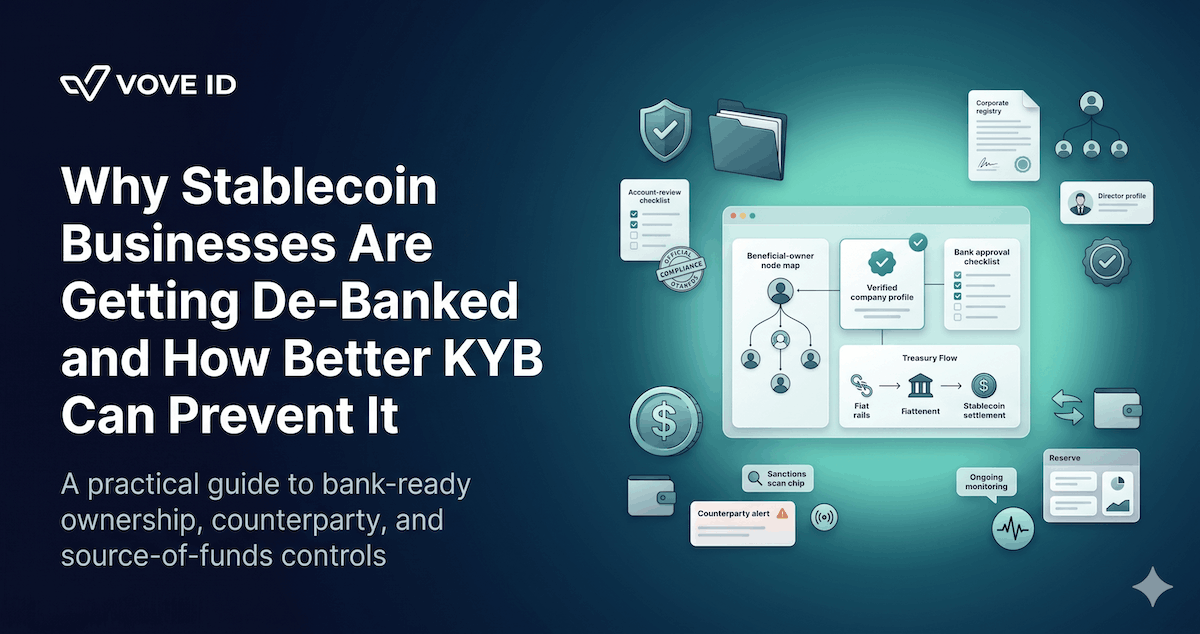
Stablecoin companies usually do not lose banking access because a bank suddenly decided "crypto is bad." They lose it when the bank cannot get comfortable with ownership, control, source of funds, transaction exposure, and the firm's ability to explain counterparties over time. In 2026, better KYB is one of the clearest ways to reduce that risk.
Why are stablecoin businesses getting de-banked, and how can better KYB help?
Stablecoin businesses get de-banked when banking partners decide the relationship creates more unresolved AML, sanctions, fraud, or governance risk than the firm can evidence and control. Better KYB helps by giving banks a clearer view of ownership, business purpose, counterparties, source of funds, and ongoing changes in risk before those gaps turn into account restrictions or exits.
Stablecoin founders often describe de-banking as if it were a mystery.
A bank asks more questions. The onboarding process drags. Limits appear. A review starts. Then the relationship gets paused, narrowed, or terminated.
From the operator's side, it can feel arbitrary.
From the bank's side, it usually is not.
In 2026, the pressure on banks is still the same basic pressure it has always been: know the customer, understand the relationship, identify beneficial owners, assess sanctions and financial-crime exposure, and monitor the relationship on an ongoing basis. Stablecoin businesses are not impossible to bank, but they are often difficult to underwrite if the evidence file is thin.
That is why KYB matters so much.
Retail KYC may explain who an end user is. It does not explain a stablecoin issuer, treasury vehicle, liquidity partner, market-making entity, embedded distributor, or cross-border payments business well enough for a banking partner to stay comfortable over time.
De-banking is usually a risk-management decision
The first mistake is assuming every bank exit means blanket anti-crypto hostility.
Sometimes a bank does decide that a whole segment is not worth the effort. But in many cases, the bank is reacting to a more specific problem:
- ownership is unclear or layered through multiple entities
- the real operating entity is different from the contracting entity
- source of funds and liquidity flows are not well documented
- key counterparties sit in higher-risk jurisdictions
- sanctions controls look too shallow for the firm's actual transaction profile
- onboarding and monitoring evidence do not connect cleanly
- the bank cannot explain the relationship to its own compliance or supervisory teams
That distinction matters.
If the problem were simply "banks do not bank stablecoin companies," there would be little a founder could do beyond shopping for a different institution.
But the real issue is usually evidencing and controlling risk well enough that the relationship remains defendable.
What banks are actually trying to understand
For a stablecoin business, a bank is not only asking whether the company exists.
It is asking a broader set of questions:
- Who ultimately owns and controls this business?
- Which entity in the group holds customer relationships, funds, wallets, or reserves?
- What products does the firm really offer today, not only in the pitch deck?
- Which jurisdictions matter operationally?
- Who are the major counterparties and liquidity providers?
- What does expected transaction behavior look like?
- Where do funds originate, and where do they move next?
- What controls exist if sanctions, fraud, mule activity, or suspicious flows appear?
This is where weak KYB breaks down.
A startup may have incorporation documents, a clean website, and a coherent story for investors. But if it cannot map legal entities, beneficial owners, directors, delegated operators, payment flows, and ongoing counterparties in a structured way, the bank is left carrying too much uncertainty.
Banks do not need zero risk.
They need manageable risk with a credible evidence trail.
Why stablecoin businesses trigger harder banking reviews
Stablecoin businesses often look simple from the outside and complex from the inside.
A product might present as:
- cross-border payments
- treasury movement
- merchant settlement
- wallet infrastructure
- B2B liquidity routing
- on-ramp or off-ramp services
- embedded stablecoin accounts for platforms
But behind that surface, the bank may be looking at:
- several operating entities
- third-party program managers or distributors
- fiat payment rails and wallet rails moving in parallel
- changing counterparties across jurisdictions
- clients that are themselves financial intermediaries
- reserve, redemption, or settlement dependencies
- sanctions exposure that changes with corridor mix
This is why many stablecoin firms get into trouble even when their retail KYC is reasonably strong.
The bank is not underwriting a consumer onboarding widget. It is underwriting an operating network.
Why retail KYC is not enough
Many founders still try to solve a banking problem with a user-verification answer.
That misses the actual pressure point.
For stablecoin businesses, banking partners often care just as much, or more, about:
- business ownership and control
- legal entity purpose
- authorized representatives
- licensing and regulatory perimeter
- source of funds
- source of liquidity
- upstream and downstream counterparties
- transaction pattern plausibility
- ongoing changes in the business
Retail KYC helps with one layer of this picture.
KYB is what lets the bank understand the business behind the flow.
What bank-ready KYB looks like for a stablecoin company
Good KYB for a stablecoin business is not a one-time company lookup.
It is a structured view of who the firm is, how it operates, and where the bank's residual risk actually sits.
1. Entity verification that reflects the real group structure
The bank needs to know which entity does what.
That means identifying:
- the contracting entity
- parent and intermediate holding entities
- affiliates providing operations, technology, or treasury support
- entities holding licenses, registrations, or key customer relationships
If the operating model spans multiple entities, the file should explain that clearly rather than forcing the bank to infer it.
2. Beneficial ownership mapping that goes past surface-level names
The core question is not only who signed the onboarding pack.
It is who ultimately owns or controls the business, directly or indirectly, and whether that ownership story is coherent.
For stablecoin firms, that often includes:
- cap-table concentration
- founder and investor control rights
- trusts, SPVs, or offshore holding layers
- nominee or delegated arrangements
- related entities with operational influence
If the ownership story is incomplete, the banking relationship usually becomes fragile.
3. Source-of-funds and flow-of-funds evidence
Stablecoin firms get reviewed much more heavily when banks cannot trace how money enters, moves through, and exits the product.
A bank-ready KYB file should make it easy to understand:
- initial funding sources
- reserve or treasury relationships where relevant
- liquidity providers and settlement partners
- major corridor patterns
- how fiat and stablecoin flows connect
- which third parties touch customer funds or transaction execution
This is not just an AML exercise. It is a relationship-explainability exercise.
4. Counterparty and partner visibility
Many stablecoin risks do not sit only in the primary customer entity.
They sit in:
- distributors
- OTC desks
- market makers
- payment facilitators
- wallet providers
- embedded-finance partners
- high-volume business customers
Weak KYB on those linked parties makes the bank feel like it is being asked to trust a black box.
5. Ongoing monitoring, not static onboarding
Stablecoin businesses change quickly.
New corridors open. New counterparties appear. Transaction behavior shifts. Ownership evolves. A previously low-risk relationship can become harder to justify in a short period of time.
That is why strong KYB has to include:
- periodic refresh triggers
- ownership-change alerts
- sanctions and PEP rescreening
- status changes for corporate entities
- re-review when product scope or geography expands materially
If KYB is frozen at onboarding, the bank's confidence decays fast.
The signals that make a bank nervous
Several patterns show up repeatedly in bank exits and restrictions.
| Weak signal | What the bank sees |
|---|---|
| One entity on paper, another in practice | Unclear accountability |
| UBO file is incomplete or stale | Ownership risk the bank cannot explain |
| Counterparties are poorly documented | Hidden sanctions or fraud exposure |
| Source of funds is generic or vague | Elevated AML and fraud uncertainty |
| Monitoring is disconnected from onboarding | Weak ongoing control story |
| Rapid geographic expansion without control updates | Risk appetite drift |
None of these automatically kills a banking relationship.
But when several appear together, the bank often concludes that the relationship will become harder to defend than to exit.
How better KYB changes the conversation
Good KYB does not guarantee a bank account.
What it does is improve the quality of the conversation.
Instead of answering reactive questions one by one, the firm can show:
- a clear ownership map
- documented control and governance
- structured business purpose
- known counterparties and dependencies
- explainable fund flows
- risk-based screening and escalation
- an ongoing monitoring model rather than a static onboarding pack
That changes the relationship from "please trust us" to "here is how this business is controlled."
For banking partners, that difference is significant.
A practical KYB standard for stablecoin teams
If a stablecoin business wants to reduce de-banking risk, its KYB file should usually cover at least:
Corporate structure
- legal entities and jurisdictions
- parent and subsidiary relationships
- directors, controllers, and authorized signatories
Ownership
- ultimate beneficial owners
- intermediary entities
- control rights and unusual governance arrangements
Operations
- exact business model
- product lines and customer types
- key geographies and corridors
Funds flow
- liquidity sources
- payment rails and wallet rails
- reserve, settlement, and redemption logic where relevant
Counterparties
- major service providers and partners
- higher-risk customer segments
- screening approach for linked businesses
Ongoing control
- sanctions and PEP screening
- periodic and event-driven refresh
- escalation and case-management workflow
This is the level of detail that helps a bank see a stablecoin company as a managed business rather than an expanding unknown.
How VOVE ID helps stablecoin teams build bank-ready KYB
VOVE ID helps stablecoin and cross-border fintech teams turn KYB from a document chase into a repeatable operating layer.
That includes support for:
- business verification
- beneficial-owner mapping
- director and representative checks
- sanctions and PEP screening
- ongoing business monitoring
- cleaner case context across onboarding and AML workflows
For stablecoin operators, the advantage is not only faster onboarding.
It is being able to show banking partners a more coherent control environment around business customers, counterparties, ownership, and ongoing change.
That is often the difference between a relationship that survives review and one that does not.
Stablecoin banking survival checklist
- Map the full legal entity structure, not only the contracting entity.
- Keep beneficial ownership current and explain intermediary layers clearly.
- Document source-of-funds and flow-of-funds logic in a way a bank can follow quickly.
- Apply KYB to major business counterparties, not only to your own firm.
- Connect onboarding evidence to sanctions screening and transaction monitoring.
- Trigger refreshes when ownership, product scope, geography, or counterparties change.
- Treat bank reviews as evidence exercises, not as sales conversations.
Stablecoin firms do not control bank risk appetite.
They do control how understandable their business is.
In 2026, that is one of the most practical ways to reduce de-banking risk before it becomes a crisis.
Need stronger KYB for stablecoin counterparties, treasury clients, and banking-partner reviews? Talk to the team.
FAQ
1. Why do banks de-risk stablecoin businesses in the first place?
Usually because the bank cannot get comfortable with ownership, source of funds, counterparties, transaction exposure, or the firm's ongoing AML and sanctions controls. The issue is often not stablecoins alone. It is unresolved risk around the business operating them.
2. Is retail KYC enough to keep a stablecoin business bankable?
No. Retail KYC helps with end-user onboarding, but banking partners also need strong KYB on the company itself, its beneficial owners, its major counterparties, and its flow-of-funds model.
3. What part of KYB matters most in a banking review?
Usually the combination of beneficial ownership, business purpose, source-of-funds clarity, and ongoing monitoring. A company lookup on its own is rarely enough for a stablecoin relationship.
4. How can a stablecoin team reduce de-banking risk fastest?
Start by making the business easier to understand. Clean up entity structure, map UBOs properly, document counterparties and treasury flows, and connect KYB evidence to sanctions screening and monitoring so the bank sees a controlled relationship rather than a moving target.