AML for Payroll Fintech: What Regulators Expect When You Disburse Salaries at Scale
Payroll fintech AML requires batch-level monitoring, employer risk baselines, and structured control over high-volume salary disbursements across beneficiaries.
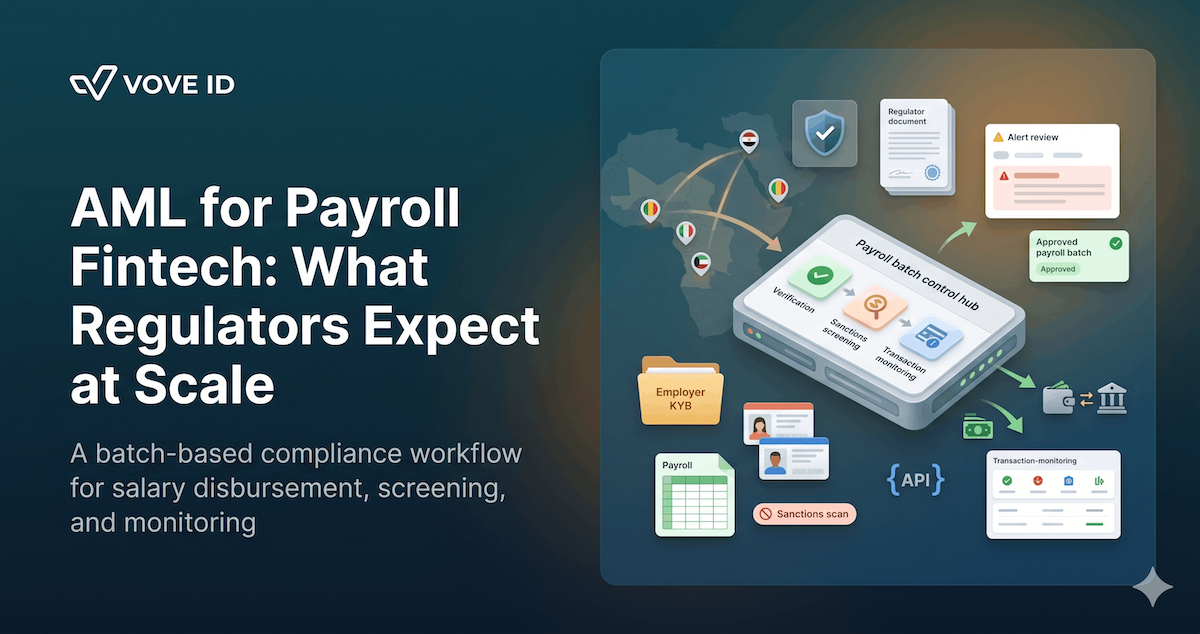
A payroll fintech needs an AML program designed for structured, high-volume salary disbursement — not a generic payments compliance layer.
In 2026, regulators no longer treat payroll as a low-risk operational workflow. They treat it as recurring, large-scale money movement across beneficiary populations, often with cross-border exposure and automated execution.
That distinction matters.
A payroll system does not behave like a typical payments product. Transactions are batched, not individual. Beneficiaries are derived from employer data. Patterns are repetitive rather than random. And anomalies tend to hide inside normal-looking operational volume.
An AML program that does not account for these characteristics will miss risk.
What AML compliance does a payroll fintech need?
A payroll fintech needs risk-based onboarding, employer verification, screening of relevant beneficiaries and counterparties, monitoring of payroll batches for unusual patterns, escalation workflows for suspicious activity, and governance that ties every approval, hold, and report back to documented controls.
The exact requirements depend on the product structure and regulatory perimeter. But operationally, the expectation is consistent: payroll money movement must be monitored as a live financial system, not treated as a static HR workflow.
What makes payroll AML structurally different
Payroll AML is not just about who sends money. It is about how structured money flows behave over time.
Three properties define the risk model.
First, beneficiaries are derived. Employees and contractors are not independently onboarded users in most payroll systems. They are introduced through employer data, which means risk is inherited from both the employer and the integrity of the payroll file itself.
Second, execution is batch-based. Payments are processed as files rather than individual events. Suspicious activity does not usually appear as a single outlier transaction. It appears as a deviation in structure, distribution, or composition.
Third, behavior is predictable. Payroll follows cycles. That means risk detection depends on identifying changes relative to a known baseline, not just flagging absolute thresholds.
Generic AML frameworks rarely account for all three at once. That is where gaps emerge.
Why payroll fintechs attract AML scrutiny
At first glance, payroll appears lower risk than remittance or peer-to-peer transfers. Funds are tied to employment relationships, cycles are predictable, and customers are corporate entities.
At scale, that assumption breaks down.
A single employer can generate thousands of beneficiary payments in one run. Platforms may onboard companies in one jurisdiction and pay workers in another. Many products expand into contractor payouts, earned wage access, salary wallets, or cross-border disbursement.
These dynamics create specific pressure points:
- large volumes of end-beneficiary payments generated by a single customer
- shifting beneficiary populations that are difficult to verify individually
- sanctions exposure across employers, beneficiaries, and destination banks
- manipulation of payroll files to insert unauthorized recipients
- structured patterns that allow suspicious activity to blend into routine operations
Payroll is structured money movement. That makes it efficient to scale, but it also makes errors and abuse scalable.
The core AML obligations for payroll fintechs
The regulatory perimeter varies depending on licensing, partners, and product scope. But operationally, payroll AML consistently relies on five layers.
Employer onboarding and KYB as baseline modeling
The first control surface is the employer.
Payroll AML does not stop at verifying legal existence or ownership. It requires building a baseline of expected behavior:
- typical payroll size and range
- number and type of beneficiaries
- payout geographies
- frequency and timing of runs
This baseline is critical. Without it, monitoring systems cannot distinguish between legitimate growth and suspicious deviation.
Beneficiary and counterparty controls
Payroll platforms often avoid full KYC on every employee. That does not eliminate risk.
Exposure can arise through:
- fake or duplicated employees
- mule accounts inserted into payroll data
- synthetic contractor identities
- reused or recycled bank accounts
Effective control does not always require full identification. It requires a defensible combination of data validation, selective screening, and ongoing monitoring of beneficiary changes.
Batch-level transaction monitoring
This is the core difference between payroll AML and standard transaction monitoring.
The unit of analysis is not the individual payment. It is the payroll batch.
Relevant signals include:
- changes in employee count or payout volume
- shifts in distribution of payment amounts
- introduction of new or previously unseen accounts
- concentration of payments to specific beneficiaries
- new payout corridors or destination banks
- repeated corrections, reruns, or split batches
The goal is to detect when routine payroll structure is being used to mask non-routine behavior.
Suspicious activity escalation
An alert is only the starting point.
Payroll AML requires a workflow that can interpret anomalies in context. Not every irregular payroll run is suspicious. Corrections, bonuses, and off-cycle payments are common.
Effective escalation combines:
- employer baseline data
- historical behavior
- operational context
- structured case documentation
From there, decisions must be traceable: hold, release, or report, with a clear audit trail.
Governance and operational ownership
Payroll AML often fails because responsibility is fragmented.
Compliance, product, operations, and banking partners may all assume another party owns the risk. This creates gaps that persist until scale exposes them.
A functioning program requires:
- clear ownership of AML controls
- risk-based policies tied to payroll workflows
- defined escalation thresholds
- training and review processes
- evidence that controls operate in practice
Regulatory direction increasingly emphasizes this operational reality. It is not enough to define controls. Firms must demonstrate that those controls are actively applied.
How payroll complexity increases AML exposure over time
Payroll risk does not grow linearly. It compounds as the product evolves.
At an early stage, a payroll fintech may handle a small number of employers, predictable monthly salary runs, and limited geographic exposure. At that stage, even basic controls may appear sufficient.
Growth introduces structural changes:
- expansion into new jurisdictions
- increased contractor payouts and variable schedules
- off-cycle and real-time disbursements
- earned wage access flows
- more complex treasury and prefunding models
Each change breaks earlier assumptions about normal behavior.
An AML system calibrated for fixed payroll cycles and stable employee counts will not adapt automatically. Without recalibration, monitoring either misses new risk patterns or generates excessive false positives. Both outcomes degrade control quality.
The hidden risk in payroll data integrity
Most payroll systems assume that input data is trustworthy. From an AML perspective, this is a critical weakness.
Payroll files can be manipulated in subtle ways:
- adding non-existent employees
- changing bank details shortly before payout
- splitting payments across multiple accounts
- reusing beneficiary credentials across identities
Because payroll is repetitive, these changes can appear legitimate in isolation.
The risk is not just identity fraud. It is data-layer manipulation that directly controls where funds are sent.
Effective payroll AML therefore requires:
- validation of beneficiary changes
- detection of unusual edit patterns
- linkage analysis between accounts and identities
- controls on last-minute modifications before execution
Without this, the system implicitly trusts the data that drives financial movement.
Why transaction-level monitoring is not enough
Many fintech teams attempt to reuse traditional transaction monitoring systems for payroll. This creates a structural mismatch.
Standard systems are designed to detect anomalies in individual transactions. Payroll risk rarely appears that way.
A suspicious payroll scenario may involve:
- hundreds of individually normal payments
- gradual introduction of new beneficiaries
- subtle redistribution of amounts across a batch
No single payment stands out.
Only the aggregate pattern reveals the anomaly.
That is why payroll AML requires:
- batch-level analytics
- comparison across historical payroll runs
- employer-level pattern tracking
- structural anomaly detection
Without this, monitoring appears complete but misses the actual risk surface.
Designing AML controls for evolving payroll products
Payroll fintechs rarely remain limited to salary processing.
As products expand, AML complexity increases.
Earned wage access introduces continuous, user-driven disbursement patterns. Contractor payouts create variability in timing and amount. Global payroll introduces multi-entity structures and jurisdictional overlap. Embedded financial services add additional transaction layers.
Each expansion changes the risk model.
Controls must evolve alongside the product. Otherwise, gaps accumulate between how money moves and how it is monitored.
Operational scalability vs compliance scalability
Operational systems scale through automation, batching, and standardization.
Compliance systems often lag behind, relying on manual review and fragmented tools.
This creates a widening gap.
At low volume, manual processes can compensate. At scale, they break down.
Typical failure signals include:
- growing alert backlogs
- inconsistent decision-making
- delayed investigations
- inability to reconstruct historical actions
Closing this gap requires:
- unified data models across payroll and AML
- automated alert generation and routing
- structured case management
- feedback loops between onboarding and monitoring
Without this alignment, compliance becomes a constraint on growth.
Building an audit-ready payroll AML system
Regulators expect not just controls, but explainability.
A payroll fintech should be able to reconstruct:
- what data was received
- what checks were performed
- what anomalies were detected
- who reviewed the case
- what decision was made and why
This requirement applies even long after the payroll run has been completed.
Audit readiness depends on:
- consistent data capture
- version control of employer and beneficiary data
- immutable logs of screening and monitoring results
- documented decision rationale
In a batch-driven system, this requires deliberate architecture. Without it, reconstructing decisions becomes difficult or impossible.
How VOVE ID fits into payroll AML workflows
For payroll fintechs, the main challenge is not adding more checks. It is connecting identity, payroll data, and transaction monitoring into a coherent system.
VOVE ID supports this by structuring:
- employer KYB with risk-based profiling
- beneficiary validation layers where required
- sanctions and PEP screening embedded into payout workflows
- batch-level anomaly detection aligned with payroll structure
- case management with full audit traceability
This approach treats payroll batches as controlled financial events rather than static files. It allows teams to evaluate, monitor, and reconstruct decisions consistently as volume grows.
Questions payroll founders should ask
- Do we define expected payroll behavior per employer, or only verify identity at onboarding?
- Can we detect anomalies at the batch level rather than only per transaction?
- How do we validate and track changes in beneficiary data over time?
- Are operational payroll events distinguishable from suspicious manipulation?
- Who owns AML decision-making across the payroll workflow?
- Can we reconstruct why a specific payroll batch was approved or flagged?
If these answers are unclear, the system may scale operationally but remain fragile from a compliance perspective.
Conclusion
Payroll AML is not a simplified version of payments compliance. It is a different problem entirely.
Risk does not sit in isolated transactions. It emerges from structured repetition, inherited data, and scale-driven complexity.
Fintechs that apply generic AML models to payroll will focus on the wrong signals and miss meaningful anomalies.
Those that design controls around batch behavior, baseline modeling, and data integrity can scale payroll systems without losing visibility into risk.
Need to operationalize payroll AML without building a large manual review function?