Travel Rule Compliance: How Cross-Border Fintechs Automate FATF Obligations via API
Understand how fintechs implement Travel Rule compliance in 2026 by linking identity data to transactions, ensuring required information moves with each transfer across jurisdictions and payment rails.
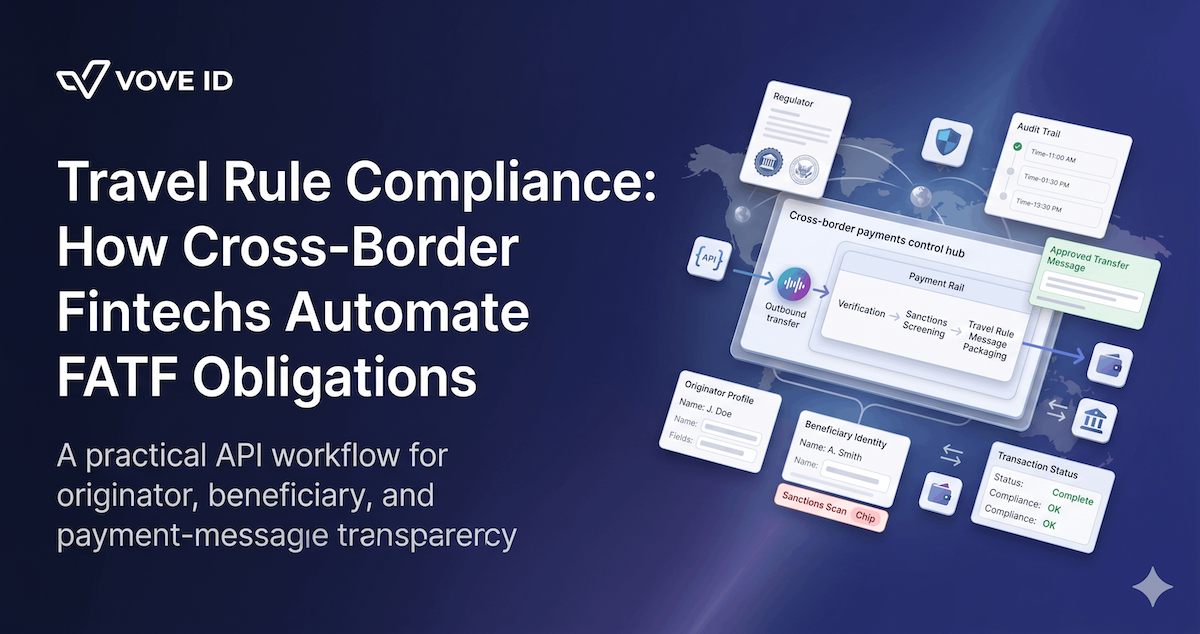
Fintech startups comply with the Travel Rule by collecting verified originator and beneficiary data before a transfer, attaching the required information to the payment message, screening both sides of the transaction, and retaining a clear audit trail. In 2026, the exact fields still depend on the rail and jurisdiction, but the core requirement is consistent: customer identity data must move with the transfer, not live in a separate manual workflow.
Unlike onboarding-focused KYC or KYB processes, the Travel Rule applies at the transaction level, requiring identity data to move with each transfer event rather than remaining isolated in onboarding systems.
For most cross-border teams, Travel Rule work becomes urgent right after launch.
The product grows from local payouts into international transfers, wallet corridors, treasury flows, or stablecoin settlement. Suddenly the compliance question is no longer just whether you verified the sender at onboarding. It is whether the right information actually accompanies the payment, reaches the next institution intact, and can be reconstructed when an auditor, banking partner, or regulator asks for it.
That is where many startups get exposed. They may have KYC in one system, sanctions screening in another, and transfer orchestration in a third. The result is fragmented evidence, inconsistent messaging, and a growing operational gap between what compliance expects and what the payment stack really does.
What the Travel Rule is and who it applies to
At a practical level, the Travel Rule is a payment-transparency requirement.
It is designed to make sure information about the sender and recipient travels through the payment chain so financial institutions and authorities can detect suspicious activity, investigate flows, and prevent funds from moving anonymously across institutions or borders.
In 2026, founders need to think about three layers at once:
- existing domestic rules, such as FinCEN's Travel Rule framework in the United States
- regional regimes, such as the EU Transfer of Funds Regulation
- the FATF standard, which countries implement through local law and supervision
The important nuance is timing.
FinCEN's current guidance already applies to transmittals of funds of $3,000 or more. The EU's Regulation (EU) 2023/1113 governs information accompanying transfers of funds and certain crypto-assets where at least one provider in the chain is established in the Union. FATF updated Recommendation 16 in June 2025 to further standardize cross-border payment information requirements, with implementation timelines depending on how national regulators adopt the updated standard.
That means startups cannot treat Travel Rule compliance as a future requirement. Systems must work under current local rules while remaining adaptable to evolving international standards.
What information must travel with each transfer
The data payload is not identical in every regime, but the operating logic is similar across them.
| Regime | Practical requirement |
|---|---|
| FinCEN Travel Rule | For transmittals of funds of $3,000 or more, sender, recipient, institution, amount, date, and identifying information must travel with the payment order. |
| EU Regulation 2023/1113 | Transfers of funds and certain crypto-assets must carry payer/payee or originator/beneficiary data when an EU provider is involved. |
| FATF Recommendation 16 | Cross-border payments require standardized originator and beneficiary information, with increasing alignment across jurisdictions. |
For product teams, the concrete fields usually include:
- sender name
- recipient name
- account, wallet, or transaction identifier
- address or equivalent identifying details
- date of birth or official identity details where required
- sending and receiving institution identifiers
- amount, currency, date, and execution metadata
The real engineering challenge is not storing these fields. It is ensuring they remain linked to the transfer event from initiation through execution, handoff, and audit.
How most fintechs handle this today and why it breaks
Most early-stage teams do not fail because they ignore the Travel Rule. They fail because they treat it as a documentation problem rather than a workflow problem.
The common weak pattern looks like this:
- onboarding verifies the sender, while beneficiary data is captured later with limited validation
- sanctions screening runs independently of transfer messaging
- operations teams manually enrich or correct data after partner rejection
- audit evidence is fragmented across tickets, spreadsheets, or communication tools
This creates four predictable issues.
1. Message quality becomes inconsistent
A transaction may pass internal approval while lacking fields required by downstream institutions or regulatory frameworks.
2. Exceptions multiply as volume grows
As corridors and partners expand, manual exception handling increases, creating delays and operational risk.
3. Screening and messaging drift apart
The screened identity profile may differ from the actual data transmitted with the payment, weakening compliance defensibility.
4. Investigations become slow and expensive
Reconstructing transaction history across disconnected systems increases review time and reduces confidence in outcomes.
How Travel Rule compliance can be operationalized
Travel Rule compliance becomes manageable when identity data, screening, transfer execution, and audit records are treated as a single transaction-level workflow.
This requires infrastructure that can:
- capture sender and beneficiary data before execution
- validate required fields based on jurisdiction and transfer type
- perform sanctions and risk screening prior to release
- attach identity data to the transfer message or event
- retain a complete audit trail linked to each transaction
Platforms like VOVE ID support this model by integrating identity verification, screening, and transaction-level data management into a unified workflow.
A typical implementation flow includes:
- Sender verification through KYC or KYB processes
- Beneficiary data collection and validation at payment initiation
- Pre-transaction screening (sanctions, PEP, risk signals)
- Linking identity payloads to the transfer record
- Centralized audit trail for compliance review and reporting
The key shift is moving from fragmented systems to a single control surface where identity and transaction data remain aligned.
Jurisdictions and frameworks founders should watch in 2026
United States
FinCEN's Travel Rule applies to covered transmittals of funds, with a $3,000 threshold and defined sender and recipient information requirements.
European Union
Regulation (EU) 2023/1113 applies to both traditional funds and certain crypto-asset transfers, requiring data to accompany transactions when EU-based providers are involved.
FATF member jurisdictions
FATF Recommendation 16 shapes global expectations, with updated standards influencing national regulatory implementation over time.
Virtual asset and stablecoin flows
Virtual asset service providers are expected to implement Travel Rule controls similar to traditional financial institutions, including identity data transmission and AML screening.
A practical Travel Rule checklist for fintech teams
Before expanding cross-border payment capabilities, teams should confirm:
- which regulatory framework governs each transfer corridor
- required sender and beneficiary data fields for each transfer type
- validation points for missing or incorrect data
- mechanisms to halt or review transactions based on screening results
- ability to retrieve the exact identity payload linked to a transaction
- availability of a complete audit trail without manual reconstruction
Conclusion
Travel Rule compliance is not a documentation layer added to payments. It is a core requirement of transaction integrity and control design.
Fintechs that scale successfully treat identity verification, sanctions controls, transfer messaging, and audit evidence as part of a single system rather than separate processes.
This approach ensures that compliance holds under operational pressure, partner requirements, and regulatory review.
Explore how Travel Rule workflows can be implemented with VOVE ID.
Sources
- FATF, "FATF updates Standards on Recommendation 16 on Payment Transparency," 18 June 2025
- FATF, "Updated Guidance for a Risk-Based Approach to Virtual Assets and Virtual Asset Service Providers," 28 October 2021
- FinCEN, "Funds 'Travel' Regulations: Questions & Answers," updated 9 November 2010
- EUR-Lex, Regulation (EU) 2023/1113 on information accompanying transfers of funds and certain crypto-assets