Onboarding 10K SMEs in 12 Months: A Compliance Architecture for Startups
At 800 applications a week, heroic operations break. What separates fintechs that hit 10K SMEs from those that drown is how early they separate clean cases from real risk.
Onboarding 10,000 SMEs in a year is not a staffing question first. It is an architecture question. In 2026, the startups that hit the target are not the ones with the biggest review team — they are the ones that separate low-friction cases from real risk early and keep the exception queue narrow.
VOVE ID helps fintech startups build SME onboarding architectures in markets where the volume is the plan.
On paper, 10K SMEs in 12 months looks like a growth target. In practice, it is an operations design target. This guide covers what that volume means in practice, where high-volume onboarding breaks, and what the underlying architecture needs to look like. For the full KYB framework that supports it, see our KYB Requirements Explained 2026.
What the target actually means in practice
The number sounds strategic until you break it down.
Ten thousand SMEs in a year is roughly 833 a month, 192 a week, 27 a day if volume is evenly spread. Real volume is never evenly spread. Launches, partnerships, and campaign bursts compress those numbers into heavier weeks fast.
The workflow cannot depend on constant human attention per case. It has to absorb volume spikes without collapsing.
The two queues inside every SME onboarding flow
Most founders think of onboarding as one queue. It is two.
Queue one: customer-side collection. The SME provides company details, directors or controllers, registry identifiers, ownership information, and any required documents. If this step is slow, conversion drops.
Queue two: internal review and exception handling. Even after the customer submits everything, the business still needs to resolve incomplete or inconsistent registry data, ownership questions, sanctions hits, business-model mismatches, and operating-name versus legal-name discrepancies. If this queue grows, the product starts looking broken even when the front-end flow looks polished.
Why manual review becomes the product
Early on, teams get away with heroic operations. Two people know which documents matter, which markets are messy, and which exceptions can be approved with a quick note. That works for a pilot.
Once volume rises, the hidden costs appear: reviewers spend time on clean cases that should never have hit manual review, turnaround times become unpredictable, commercial teams stop promising go-live dates with confidence, and exception logic lives in reviewer memory rather than in the workflow.
At that point, manual review is no longer a safety layer. It is the operating system. Conversion, revenue, and partner trust start moving at the speed of the review queue.
A realistic scale failure: when 800 applications a week hits a two-person team
A B2B fintech launches SME onboarding for a new payments product. The first month looks manageable. Then a distribution partnership lands and weekly application volume jumps to 800.
The team has two reviewers. Nothing is formally broken, but everything starts leaking: simple cases wait behind complex ones, duplicate requests go back to customers, legal names and trading names are resolved by email, director mismatches sit in a spreadsheet, sales asks compliance for status updates one case at a time.
Within weeks, the queue is two weeks deep. Conversion drops because qualified SMEs do not want to wait.
The startup assumes it has a staffing problem. It usually has a routing problem first.
What a 10K-SME onboarding architecture needs
The architecture does not need to be complex. It needs to be structured.
Pre-fill the entity wherever possible. If the business already knows the registry identifier, the workflow should not ask the SME to type everything from scratch. That reduces both customer friction and downstream mismatch risk.
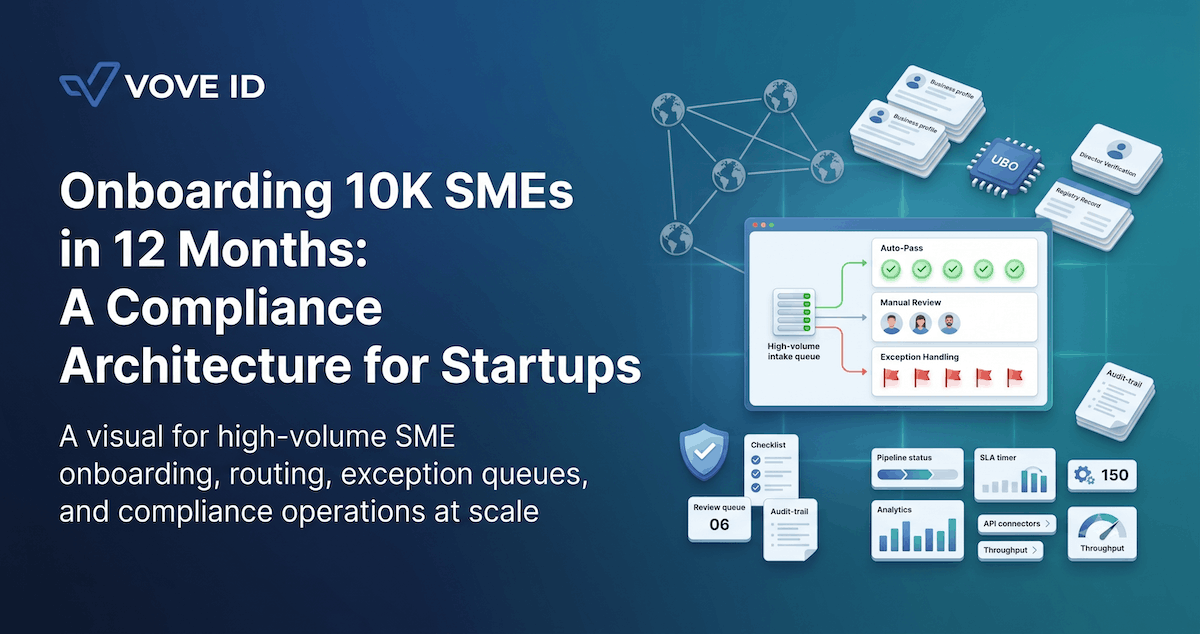
Split auto-pass, review, and hard-stop logic clearly. Not every case deserves the same path. Clean, low-risk cases should progress quickly. Cases with ownership questions or screening flags need targeted manual review. Cases with unacceptable risk should stop immediately. Without this split, the review team becomes a bottleneck for the entire funnel.
Treat KYB, UBO, and screening as one decision flow. Many startups still run these as disconnected checks. A director mismatch discovered after entity approval reopens the file. A sanctions question found after ownership review reopens it again. The better model is one decision trail with shared evidence.
Build exception handling into the architecture. High-volume onboarding does not fail because exceptions exist. It fails because exceptions are handled in ad hoc channels — email threads, Slack messages, spreadsheets, undocumented reviewer notes. An exception lane needs explicit rules, owners, and SLA visibility.
Measure where the queue actually forms. Teams often track top-line approval rate and average turnaround time. They should also know how many cases hit manual review, which reasons drive the queue, where customers abandon the flow, and which markets or partner segments create the most rework.
How VOVE ID builds the operating model from day one
VOVE ID helps startups design SME onboarding as a system rather than a reviewer backlog. That includes structured entity intake and registry matching, KYB, UBO, and screening inside one flow, risk-based routing between auto-pass and review, exception handling with one case record, and audit-ready decision history for every approved or escalated SME.
The point is not to remove humans from onboarding. It is to make sure humans work on the right cases.
Practical SME onboarding checklist
Auto-pass
- Pre-fill entity data whenever a reliable identifier is available
- Keep clean cases out of manual review by default
- Route low-risk SMEs through one short evidence path
Review
- Define which mismatches actually require a human
- Keep KYB, UBO, and screening evidence in one case file
- Give reviewers clear approval and escalation rules
Exception
- Create a separate lane for ownership, sanctions, and business-model edge cases
- Set response SLAs for exception cases instead of letting them sit in general backlog
- Avoid resolving material exceptions through email alone
Measurement
- Track manual-review rate by corridor, partner, and market
- Measure where customers abandon the flow
- Review exception reasons monthly and convert repeat ones into rules
Q&A
Is 10K SMEs in 12 months realistic for a startup?
Yes, if the onboarding flow is designed for throughput from the start. No, if most cases still depend on reviewer memory, manual collection, and unclear exception handling.
What usually breaks first at this volume?
Manual review. The visible symptom is turnaround time, but the deeper issue is that too many clean cases are being treated like exception cases.
Do startups need a large compliance team to reach this number?
Not necessarily. They need clear routing, structured evidence, and a narrow exception queue. More headcount helps less than better case design when the workflow itself is too broad.
What should founders measure besides approval rate?
Manual-review rate, exception reasons, turnaround by case type, and where SMEs abandon the process. Those numbers show whether the architecture is scaling or just hiding strain.
Conclusion
Onboarding 10K SMEs in 12 months is a systems problem, not a heroics problem. Startups hit that number when low-risk SMEs move quickly, exceptions are isolated early, and every ownership, screening, and approval decision lives in one workflow. When the architecture is weak, the backlog becomes the product and growth starts waiting on reviewer bandwidth.
SME onboarding at scale works when automation, review, and exception handling are designed together from the start.
At 800 applications a week, the review queue is the product — whether the team means it to be or not. VOVE ID helps fintechs build onboarding architecture that keeps clean cases moving and exceptions contained from day one.
This article is intended for general informational purposes only and does not constitute legal, financial, or regulatory advice. KYC/KYB/AML requirements may vary depending on jurisdiction, industry, and specific business circumstances. For up-to-date and binding compliance obligations, readers should refer to the relevant regulatory authorities or consult qualified professionals.