KYB Compliance in Mauritius 2026: Business Verification for GBL Companies, Fintechs, and Investment Structures
Mauritius is a holding jurisdiction as much as a domestic market — which makes KYB here structurally different from most African countries. Complex GBL ownership structures, cross-border directors, and layered beneficial ownership are the norm, not the exception.
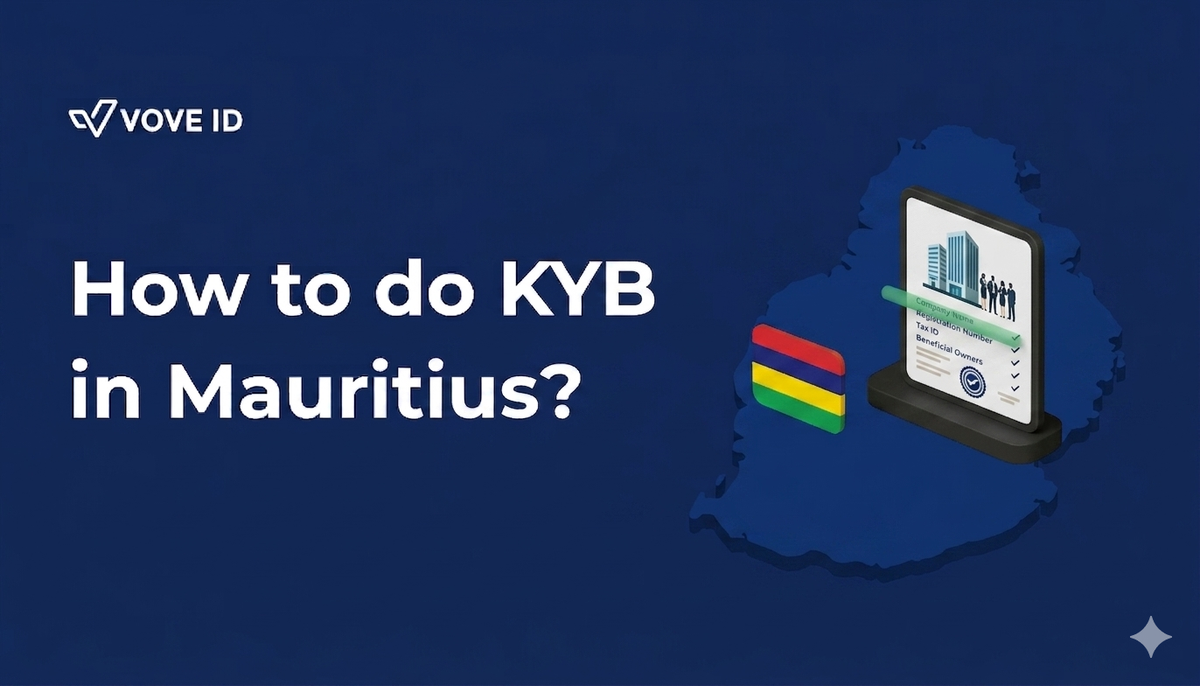
Mauritius has positioned itself as the primary gateway for structured investment into Sub-Saharan Africa. That positioning comes with a specific compliance challenge: a substantial share of the corporate entities registered here are not operating businesses in the conventional sense. They are holding structures — Global Business License companies, Special Purpose Vehicles, and investment funds — whose beneficial owners are typically located in other jurisdictions entirely. For any regulated entity onboarding these structures, KYB is not a formality. It is the central compliance problem. VOVE ID supports regulated businesses in Mauritius with end-to-end KYB workflows, including biometric verification of UBOs and directors regardless of their country of origin.
This guide covers what business verification requires in Mauritius in 2026. For the underlying KYB framework — how CDD applies to legal entities, how UBO tracing works, and what a compliant corporate onboarding flow looks like — see KYB Requirements Explained: 2026.
Why KYB in Mauritius Is Structurally Different
In most jurisdictions, KYB means verifying a trading company — an entity with customers, revenue, and a recognisable business purpose. In Mauritius, a significant proportion of entities subject to KYB obligations are holding structures: GBL companies owning African assets, SPVs created for specific investment transactions, fund vehicles with no employees and no domestic operations.
This creates three specific challenges for KYB:
Registry data is limited. The Corporate and Business Registration Department (CBRD) is the official company registry. It handles incorporation and maintains the register, but does not publicly disclose full director and shareholder information for Global Business License companies. UBO data is not publicly accessible for GBL entities, which means regulated entities cannot rely on a registry lookup to establish beneficial ownership. Verification must come from documentation provided by the entity itself, cross-referenced against independent sources.
Ownership is frequently layered. GBL structures often involve multiple holding layers across jurisdictions — a Mauritius GBL owned by a Cayman fund, whose investors include individuals from several countries. Tracing to the natural person with 20%+ ownership or control requires working through each layer.
Directors and UBOs are almost always foreign. The practical reality of verifying individuals who may be in London, Dubai, Nairobi, or Singapore — without physical meeting — requires biometric verification infrastructure. A certified copy of a passport mailed by post is not adequate for a high-value investment structure in 2026.
The Regulatory Framework for Business Verification
KYB obligations in Mauritius are governed by FIAMLA and the sector-specific guidelines issued by the FSC and Bank of Mauritius. Both regulators require reporting entities to:
- Verify the legal existence of the business entity (registration, name, address, nature of activity)
- Identify and verify directors and authorised signatories
- Identify and verify Ultimate Beneficial Owners (UBOs) — individuals with 20% or more ownership or control
- Assess and document the purpose and nature of the business relationship
- Apply enhanced due diligence to high-risk corporate clients
The 20% UBO threshold is notably lower than the 25% standard used in the EU and most other jurisdictions. In practice, this means more individuals in a given ownership structure fall within scope for identity verification — particularly relevant in fund structures with multiple investors above this threshold.
Under AMLA 2026, UBO definitions have been expanded to capture control beyond direct shareholding — meaning entities that exercise effective control through means other than equity (board representation, contractual rights, veto powers) are now within scope. Compliance files must reflect this broader definition.
Corporate Documents Required for KYB
For a standard Mauritius company or GBL entity, a complete KYB file typically includes:
Corporate documents:
- Certificate of Incorporation from CBRD
- Constitution / Memorandum and Articles of Association
- Certificate of Good Standing (for established entities)
- Global Business License or Authorised Company certificate (where applicable)
- Register of directors
- Register of shareholders
- Proof of registered address
For each director and UBO:
- Government-issued photo ID (passport standard for foreign nationals)
- Proof of address
- Liveness verification or certified identity confirmation for remote onboarding
For the business relationship:
- Description of business activities and source of funds
- For investment structures: fund documentation, investment mandate
- For high-risk cases: senior management approval and source of wealth documentation
The FSC's enforcement activity in 2025 — which included over 25 license revocations — was substantially linked to inadequate beneficial ownership documentation. A KYB file that stops at the registered shareholder without tracing to the natural person is not compliant.
GBL Companies: The Specific Compliance Challenge
The Global Business License structure is central to Mauritius's role as an investment hub. A GBL company must have substance in Mauritius — at least two directors resident in Mauritius, adequate local management, and an operational presence — but its beneficial ownership may be entirely foreign.
From a KYB perspective, this means:
The Mauritius-resident directors are easy to identify and verify domestically. They are often professional directors employed by a management company or corporate service provider.
The ultimate beneficial owners — the fund investors, family office principals, or corporate shareholders who actually own the GBL — are the verification challenge. They may be individuals in multiple jurisdictions, with different document types, languages, and identity document formats.
For regulated entities onboarding GBL companies as clients (banks, investment managers, payment platforms), the KYB obligation runs through the GBL to the foreign UBOs. There is no shortcut based on the Mauritius incorporation.
VOVE ID's document coverage across 190+ countries, combined with biometric liveness detection and face matching, addresses this directly — enabling remote UBO verification regardless of the individual's country of origin or document type.
VASP and Fintech KYB
Mauritius has developed a licensing framework for Virtual Asset Service Providers (VASPs) under the VAITOS Act 2021, supervised by the FSC. VASPs operating in Mauritius are subject to KYB obligations when onboarding business clients, with particular attention to:
- Verification of counterparty VASPs in cross-border transactions
- Enhanced due diligence for corporate clients in high-risk sectors
- Sanctions screening for all business relationships
- Travel Rule compliance for virtual asset transfers
The fintech sector more broadly — payment service providers, digital lenders, investment platforms — operates under FSC or BoM licensing depending on activity type. KYB obligations apply to merchant onboarding, B2B relationships, and institutional client verification. For the AML framework governing these platforms in more detail, see AML Requirements Explained: 2026.
Ongoing Monitoring and Periodic Review
KYB is not a one-time event at onboarding. FIAMLA and regulator guidance require:
Ongoing monitoring of the business relationship — reviewing transactions against the stated business purpose and risk profile.
Periodic review of corporate client files — typically annual for high-risk clients, less frequently for lower-risk relationships. The trigger is not just time but events: a change of ownership, a change in business activity, or a transaction that is inconsistent with the original risk assessment.
Re-verification when material changes occur — new directors, changes in UBO structure, or the entity entering a new business line.
Given the volume of holding structures that go through restructurings, investor changes, and ownership transfers, the ongoing monitoring obligation in Mauritius is more operationally demanding than in a typical domestic market. Systems that automate re-KYC triggers and maintain audit-ready documentation are not a luxury in this environment — they are a practical necessity ahead of the ESAAMLG Mutual Evaluation in 2027.
Friction Points in Practice
UBO tracing through layered structures is the dominant pain point. Manually working through a multi-jurisdiction ownership chain — requesting documents from each layer, verifying each individual — is slow, error-prone, and creates significant onboarding delays for legitimate clients.
Director verification at scale is the second challenge. Corporate service providers and fund administrators may need to verify dozens or hundreds of directors across a portfolio of GBL companies. Without a standardised, API-driven workflow, this becomes a bottleneck.
Document diversity is underestimated. A GBL with investors from Nigeria, the UK, India, and the UAE requires handling four different document types, in potentially different languages, with different authentication standards. OCR-based verification that handles multi-jurisdiction document formats is not optional for this market.
If UBO verification, director identity checks, or corporate onboarding at scale are creating compliance friction in your Mauritius workflow, talk to our team.
This article is intended for general informational purposes only and does not constitute legal, financial, or regulatory advice. KYC/KYB/AML requirements may vary depending on jurisdiction, industry, and specific business circumstances. For up-to-date and binding compliance obligations, readers should refer to the relevant regulatory authorities or consult qualified professionals.