
Transaction Monitoring for Stablecoin Flows: Rules That Don't Translate from Card
Card rules see the transaction. Stablecoin risk lives one layer deeper, in the wallet path behind it.
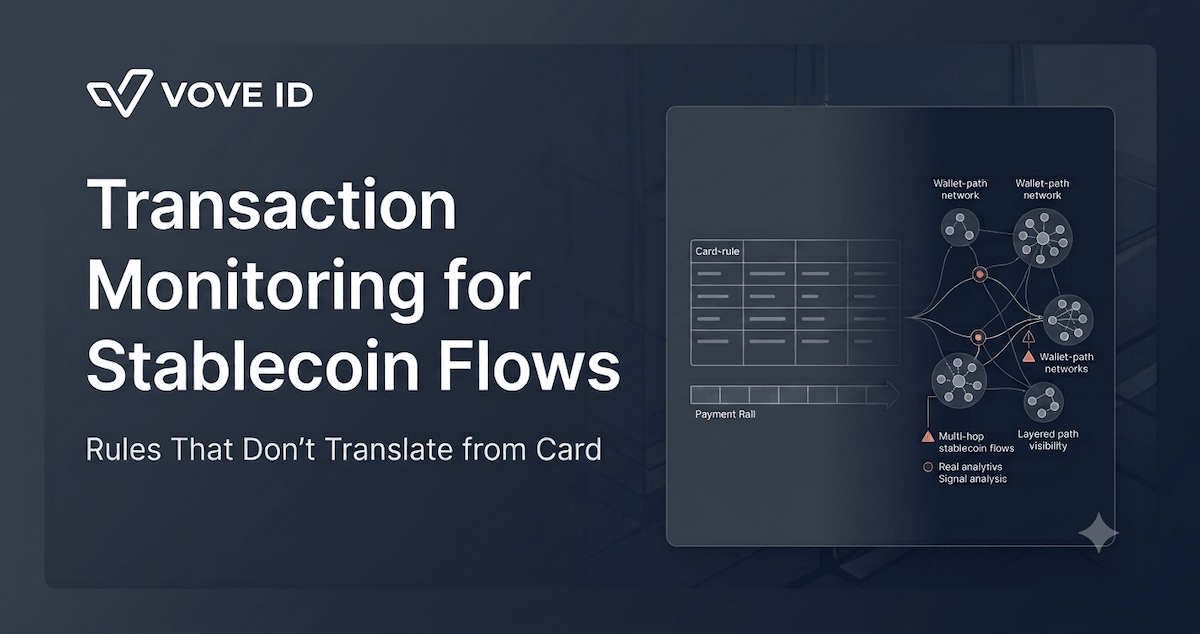
VOVE ID helps stablecoin operators rebuild monitoring in markets where the rules engine carried over from card and the signal lives on-chain. On paper monitoring runs. In practice it sees only half the picture.
The short answer
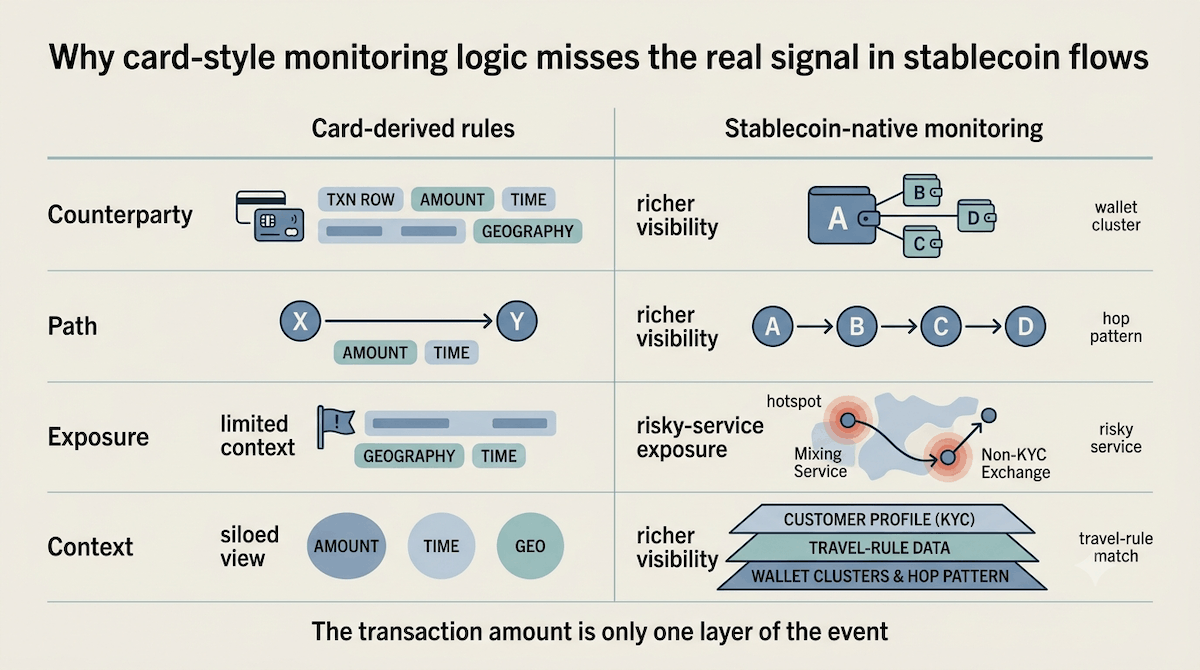
Card-grade monitoring logic does not map cleanly onto stablecoin flows because the transaction itself is only one layer of the event. On-chain movement, wallet relationships, hop patterns, counterparty clustering, and travel-rule context carry the signal that card systems were never designed to read. When teams port card rules into a stablecoin product, they often create the appearance of control while missing the behavior that actually matters. This is a detection gap, not an alert-tuning problem — the rules stay quiet, rather than firing too often.
Why card rules break on stablecoin flows
Card monitoring was built for a world with merchant descriptors, issuer data, chargeback patterns, and relatively stable counterparties. Stablecoin flows behave differently. Funds can move across self-hosted wallets, exchanges, bridges, and layered wallet chains before the institution sees a meaningful customer explanation. The same nominal amount can carry a different risk story depending on the wallet path behind it.
That is why familiar rules like velocity thresholds, transaction amount bands, or simple geography flags tend to underperform when copied across unchanged. They may still catch obvious anomalies, but they miss the structure of the flow. A stablecoin transaction can look ordinary at the fiat edge and still be deeply suspicious on-chain. The result is a rules engine that works hard without becoming more intelligent about the thing it is supposed to catch.
This is a different problem from alert-quality tuning. Getting the balance of alert volume and precision right matters once the engine is looking at the right signals — but if the underlying feature set never captures wallet relationships or hop patterns, no amount of threshold tuning fixes it.
For a full breakdown of AML monitoring obligations, see our AML Requirements Explained 2026.
The four on-chain signals card rules cannot generate
Stablecoin-native monitoring starts by accepting that the institution needs different features, not just stricter thresholds. Four signals matter immediately.
Wallet relationship
Card systems assume a known or semi-known counterparty model. Stablecoin monitoring has to ask whether the sending and receiving wallets belong to the same cluster, a fresh wallet set, or a pattern already linked to elevated risk.
Hop pattern
A payment that passes through multiple wallets or services in quick succession changes the risk picture. A card authorization message cannot express that path. An on-chain analysis layer can.
Exposure to risky services
Mixers, sanctioned entities, high-risk exchanges, or nested service relationships may only become visible through wallet intelligence. Card rules do not have an equivalent concept for most of that exposure.
Travel-rule and off-chain context
Stablecoin flows often become legible only when the on-chain path is combined with travel-rule payloads, customer identity, and business purpose. The problem is not missing one data source. It is failing to combine them.
A realistic monitoring failure: when a layered stablecoin scheme passes card-grade rules
Consider a USDC-focused EMI that launches with a monitoring stack adapted from cards. The rules look sensible: large-value thresholds, unusual-hour checks, repeated beneficiary flags, rapid velocity, and geography filters. A layered stablecoin scheme moves through multiple intermediary wallets, touches a high-risk exchange cluster, and lands with a customer whose fiat profile looks clean enough. None of the card-derived rules trigger because each individual transaction is modest and each step looks ordinary in isolation.
The problem only surfaces when a travel-rule packet and later investigative review expose the wallet chain behind the customer. By then, the institution has already processed the flow and documented a false sense of control. The monitoring engine was active, but it was blind to the part of the transaction that mattered.
How VOVE ID builds stablecoin-native monitoring
The right design is not "crypto plus more rules." It is a monitoring stack built around the actual structure of stablecoin movement.
1. Start with wallet intelligence, not only transaction fields
Each monitored event should carry counterparty wallet context, cluster risk, service exposure, and path-level clues alongside the customer and amount data.
2. Model behavior across flows, not only single events
Stablecoin risk often appears across sequences: peel chains, rapid fan-out, hub-and-spoke movement, repeated interaction with risky counterparties, or returns from newly created wallets. Those patterns need sequence-aware logic.
3. Combine on-chain and off-chain evidence
Travel-rule payloads, customer profile, business activity, expected corridor, and prior alerts should sit next to the wallet path. If those layers remain in separate tools, analysts spend their time reconstructing context instead of judging risk.
4. Tune rules for explainability
A strong stablecoin monitoring program should still explain why an alert fired in language an operations or compliance team can act on. That means mapping technical signals into reviewable cases, not flooding analysts with opaque chain scores.
For a deeper look at reducing alert noise once the right signals are in place, see our guide to false positives in crypto AML monitoring.
Stablecoin monitoring checklist
Rules: Retire card-only logic that assumes the transaction row contains the whole story.
Signal: Add wallet clustering, hop analysis, risky-service exposure, and travel-rule context.
Tuning: Optimize for fewer, better alerts that an analyst can actually explain and escalate.
Q&A
Are card rules useless for stablecoin monitoring?
No. Some generic controls still help. The mistake is assuming they are enough without an on-chain feature layer.
What is the first capability most teams are missing?
Usually wallet relationship and path visibility. Without that, the institution can see the payment amount but not the behavior around it.
Does stablecoin-native monitoring mean a totally separate compliance program?
Not necessarily. It means the monitoring layer needs new inputs and rule logic so the wider compliance program can evaluate stablecoin behavior properly.
Conclusion
Stablecoin monitoring fails when teams move card logic onto a new rail and call the job done. The real requirement is different: build rules around wallet relationships, hop patterns, risky-service exposure, and travel-rule context. Once those signals are visible, monitoring stops being performative and starts becoming defensible.
Want to see how VOVE ID builds stablecoin-native monitoring? The gap between "monitoring runs" and "monitoring sees the risk" usually shows up the first time you look at wallet paths instead of transaction rows.
This article is intended for general informational purposes only and does not constitute legal, financial, or regulatory advice. KYC/KYB/AML requirements may vary depending on jurisdiction, industry, and specific business circumstances. For up-to-date and binding compliance obligations, readers should refer to the relevant regulatory authorities or consult qualified professionals.