AIFMD and Retail Investor Access: Compliance for Alt-Investment Startups
AIFMD retail access is not one EU-wide switch. Every subscription is a compliance event — disclosure, suitability, source-of-funds, and a decision record that holds up on inspection.
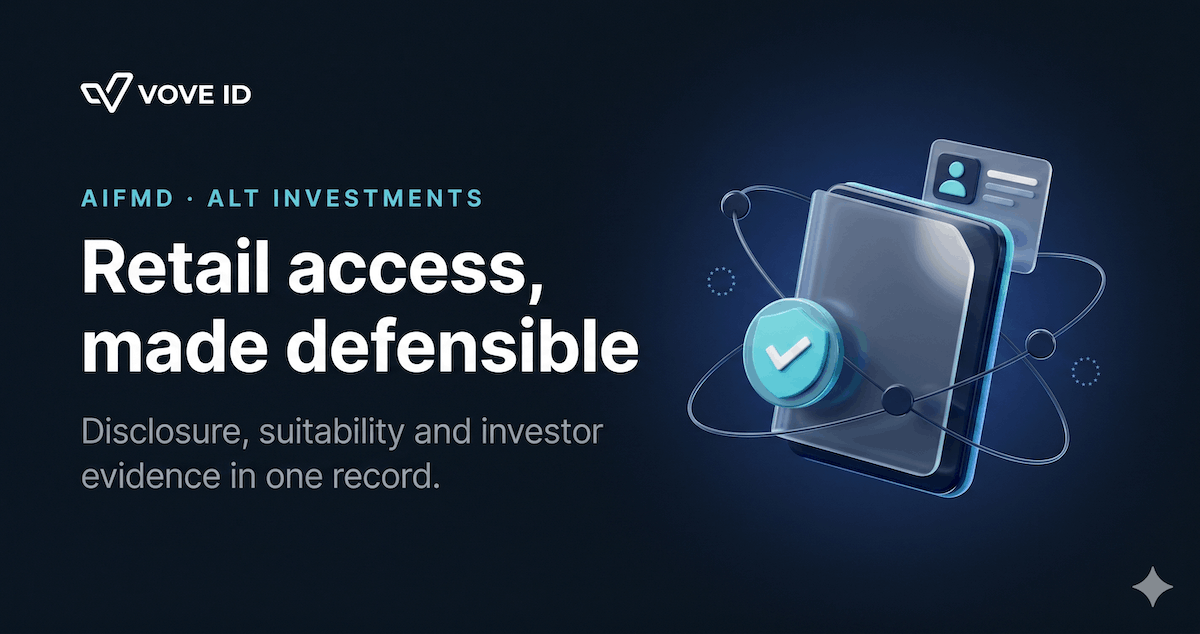
VOVE ID helps alternative-investment startups offer retail access to AIFs in markets where compliance obligations sit just below the headline. On paper retail access is permitted. In practice each subscription is a compliance event.
This guide covers the operational requirements behind AIFMD retail distribution. For the KYC and AML framework that applies to each investor, see our KYB Requirements Explained 2026.
Direct answer: AIFMD does not create a single EU-wide permission to market every alternative investment fund to retail investors. The manager must navigate the applicable member-state rules and demonstrate the disclosures, investor assessment, appropriateness of the distribution route, and ongoing controls behind each subscription.
AIFMD's Retail Access Regime in 2026
AIFMD harmonises much of the framework for alternative investment fund managers across the EU. It does not harmonise retail distribution into one straightforward launch step. Retail access remains shaped by the fund structure, the target investor's country, the marketing route, and national rules that apply alongside the directive.
That distinction matters for startups building a digital subscription journey. A platform may correctly identify the fund's structure and still fail to answer the operational questions a regulator will ask later:
- Was this investor eligible for this offering in this country at this time?
- Which version of the disclosure was presented before the commitment was made?
- What information was collected before the subscription was accepted?
- Who cleared the decision, under which policy, and can that record be retrieved?
The product team experiences these as onboarding steps. Compliance experiences them as evidence requirements.
Disclosure, Suitability, and Ongoing Monitoring
Retail distribution should be a controlled journey, not a single form submission. The exact assessment required depends on the product, distribution model, and local regime — legal advice is necessary to map that correctly. Operationally, the same pattern is useful across the stack: capture the information, apply the defined rule, preserve the rationale, and trigger follow-up when the facts change.
For a retail investor, that means connecting several records that often live apart:
- Identity and eligibility. Confirm the investor's identity, country of residence, and any country-specific access conditions for the offering.
- Disclosure delivery. Store the exact disclosure pack, language version, and timestamp at which it was presented — not a confirmation that disclosure happened.
- Suitability or appropriateness evidence. Collect the information required by the distribution model, apply documented decision logic, and record the outcome — not just the form submission.
- AML and source-of-funds controls. Apply risk-based checks before accepting funds and retain the evidence and decision rationale.
- Ongoing review. Revisit the record when the investor's profile, transaction pattern, product access, or regulatory classification changes.
This is not an argument for asking every investor every question. It is an argument for making the questions, thresholds, and escalations auditable.
For a full breakdown of AML requirements relevant to alternative investment fund distribution, see our AML Requirements Explained 2026.
A Form Is Not a Decision
Consider a Luxembourg-based AIF that opens an EU retail distribution channel through a fintech app. The platform captures a short questionnaire, presents the offering documents, and accepts subscriptions quickly. Months later, the CSSF asks how each retail subscription was assessed as suitable under the platform's own policy.
The team can export completed forms. It cannot show the policy version that was active, the answers that produced the outcome, an exception workflow, or a dated decision record.
The gap is not that investors were never asked questions. The gap is that the platform stored inputs when it needed to store defensible decisions.
That pattern becomes harder to manage as products, markets, and eligibility rules expand. A process that works for one fund in one jurisdiction becomes difficult to reconstruct when the same account can access multiple offerings through different distribution routes.
How VOVE ID Makes Retail Access Defensible
VOVE ID gives teams a way to build the compliance record around the investor rather than around disconnected form submissions. A configurable workflow can combine identity verification, screening, document collection, source-of-funds requests, and policy-driven review in one case record.
For retail access, the useful unit of work is a subscription decision. The record should capture:
- what the investor provided;
- which documents and disclosures were shown;
- which checks passed, failed, or required review;
- which policy version was active at that time;
- who cleared an exception; and
- what must trigger a re-review in future.
That does not replace the AIFM's legal and compliance judgment. It makes the judgment operational, repeatable, and exportable when the fund, distributor, or regulator asks for the file.
Implementation Checklist
- Disclosure: Map the required disclosure documents by product, investor country, language, and distribution route. Version every asset so the record shows what was shown and when.
- Suitability: Define the information the investor journey must collect, the rule that converts it into a decision, and the path for exceptions or manual review.
- Monitoring: Set review triggers for investor profile changes, high-risk transactions, new product access, and periodic refreshes.
- Evidence: Keep the decision, source documents, timestamps, policy version, and reviewer actions in one exportable record per subscription.
- Ownership: Assign a named owner for each control and test the evidence trail before a live launch — not after the first regulatory query.
Q&A
Does AIFMD give every AIF a retail passport across the EU?
No. Retail access depends on the fund, the target country, the local distribution regime, and the safeguards applicable to that route. AIFMD is not a universal retail permission.
Is a completed investor questionnaire sufficient for suitability?
Usually not. The platform needs the process around the questionnaire: the policy version applied, the decision the answers produced, any exceptions, the disclosures presented, and the evidence used to approve the subscription.
When should an alt-investment platform re-review a retail investor?
Use a risk-based schedule and event-based triggers. Material profile changes, unusual funding patterns, new product access, policy changes, and periodic refreshes are common reasons to revisit the record.
Conclusion
Retail access to alternative investments can be a legitimate growth route, but it requires a record that is more than a polished onboarding form. Each subscription should be a traceable compliance decision: disclosure, assessment, evidence, approval, and monitoring in one place — so the file holds up when the fund, distributor, or regulator asks for it.
Opening retail access to an AIF and not sure the subscription record will hold up in a regulatory review? VOVE ID can walk you through how the decision trail is built and what reviewers actually check.
This article is intended for general informational purposes only and does not constitute legal, financial, or regulatory advice. KYC/KYB/AML requirements may vary depending on jurisdiction, industry, and specific business circumstances. For up-to-date and binding compliance obligations, readers should refer to the relevant regulatory authorities or consult qualified professionals.