AML Compliance in Cameroon: A 2026 Guide for Fintechs and Regulated Businesses
Cameroon remains on the FATF grey list in 2026 — here's the CEMAC-wide framework fintechs are actually being examined against.
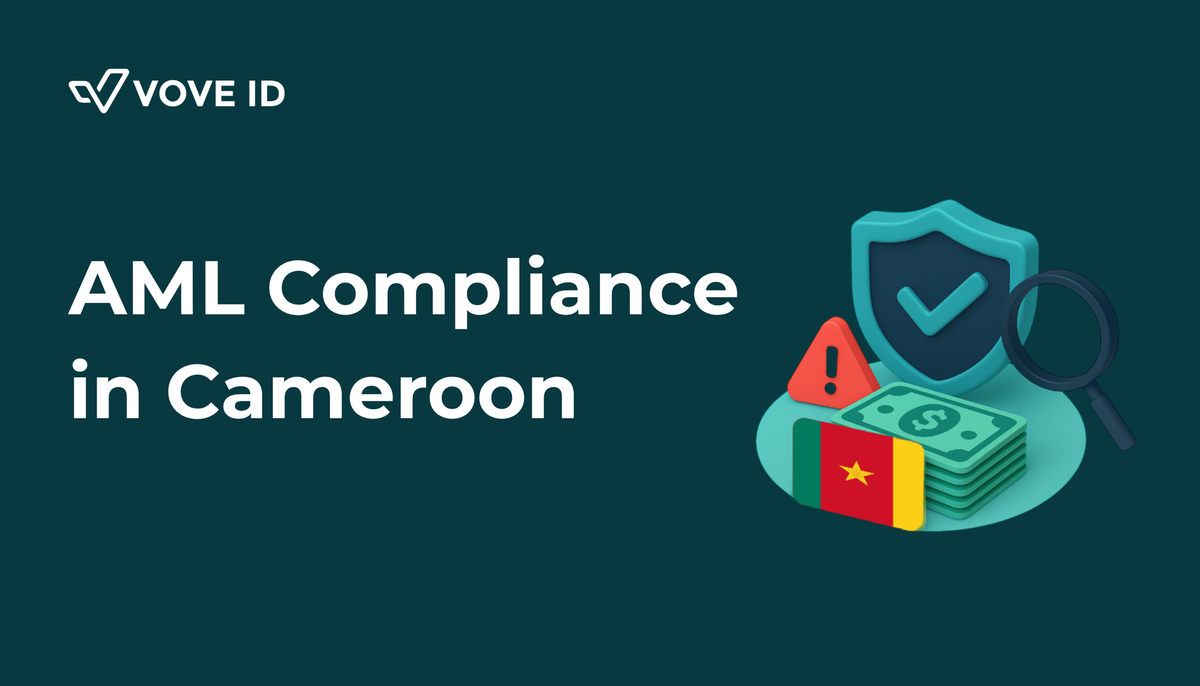
Cameroon is the economic engine of the CEMAC region, and that comes with a dual reality: fast fintech growth and a live FATF grey-list status. Mobile money usage keeps rising, per BEAC, bringing millions into the formal economy while widening the surface area for illicit flows. VOVE ID helps fintech founders and banks in Cameroon turn that regulatory pressure into a working compliance program rather than a liability.
This guide covers AML obligations for regulated entities in Cameroon. For the underlying compliance framework, see our AML Requirements Explained 2026.
Cameroon's AML Regulatory Framework: Regional Power, National Execution
Cameroon's AML system reflects its CEMAC membership — regional rules enforced through national supervision.
Regional backbone: CEMAC Regulation No. 02/24 (20 December 2024) is the current AML/CFT/CPF regulation for all CEMAC member states, having replaced the earlier 2016 regulation. It sets risk-based CDD, suspicious transaction reporting obligations, a 10-year record-retention period, and mandatory PEP and sanctions screening.
National implementation:
- ANIF (Agence Nationale d'Investigation Financière): Cameroon's Financial Intelligence Unit, receiving and analyzing suspicious transaction reports.
- COBAC (Commission Bancaire de l'Afrique Centrale): the regional banking commission, supervising banks and payment institutions and enforcing compliance across CEMAC, with authority to sanction or revoke licenses.
- BEAC (Banque Centrale des États de l'Afrique Centrale): sets payment-service rules, including Regulation No. 04/18.
- Law No. 2024/017 (23 December 2024): Cameroon's current personal data protection law — its 18-month transition period expired in June 2026, so full compliance now applies, including prior-authorization requirements for biometric data processing.
For customer due diligence requirements for individuals, see our KYC guide for Cameroon. For business verification and beneficial ownership requirements, see our KYB guide for Cameroon.
Cameroon and the FATF Grey List
Cameroon remains under FATF increased monitoring — the "grey list" — as of the 19 June 2026 FATF statement. GABAC's 2022 mutual evaluation (Central Africa's FATF-style regional body) rated the country partially compliant on several recommendations, with a follow-up review noting continued progress on inter-agency coordination through ANIF alongside persistent gaps in DNFBP supervision and beneficial-ownership transparency. FATF's current action plan for Cameroon specifically calls for timely access to adequate, up-to-date beneficial-ownership information — a signal that a registry search alone doesn't complete KYB here.
Core AML Obligations
AML obligations apply broadly to banks, fintechs, microfinance institutions, forex bureaus, and DNFBPs (lawyers, accountants, real-estate agents, casinos, precious-metals dealers).
- Customer Due Diligence (CDD): verify identity and beneficial ownership; apply enhanced measures for PEPs and high-risk customers.
- Beneficial-ownership threshold: natural persons holding, directly or indirectly, at least 20% of shares or voting rights, with a control-based and senior-management fallback where ownership can't be established.
- Suspicious Transaction Reporting: report to ANIF without delay once suspicion forms; a report made by phone or electronic means must be confirmed in writing within 48 hours — that confirmation window isn't itself the filing deadline.
- Record-keeping: CDD, relationship, and transaction records retained for at least 10 years.
- Risk-Based Approach: internal controls aligned with customer and product risk.
Cameroon-Specific AML Challenges
Cash-dominant economy: much of the economy remains cash-based, complicating traceability. Mobile money has expanded access but introduced new vulnerabilities, including transaction structuring and agent-level fraud.
Cross-border informality: trade corridors with Nigeria, Chad, and Gabon carry substantial informal flows, and weak oversight of remittances complicates control of trade-based money laundering.
PEP exposure: significant public-sector spending and state-owned enterprises raise exposure to politically exposed persons, requiring enhanced due diligence and continuous monitoring.
How VOVE ID Supports AML Compliance in Cameroon
VOVE ID helps fintechs and financial institutions build compliance programs that meet ANIF and COBAC expectations:
- Document and biometric verification for fast, structured eKYC onboarding.
- Automated sanctions and PEP screening against global and regional watchlists.
- Audit-ready recordkeeping for full traceability.
- Structured STR workflows aligned with ANIF reporting expectations.
For the complete, sourced requirement-by-requirement checklist, see VOVE ID's Cameroon compliance checklist.
Conclusion
Cameroon's AML reforms reflect a country modernizing under real FATF pressure, not just ticking boxes. For fintechs and financial institutions, the practical requirement while that grey-list status is active is a compliance program that can demonstrate — not just claim — active transaction monitoring and defensible beneficial-ownership evidence.
Cameroon's grey-list status means examiners are checking evidence, not policies on paper. VOVE ID helps fintechs build the audit-ready CDD, screening, and recordkeeping that ANIF and COBAC reviews actually look for.
This article is intended for general informational purposes only and does not constitute legal, financial, or regulatory advice. KYC/KYB/AML requirements may vary depending on jurisdiction, industry, and specific business circumstances. For up-to-date and binding compliance obligations, readers should refer to the relevant regulatory authorities or consult qualified professionals.