Data Residency for KYC: Where Users’ Biometric Data Lives
A hosting label doesn't answer a residency question. Here's the data flow compliance teams need before they can trust it.
Biometric data turns a hosting choice into a documented compliance decision. Teams need to trace where data travels, who can access it, and what proves the answer.
Verification workflows built with VOVE ID are meant to make the handling of sensitive data a defined control, not an assumption. For biometric data, an answer such as "it is in the cloud" leaves out the locations, processors, transfers, backups, and access paths that a compliance team needs to understand.
A hosting label and a governance answer are not the same thing, and the gap between them is exactly where reviews stall.
Data residency: location is only the first question
Data residency asks where a system stores or processes data. For a KYC workflow, the answer can involve more than the application database. It can include capture services, document storage, review tools, audit logs, backups, support access, and contracted subprocessors.
Data localization is a different question. A law or contract can require data to remain in a particular jurisdiction. Teams should not treat a general statement about a provider's primary region as proof that every processing activity meets that requirement.
This means one thing: the relevant answer is a documented data flow for the specific service, customer configuration, and jurisdiction.
Biometric data: the sensitivity raises the review standard
A selfie or facial template can be personal data, and its legal treatment depends on what the system does with it and the law that applies. Under the GDPR, biometric data used to uniquely identify a person falls within special-category data, subject to the conditions in Article 9. The European Commission also describes data minimization and storage limitation as core principles: collect only what is necessary and keep it only as long as needed.
That does not produce a universal retention period or residency rule. It does mean teams must connect the intended verification purpose to the data they collect, the parties that process it, and the period they can justify.
For the underlying identity-verification framework, see our KYC requirements guide.
A realistic launch review: when "EU-hosted" is not enough
A payments platform plans to onboard customers in the European Economic Area. Its procurement file says the chosen verification service is "EU-hosted."
- The mobile capture starts in the applicant's device.
- The identity evidence enters a verification service.
- A reviewer may open a case from another location.
- Backups and support records follow separate operational paths.
Then the questions appear. Which specific data categories enter each path? Which entity acts as controller or processor? Are support and backup locations included in the answer? What transfer mechanism applies if a path leaves the expected region?
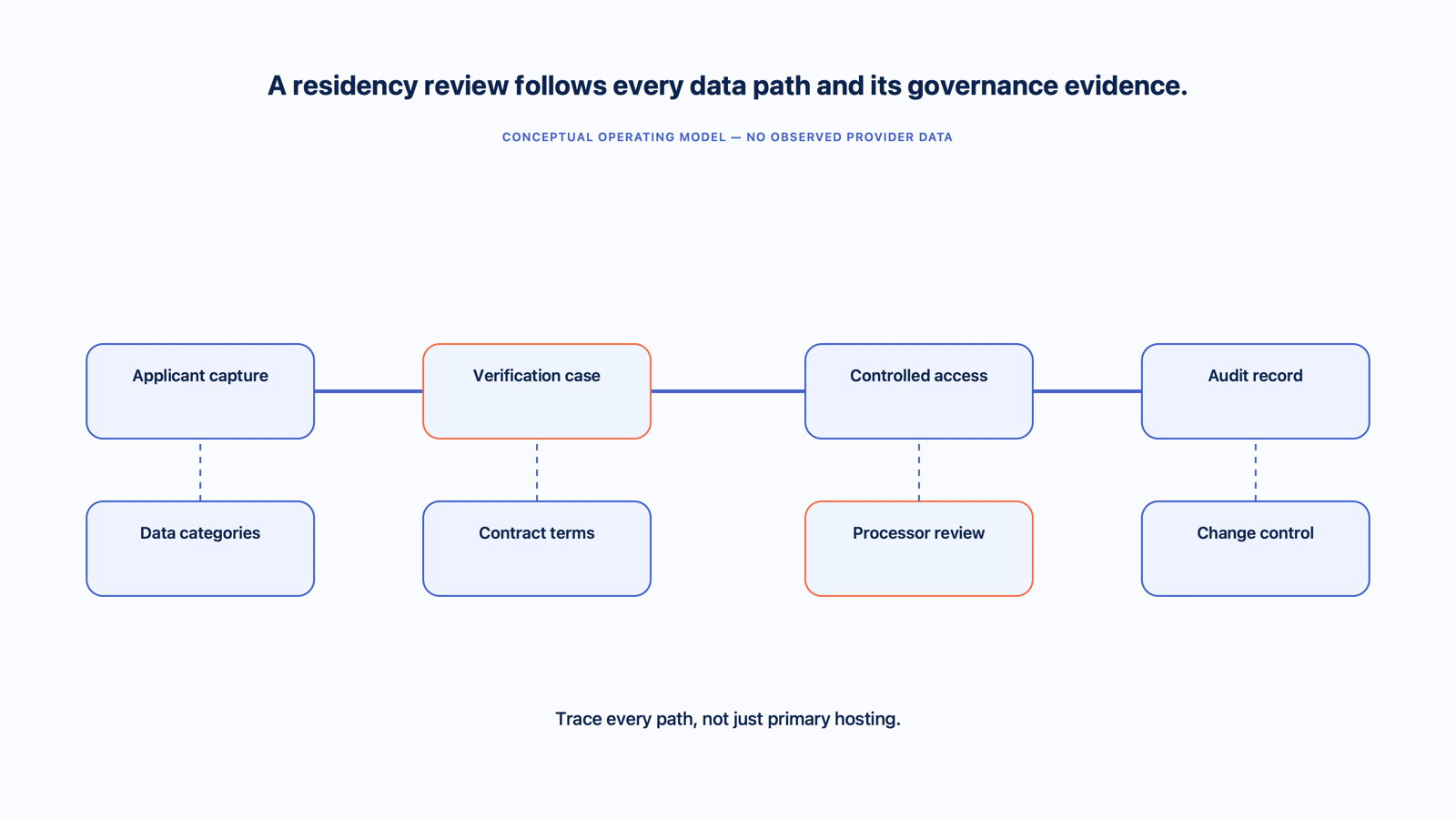
The platform cannot close the review with a hosting label. It needs an evidence pack that maps the full processing chain and identifies the contract terms that govern it.
This is not a cloud-region question. It is an accountability question.
Make the data path reviewable before launch
Start with data categories, not vendor terminology. Separate identity-document images, selfie or liveness captures, facial-comparison outputs, account details, decision records, and audit logs. A single label such as "biometric data" can hide material differences in how a workflow treats each category.
Then map every system that receives or can access those categories. Include production environments, testing controls, manual-review access, monitoring, support, backups, and incident-response procedures. Ask for the answer in a form that a privacy lead can compare with the data-processing agreement and internal records.
Finally, define what changes need review. A new subprocessor, a support-access change, an expanded use case, or a new market can alter the original data-flow answer.
How VOVE ID fits: establish the evidence before making a claim
Evaluating VOVE ID for this use case means asking the same operational questions a team would ask any identity-verification provider: which personal-data categories are processed, where they are processed, which subprocessors participate, and what written terms apply to the customer's use case.
Those answers require current product and legal confirmation. This review-only draft does not state that a particular residency setting, retention period, backup location, or transfer arrangement is available.
The useful outcome is a clear decision record: the compliance team knows which claim it can make, what evidence supports it, and when it must be revisited.
Practical data-residency checklist
Data inventory
- List identity, biometric, decision, and audit data separately.
- Record the lawful purpose for every data category.
- Identify which data fields are necessary for each verification step.
Processing map
- Map capture, processing, review, logging, support, and backup paths.
- Identify each controller, processor, and approved subprocessor.
- Check whether any access or transfer crosses the required jurisdiction.
Evidence and change control
- Obtain current contractual and technical documentation for the use case.
- Keep the data-flow record with the privacy and security review.
- Reassess the record when vendors, regions, or workflows change.
FAQ
Is data residency the same as data localization?
No. Residency describes where data is stored or processed. Localization usually describes a legal or contractual requirement to keep data in a particular place.
Does EU hosting automatically meet every biometric-data requirement?
No. Teams still need to assess the data categories, access paths, processors, transfers, lawful basis, and retention rules that apply to their own service.
What evidence should a KYC buyer request?
Request a current data-flow description, processor and subprocessor information, applicable contractual terms, and a clear explanation of the specific customer configuration.
Who owns the final residency decision?
The decision normally involves privacy, security, compliance, procurement, and legal owners. A technical team can map systems, but it should not make a legal conclusion alone.
Conclusion
Data residency for KYC is not a location label. It is a record of where sensitive evidence goes, who handles it, and which safeguards apply along the way.
Teams need an answer they can inspect, contract for, and update when the workflow changes. Collection, processing, access, and audit are one data-governance system.
Ready to map the data-flow evidence your compliance team can actually sign off on?
This review-only draft is intended for general informational purposes and does not constitute legal, financial, or regulatory advice. Biometric-data and KYC requirements vary by jurisdiction, use case, and customer configuration.