The Right to Erasure and KYC: Deleting Biometric Data Without Breaking the Audit Trail
Deleting biometric KYC data on request looks simple until backups and audit logs get involved. Here is the actual decision process
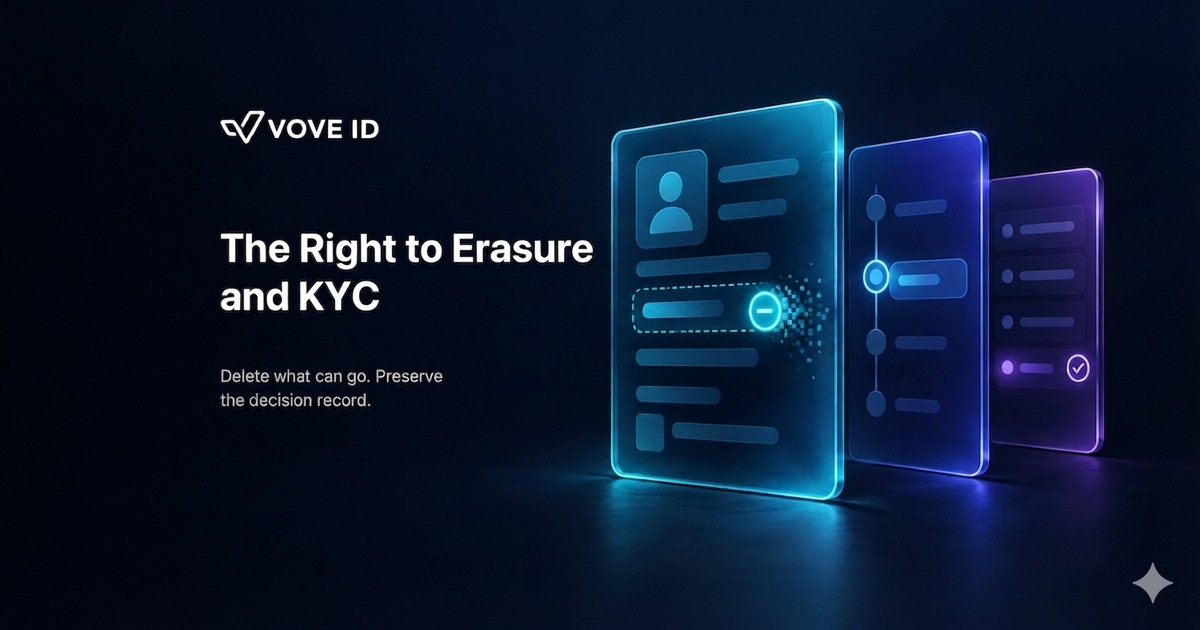
An erasure request is a decision process, not a delete button. Teams need to separate data that can be erased from evidence they must retain and explain why.
VOVE ID helps regulated teams design identity-verification workflows where sensitive evidence has a defined purpose, owner, and review path. A request to erase biometric or identity data can touch capture records, verification outputs, case notes, audit logs, backups, and records held by other parties.
This is exactly where a privacy request can expose an incomplete operating model.
The right to erasure: it is conditional, not automatic
Article 17 of the GDPR gives people a right to seek erasure without undue delay when a stated ground applies, including when data is no longer necessary for its purpose or when consent is withdrawn and no other legal ground remains. The same Article also sets out exceptions, including where processing is necessary for compliance with a legal obligation or for the establishment, exercise, or defence of legal claims.
That distinction matters in KYC. A team cannot decide a request from the word "biometric" alone. It needs to identify the relevant data, purpose, legal basis, retention obligation, and the roles of every party in the workflow.
This means one thing: a lawful erasure outcome starts with a documented decision, not a blanket deletion rule.
For the underlying identity-verification framework, see our KYC requirements guide.
Separate the evidence before deciding what changes
An identity-verification case can contain several kinds of records. Document images, selfie or liveness captures, face-comparison outputs, account information, reviewer notes, decision records, and audit events do not necessarily have the same purpose or retention logic.
The GDPR's storage-limitation principle requires personal data to be kept no longer than necessary for the purpose for which it is processed. That does not supply a universal KYC retention period. Teams still need to apply the rules that govern their regulated activity, customer relationship, and jurisdiction.
The practical question is not "can the case be deleted?" It is "which elements can be erased, restricted, retained, or separated, and which written rule supports each result?"
A realistic deletion request: when one case has several owners
A regulated payments platform receives an erasure request from a former applicant whose onboarding case included an ID image, a liveness capture, a reviewer note, and a final decision.
- Privacy receives the request from the individual.
- Compliance identifies an applicable record-retention obligation.
- Operations needs to know which systems and vendors hold case data.
- Security needs to ensure the request is traceable without reproducing the sensitive evidence.
Then the ambiguity appears. The platform knows an identity case exists, but it cannot immediately distinguish the raw capture from the decision evidence, identify downstream recipients, or explain what its backup process does with a deleted production record.
The team should not improvise. It needs a controlled assessment, an approved exception where one applies, and a record of the response.
This is not a deletion-ticket problem. It is an evidence-governance problem.
Build an erasure workflow that preserves accountability
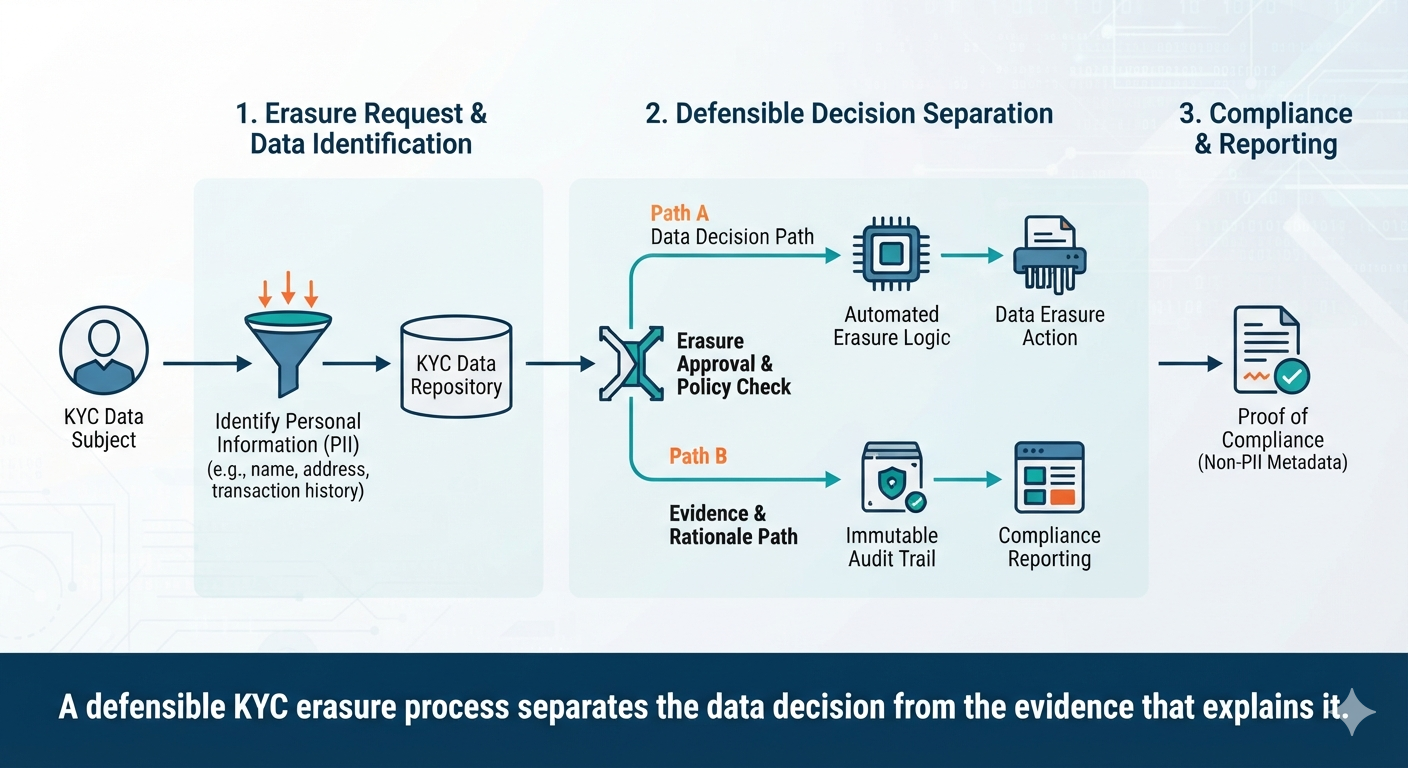
Start by authenticating and logging the request through a defined privacy process. The request should link to the correct person and case without creating a new uncontrolled copy of their sensitive data.
Next, classify each data category against the applicable purpose and rule. A privacy lead, compliance owner, security owner, and legal reviewer may need to decide whether data is erased, retained under a documented obligation, restricted, or referred to another controller or processor.
Article 19 also requires a controller that has carried out erasure or restriction to communicate that action to recipients of the personal data unless doing so is impossible or disproportionate. That makes the downstream data map part of the operating workflow, not a procurement attachment.
How VOVE ID fits: confirm the data lifecycle before making a promise
Teams evaluating VOVE ID should ask for current, use-case-specific information before making a privacy or retention commitment. The review should cover data categories, controller and processor roles, approved retention and erasure terms, relevant subprocessors, backup treatment, and the evidence available for audit.
Teams should confirm current, use-case-specific product and legal terms before making commitments about deletion, retention, backups, or biometric-data handling.
The desired outcome is clear accountability. Teams can respond to a request in a way that protects the individual's rights while preserving only the evidence they are permitted or required to retain.
Practical KYC erasure checklist
Request assessment
- Authenticate the requester and connect the request to the correct case.
- Identify the relevant data categories and processing purposes.
- Record the legal basis and any applicable retention or exception analysis.
Decision and execution
- Define the scoped outcome for each data category.
- Route uncertain cases to privacy, compliance, security, and legal owners.
- Notify downstream recipients where the applicable rule requires it.
Accountability
- Preserve a minimal decision record without reproducing unnecessary sensitive data.
- Reconcile the production result with approved backup and recovery procedures.
- Review the workflow when vendors, purposes, or regulatory obligations change.
FAQ
Does a KYC erasure request always require deleting every record?
No. The right to erasure is conditional. Teams need to assess the relevant ground, any other lawful basis, and applicable exceptions or retention obligations for the specific data and jurisdiction.
Is biometric data handled as one single record type?
No. A KYC workflow can contain raw capture material, verification outputs, decision records, and audit evidence. Teams should classify them separately before deciding an outcome.
Can an audit trail remain after erasure?
The answer depends on the applicable legal and retention rules. A team should document why a limited record remains, minimize what it contains, and confirm the decision with the appropriate owners.
What should a buyer ask a KYC provider about erasure?
Ask for current contractual and technical information about data categories, roles, retention, deletion, backup treatment, subprocessors, request handling, and the evidence available for review.
Conclusion
The right to erasure in KYC is not a request to forget how a case was handled. It is a controlled decision about what personal data remains necessary and what must change.
Teams need to map the evidence, apply the applicable rules, and retain only the accountability record that the rule permits or requires — that record is what turns a privacy request into a defensible outcome.
Want to discuss the information needed to assess a VOVE ID identity and compliance workflow for your use case?
This article is intended for general informational purposes and does not constitute legal, financial, or regulatory advice. KYC, biometric-data, retention, and erasure requirements vary by jurisdiction, use case, and customer configuration.