
Rate Limits and Batch Processing: Designing for High-Volume KYC Uploads
More requests won't fix high-volume KYC. A case-level control loop for demand, retries, and review will.
High-volume KYC is not solved by sending more requests. It is solved by making demand, capacity, retries, and review ownership visible before traffic arrives.
An identity and compliance workflow built on VOVE ID has to keep a clear case record even as volume grows. High upload volume creates an engineering problem and a compliance problem at the same time: a team needs to control demand without losing track of which identity case needs evidence, recovery, or review.
Most integrations don't break at peak traffic itself — they break at the point where a batch summary stops being able to answer for an individual case.
Rate limits: a capacity control, not a publishing detail
A rate limit sets a boundary on how often a caller can request an operation over a defined period. It protects shared resources, but it also gives an integration a known condition to handle rather than an unexplained failure.
The OWASP API Security Top 10 identifies unrestricted resource consumption as an API risk. It calls out limits on request frequency, upload size, records returned, and operations per request as controls that need explicit design.
On paper, a KYC request is one unit of work. In practice, an upload can create several demands: file transfer, document analysis, identity evidence, decision routing, webhooks, and a possible manual-review queue.
For the underlying identity-verification framework, see our KYC requirements guide.
Batch processing: grouping work does not remove the limit
Batching groups multiple operations into one submission. That can reduce connection overhead or make a customer's upload workflow easier to manage. It does not make each underlying operation free, immediate, or safe to retry without context.
Teams need to define what a batch means in their own system. Is it an asynchronous manifest of cases? A file with many records? A queue of individual jobs? The answer determines how the platform validates input, reports failures, isolates bad records, and maintains a case-level audit trail.
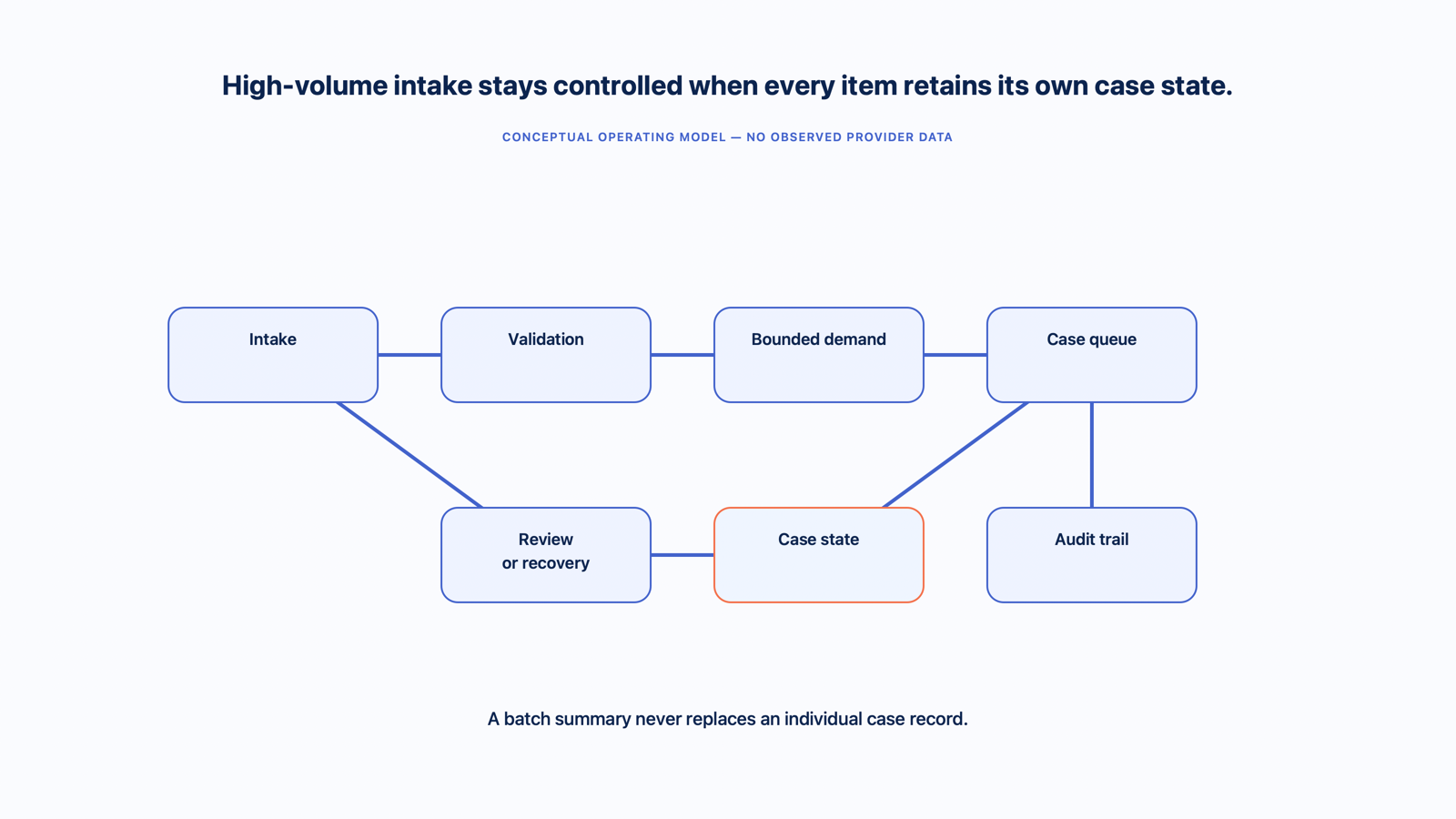
That means one thing: batch design must preserve the identity of every item inside the group.
A realistic upload surge: when the payroll file arrives at once
A payroll fintech receives a partner file containing thousands of new-worker onboarding records before a scheduled payout run.
- The partner submits many document images within a short period.
- Some files exceed the expected size or arrive incomplete.
- Several records need correction after submission.
- Operations needs to know which worker can proceed and which worker needs a new capture.
Then the failure becomes visible. The team sees timeouts and retries, but its dashboard only shows a broad batch failure. It cannot confidently identify which cases were accepted, which need recovery, and which have reached review.
This is not only a throughput problem. It is a case-accountability problem.
Design the control loop before the volume arrives
Start with an explicit workload model. Estimate the number of new cases, the largest file a user can submit, the peak window, the expected retry behavior, and the operations team's review capacity. Treat those as planning assumptions, not as provider limits.
Next, design a per-case state model. A case should move through explicit states such as received, validated, submitted, awaiting evidence, ready for review, and resolved. A batch can report an overall summary, but each item needs its own outcome and correlation identifier in the customer's system.
Then define the response to a boundary. When an upstream limit, timeout, or temporary failure occurs, stop unbounded retries. Queue work, apply a documented backoff policy, surface a clear status to operations, and keep the original evidence associated with the correct case.
How VOVE ID fits: confirm the operating boundary before launch
Before committing to a capacity plan, agree the expected demand profile with VOVE ID and request current, use-case-specific integration guidance. The relevant discussion includes data shape, file constraints, concurrency, callback handling, retry ownership, case recovery, manual-review needs, and operational escalation.
This review-only draft does not state a VOVE ID rate limit, batch endpoint, throughput level, queueing model, service level, or retry policy. Those details need product confirmation for the intended integration.
The key deliverable is an owned operating plan. Engineering knows how work enters the system, and compliance and operations can still explain the outcome of each individual case.
Practical high-volume KYC checklist
Demand model
- Estimate peak arrivals, file sizes, and time-critical onboarding windows.
- Separate normal traffic from planned migration or partner-upload events.
- Define the business impact when a case cannot complete immediately.
Integration control
- Validate files and required fields before submission.
- Track every case with a customer-owned correlation identifier.
- Queue and back off after temporary failures instead of retrying without bounds.
Operations and audit
- Show item-level outcomes inside every batch summary.
- Give reviewers a route to recover incomplete or corrected cases.
- Retain the evidence and event history needed to explain each decision.
FAQ
Are rate limits only a security feature?
No. They also make capacity expectations explicit. A well-designed integration handles a limit as a normal operating condition and gives cases a recoverable path.
Does batch processing guarantee faster KYC?
No. Batching changes how work enters a system. Actual timing depends on workload, validation, processing steps, provider behavior, and review requirements.
What should happen when a large KYC upload partially fails?
The customer system should preserve a per-case result. Teams need to know which cases succeeded, which did not, what evidence remains valid, and what action restores each failed case.
Should an integration retry every failed request?
No. A retry needs defined ownership, a bounded policy, and a case-level record. Repeating a request without those controls can create confusion and additional workload.
Conclusion
Rate limits and batch processing are not one performance setting. They are part of how a team protects capacity while preserving a reliable, explainable case path.
Teams should plan for peaks, record each item's status, and give operations a recovery route before volume turns routine integration behavior into a risk. Demand control, case management, and auditability are one operating system.
Planning an onboarding flow that needs to hold up at volume?
This review-only draft is intended for general informational purposes. It does not state VOVE ID capacity, batch, rate-limit, retry, or performance commitments, and is not legal, financial, or regulatory advice.