AML Compliance in Ethiopia: A Guide for Fintechs and Regulated Businesses
Ethiopia's STR deadline is 24 hours and records must be kept for a decade — among the strictest combinations in the region.
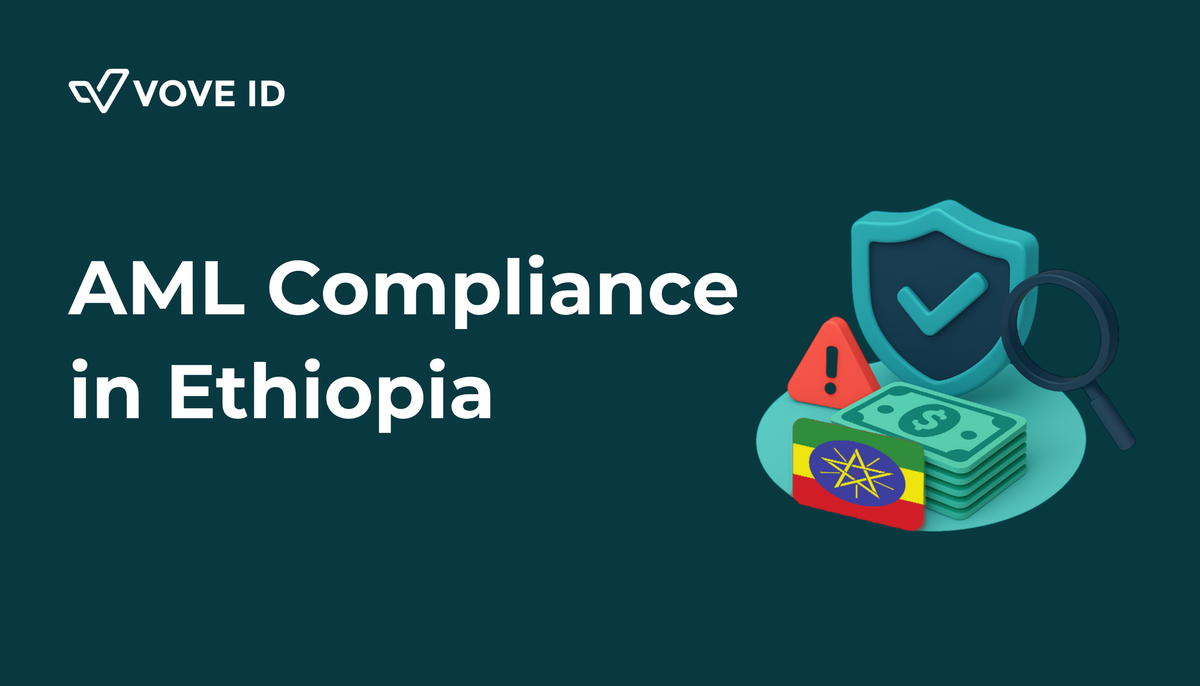
Ethiopia's financial sector has grown fast on the back of mobile money and digital payments, and its AML/CFT framework has grown correspondingly detailed. VOVE ID helps fintechs, banks, and regulated businesses build compliance into onboarding and monitoring rather than bolting it on afterward.
This guide covers Ethiopia's AML framework. For the underlying concepts, see our AML requirements explained.
Legal and Institutional Framework
Proclamation No. 780/2013 — the Prevention and Suppression of Money Laundering and Financing of Terrorism Proclamation — is Ethiopia's core AML/CFT statute, implemented in operational detail by the Financial Intelligence Service (FIS) through AML/CFT CDD Directive No. 01/2014. The National Bank of Ethiopia (NBE) supervises banks, microfinance institutions, and payment businesses, while the Ethiopian Communications Authority administers the newer personal-data framework.
As a member of ESAAMLG and the Egmont Group, Ethiopia's framework is also measured against regional and international AML/CFT expectations.
Core AML Requirements
Customer due diligence. Identify and independently verify each customer and representative, applying CDD at relationship formation and at defined transaction triggers regardless of whether the relationship exists yet.
Cash and wire thresholds. CDD applies to occasional cash transactions exceeding ETB 300,000 or USD 15,000, including linked transactions. Wire transfers at or above ETB 20,000 or USD 1,000 require originator and beneficiary information and verification.
Beneficial ownership. Build the ownership and control chain through every layer of a legal entity, identifying natural persons with controlling ownership or control by other means — a senior-manager fallback applies only where neither test resolves it, and only with the reasoning documented.
PEP controls. Every identified PEP relationship requires senior-management approval, source-of-wealth and source-of-funds analysis, and enhanced ongoing monitoring — these controls aren't optional based on an otherwise-low internal risk score.
Suspicious transaction reporting. File an STR no later than 24 hours after suspicion is formed, through the FIS-prescribed channel. Internal review can't be allowed to delay that deadline — it's one of the tighter STR windows in the region.
Cash transaction reporting. Report cash transactions above ETB 300,000 or USD 15,000 through the prescribed FIS process, aggregating linked activity. Cash reporting doesn't substitute for suspicious-activity analysis on the same transaction.
Record retention. Keep CDD, transaction, and correspondence records for at least 10 years — notably longer than the five-year standard common elsewhere in the region.
Targeted Financial Sanctions
Screen customers, beneficial owners, and transactions against applicable UN and domestic designations at onboarding, on list updates, and before relevant transactions. Proclamation No. 1132/2019 governs proliferation-financing freezing specifically — a match shouldn't be cleared just because the named customer differs from the designated person; ownership and control links need investigating first.
Payments and Foreign Exchange
Payment-system operation (switching, clearing, settlement) and payment-instrument issuance (wallets, e-money) are licensed separately under different NBE directives, and foreign-exchange activity runs under a fast-moving chain of amendments to Directive FXD/01/2024 — institutions need to track the full amendment chain, not just the original 2024 baseline, since several rounds of changes through 2026 have adjusted account, payment, and trade-finance rules.
FATF Status
Ethiopia is not currently under FATF increased monitoring; it exited the grey list in October 2019 after a prior period of enhanced scrutiny.
For the complete source-linked implementation checklist — all 11 control areas and 48 evidence prompts — see VOVE ID's Ethiopia compliance checklist.
Final Thoughts
Ethiopia's AML regime combines a tight 24-hour STR deadline with an unusually long 10-year retention requirement — both worth building into monitoring and case-management workflows deliberately rather than assuming a generic regional template covers them.
VOVE ID supports identity verification, beneficial-ownership checks, and sanctions screening as part of one connected workflow.
This article is intended for general informational purposes only and does not constitute legal, financial, or regulatory advice. AML requirements may vary depending on jurisdiction, activity, and licensing status. For binding compliance obligations, consult the relevant regulator or a qualified professional.