AML Compliance in Namibia: 2026 Guide for Fintechs and Regulated Businesses
Namibia's AML framework is under FATF scrutiny after its February 2024 grey listing. This guide covers the FIC, FIA obligations, STR requirements, and what compliance looks like in 2026.
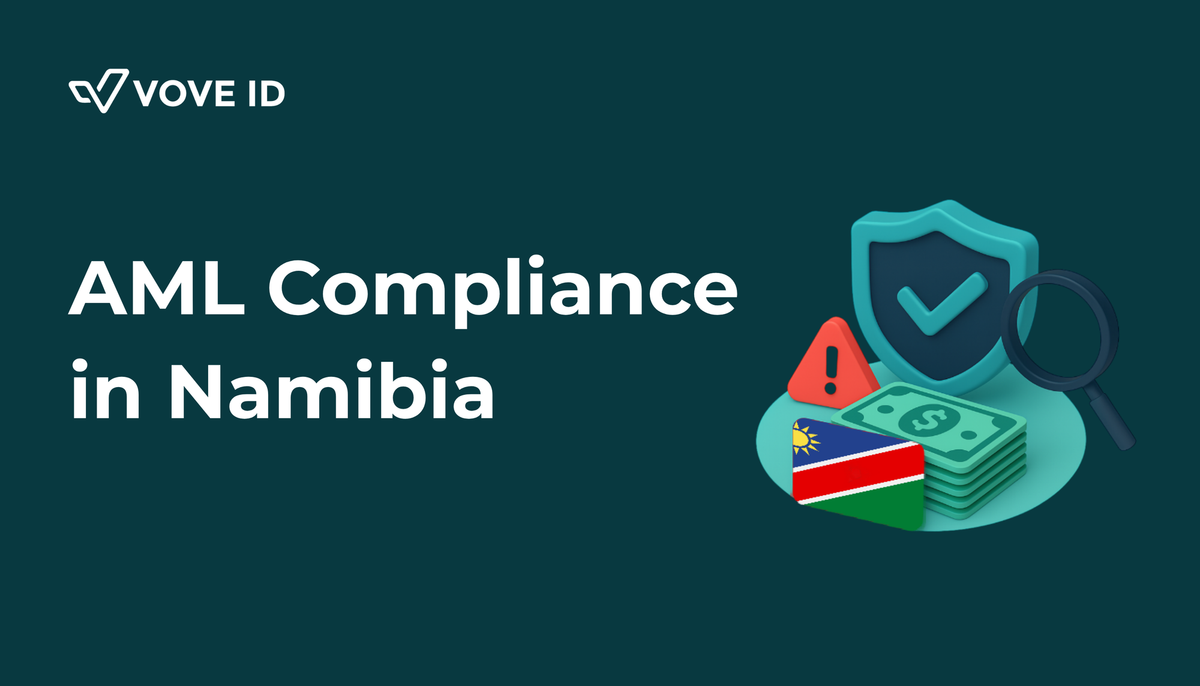
When FATF grey-listed Namibia in February 2024, it was not because the country lacked AML legislation. The Financial Intelligence Act, No. 13 of 2012 had been on the books for over a decade. The problem was effectiveness — deficiencies in suspicious transaction reporting rates, political will around PEP oversight, enforcement outcomes, and the operational capacity of the financial intelligence unit. By 2026, Namibia has moved fast to address these gaps, with FATF commending the reforms as a model at its February 2026 Plenary. But the grey list has not yet been formally lifted, and EU-regulated institutions continue to apply enhanced due diligence. For any regulated business with Namibian exposure, knowing what the AML framework actually requires — and where enforcement is now focused — matters more than it did two years ago. VOVE ID supports compliance programmes operating in grey-listed and high-scrutiny jurisdictions, including Namibia.
This guide covers AML-specific requirements in Namibia. For the underlying AML compliance framework, see our AML Requirements Explained: 2026 — Compliance Operating System for Regulated Financial Institutions.
The Legislative Framework
Namibia's AML/CFT/CPF framework rests on three primary instruments:
Financial Intelligence Act, No. 13 of 2012 (FIA) — the core AML statute. It establishes the Financial Intelligence Centre (FIC) as Namibia's financial intelligence unit, defines accountable and reporting institutions, sets out CDD obligations, requires STR and CTR filing, and mandates record-keeping. The FIA has been supplemented by regulations, determinations, and guidance notes issued by the FIC over subsequent years.
Prevention and Combating of Terrorist and Proliferation Activities Act, No. 4 of 2014 (PCTPA), as amended by Act 8 of 2023 — governs CFT and CPF obligations, including targeted financial sanctions and the freezing of assets linked to UN Security Council-designated individuals and entities.
Companies Act (as amended) — the 2023 amendment introducing section 122A mandates beneficial ownership disclosure to BIPA, a directly AML-relevant measure addressing one of FATF's specific findings on BO transparency.
Regulators and Supervisory Architecture
Financial Intelligence Centre (FIC) is Namibia's FIU and primary AML supervisor for banks, money services businesses, real estate agents, legal practitioners, accountants, and dealers in high-value goods and precious metals. The FIC receives STRs and SARs, issues guidance notes and circulars, conducts on-site and off-site supervisory inspections, and refers cases to law enforcement and prosecutors.
NAMFISA is the designated AML/CFT/CPF supervisory authority for accountable and reporting institutions within its regulated sectors: capital markets, collective investment schemes, micro-lenders, and insurers. NAMFISA conducts AML supervision under section 35 of the FIA and enforces FIA obligations alongside its own sector-specific powers. The NAMFISA Act, 2021 and Financial Institutions and Markets Act, 2021, launched in May 2026, expand this supervisory architecture.
Bank of Namibia (BoN) supervises commercial banks and payment service providers. BoN is the primary prudential supervisor for the banking sector and works alongside the FIC on AML enforcement in that space.
Suspicious Transaction Reporting
Under the FIA, accountable institutions must file a Suspicious Transaction Report (STR) with the FIC when they know, suspect, or have reasonable grounds to suspect that a transaction involves the proceeds of crime, is related to terrorist financing or proliferation financing, or forms part of a pattern of unusual behaviour.
There is no monetary threshold for STR filing. The obligation is triggered by suspicion, not transaction size.
The FIC also receives Suspicious Activity Reports (SARs) covering broader suspicious behaviour patterns that may not centre on a specific transaction.
STR under-filing was one of the explicit deficiencies identified in Namibia's 2022 FATF Mutual Evaluation. Since grey listing, the FIC has significantly increased supervisory focus on STR rates — including through outreach, training, and on-site inspections. This is an active enforcement priority in 2026.
Cash Threshold Reporting
Accountable institutions must report cash transactions that exceed the applicable identification threshold to the FIC. Following the October 2024 update:
- The identification and reporting threshold for most sectors is N$10,000 (raised from N$5,000, effective 1 October 2024, Government Gazette 27 September 2024).
- The threshold for casinos and gambling institutions remains at N$25,000.
- Related transactions must be aggregated — structuring to avoid the threshold is explicitly addressed in FIC guidance.
Record-Keeping Requirements
All records related to customer identification, transactions, and submitted STRs must be retained for a minimum of five years from the date the transaction was concluded or the business relationship ended. This applies to both the underlying CDD documents and the transaction records themselves.
Targeted Financial Sanctions
Under the PCTPA framework, all accountable institutions must screen customers against the UN Security Council consolidated sanctions list and implement asset freezes without delay where matches are identified. This obligation — along with the broader implementation of targeted financial sanctions (TFS) related to terrorism financing and proliferation financing — was one of the areas explicitly cited by FATF as deficient in its 2022 Mutual Evaluation and subsequently flagged in the grey list action plan.
NAMFISA provides guidance to its supervised entities on TFS obligations, and the FIC issues circulars on UN Security Council updates.
For a full breakdown of sanctions screening frameworks and transaction monitoring obligations, see our AML Requirements Explained: 2026.
FATF Status and the Grey List in Detail
Namibia's FATF journey in this period:
January 2023 — FATF published the Mutual Evaluation Report, identifying deficiencies in terrorism finance oversight, TFS implementation, STR filing, PEP transparency, correspondent banking risk, FIU effectiveness, and beneficial ownership of companies and trusts.
February 2024 — FATF placed Namibia under increased monitoring (grey list) at its Plenary in Paris. Namibia committed to a 13-point action plan.
June 2024 — FATF published its action plan requirements. Key items included strengthening risk-based AML/CFT supervision, increasing UBO filings, improving FIU-law enforcement cooperation, and improving ML investigation and prosecution capabilities.
June 2025 — The European Commission added Namibia to its list of high-risk jurisdictions for AML/CFT, a procedural consequence of the FATF listing. EU-regulated institutions are now required to apply enhanced due diligence to transactions involving Namibia.
October 2025 — FATF noted that Namibia had taken steps including applying effective sanctions for AML/CFT breaches and improving FIU-law enforcement cooperation, but indicated that demonstrating effective ML/TF investigation and prosecution capability remained outstanding.
February 2026 — At the FATF Plenary in Mexico, Namibia was commended for addressing all 13 deficiencies ahead of the May 2026 deadline. FATF described Namibia's reforms as a model for other countries in the grey listing process.
April 2026 — Onsite assessment by the Africa Joint Group (AJG) scheduled.
June 2026 — Results of the AJG onsite assessment to be presented at the next FATF Plenary; formal exit decision expected at this Plenary.
Until exit is confirmed, Namibia remains under increased monitoring. Regulated institutions with Namibia exposure should maintain EDD posture and documented compliance rationale.
Sector-Specific AML Risks
Namibia's 2023 National Risk Assessment Update and FATF's Mutual Evaluation identify several sectors with elevated ML/TF risk profiles:
Mining and extractives. Namibia is a significant producer of uranium, diamonds, and zinc, with emerging lithium and green hydrogen sectors. The extractives sector presents well-documented ML typologies: complex corporate structures, offshore payment flows, and opacity in royalty and licensing arrangements. Beneficial ownership of mining licence holders and their counterparties is a priority area for enhanced due diligence.
Real estate. Property transactions remain a classic vehicle for ML in Southern African jurisdictions. Namibia's real estate sector is an accountable institution under the FIA, with estate agents required to conduct CDD on buyers, sellers, and financing sources. Enforcement in this sector has historically been limited, and the FIC has flagged it as an area requiring improved supervisory attention.
Cross-border cash flows. Namibia is part of the Common Monetary Area (CMA) with South Africa, Lesotho, and Eswatini. From 30 September 2024, low-value electronic funds transfers between CMA countries are treated as cross-border transactions and subject to greater due diligence requirements under South Africa's FICA update — a change that directly affects Namibia-South Africa payment flows.
Mobile money and digital payments. Mobile penetration is high, and mobile money services represent a growing channel for financial transactions. The regulatory framework for non-bank payment providers requires NAMFISA licensing with explicit AML/KYC conditions.
Gambling. Casinos retain a N$25,000 identification threshold and are accountable institutions under the FIA, but have historically had variable compliance rates.
Enforcement and Penalties
The FIA establishes a graduated penalty structure. Key benchmarks:
- Penalties for FIA violations can reach up to N$100 million in fines, or 30 years imprisonment, or both.
- Failure to submit compliance reports to NAMFISA: up to N$10 million fine or 10 years imprisonment.
- Failure to submit BO information to BIPA: fines up to NAD 50,000 and potential deregistration.
The FIC's Appeals Board has been active, with 2025 decisions published on the FIC website. NAMFISA has also been enforcing against micro-lender and insurance sector entities for AML/CFT failures.
FIU Capacity and Cooperation
One of the central deficiencies identified by FATF in 2022 was the FIC's limited human and financial resources for operational and strategic analysis. Namibia's grey list action plan included a specific commitment to provide the FIU with adequate resources and training.
The EU-funded AML-CFT ESCAY Project delivered a technical assistance training workshop in July 2024, focused on financial intelligence analysis, ML/TF investigations, and asset tracing. EU technical experts have continued engagement with the FIC, Namibia Revenue Agency, Customs, and the Namibian Police throughout 2024-2025.
Improving operational cooperation between the FIC and law enforcement agencies — particularly the conversion of FIU intelligence into ML prosecutions — remains the key metric FATF will assess at the April 2026 onsite evaluation.
What Compliance Looks Like in 2026
For a regulated business with Namibian exposure, the compliance posture in 2026 should include:
A risk assessment that accounts for grey list status and sector-specific risks (mining, real estate, cross-border cash). An STR programme with clear escalation paths and documented suspicion-based triggers. Sanctions screening against UN, EU, OFAC, and other applicable lists at onboarding and on an ongoing basis. UBO verification for corporate counterparties that goes beyond BIPA filings alone, including biometric identity verification of beneficial owners. Record-keeping aligned to the five-year minimum retention requirement. EDD documentation for any relationship with Namibian counterparties, given the EU high-risk jurisdiction listing that remains in effect.
VOVE ID's sanctions screening capability covers UAE, UN, EU, OFAC, and other lists, with audit-ready logging built for regulatory review — relevant for any institution that needs to demonstrate its Namibia compliance programme to a regulator or correspondent bank.
The June 2026 FATF Plenary will be a turning point for Namibia — but compliance programmes don't wait for grey list exits to be stress-tested. If yours needs a second look before then, we're here.
This article is intended for general informational purposes only and does not constitute legal, financial, or regulatory advice. KYC/KYB/AML requirements may vary depending on jurisdiction, industry, and specific business circumstances. For up-to-date and binding compliance obligations, readers should refer to the relevant regulatory authorities or consult qualified professionals.