AML Compliance in Zambia, 2026: A Practical Guide for Fintechs and Regulated Businesses
Zambia isn't on the FATF grey list — but the FIC Act's beneficial-ownership test still catches more than a simple ownership percentage.
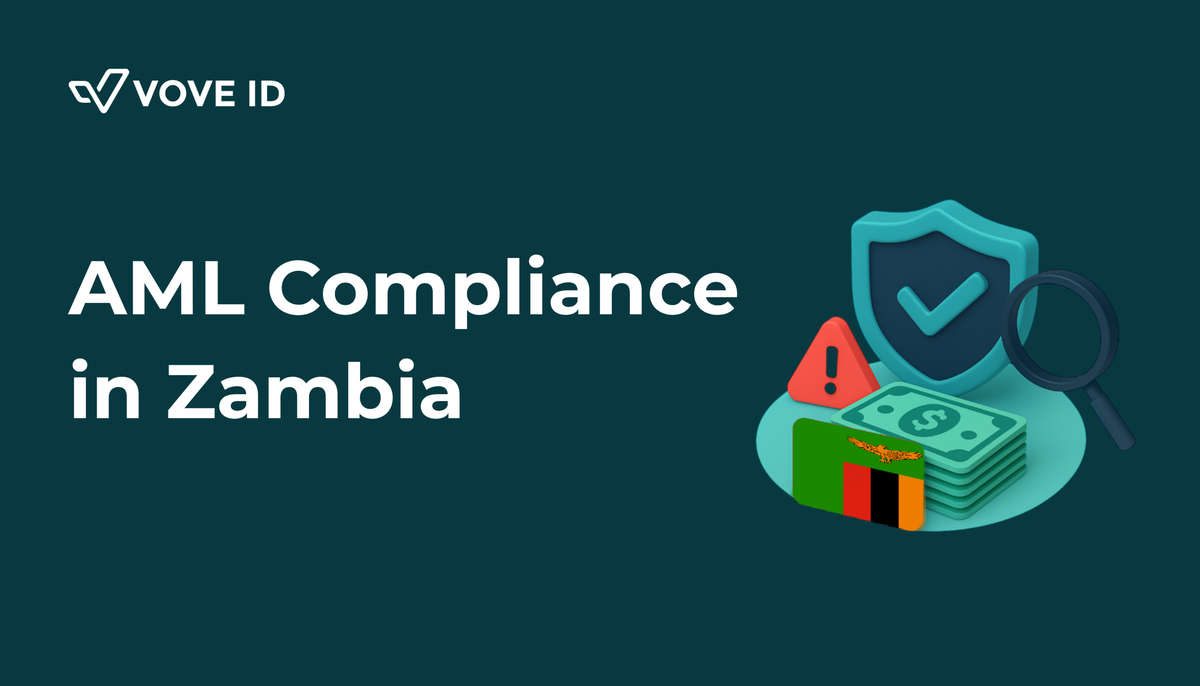
Zambia continues tightening AML and CFT oversight as regulators push for cleaner financial flows and sharper detection of high-risk activity. Fintechs, payment companies, mobile money operators, and virtual-asset businesses are expected to demonstrate real due diligence and structured reporting, not just a policy on paper. VOVE ID helps regulated businesses in Zambia build that compliance layer. This guide connects to our dedicated guides on KYC in Zambia and KYB in Zambia.
This guide covers AML obligations for regulated entities in Zambia. For the underlying compliance framework, see our AML Requirements Explained 2026.
Who Governs AML/CFT in Zambia
- Financial Intelligence Centre (FIC): the national FIU, receiving and analyzing suspicious transaction reports under the FIC Act No. 46 of 2010, as amended by Act No. 16 of 2020.
- Bank of Zambia (BoZ): supervises banks, payment service providers, mobile money operators, and virtual-asset businesses.
- PACRA (Patents and Companies Registration Agency): maintains company registration and beneficial-ownership records under the Companies Act No. 10 of 2017.
- Anti-Terrorism and Non-Proliferation Act No. 30 of 2024: the current legal basis for terrorism and proliferation-financing sanctions screening, alongside earlier anti-terrorism legislation.
For customer due diligence requirements for individuals, see our KYC guide for Zambia. For business verification and beneficial ownership requirements, see our KYB guide for Zambia.
Zambia and the FATF Grey List
Zambia is not listed in either of FATF's public statements issued on 19 June 2026 — neither "Jurisdictions under Increased Monitoring" nor "High-Risk Jurisdictions subject to a Call for Action." That's a clean position relative to several regional peers. Firms should still monitor every new FATF statement and apply risk-based controls to relevant geographies regardless.
What AML/CFT Requires in Practice
Customer Due Diligence (CDD):
- Verify natural-person identity through the NRC, passport, or accepted digital methods.
- Verify business registration, beneficial owners, and directors.
- Assess source of funds for higher-risk categories.
Beneficial ownership: Zambia's test isn't a fixed ownership percentage. A beneficial owner is a natural person who ultimately owns, controls, exercises substantial interest in, or receives substantial economic benefit from a company — assessed on control and influence, not a shareholding threshold alone.
Enhanced Due Diligence (EDD): required for PEPs, high-value transactions, cross-border virtual-asset flows, businesses with complex ownership, and high-risk industries.
Ongoing monitoring: automated transaction monitoring, sanctions screening, and review triggers for repeated high-risk behavior.
Suspicious Transaction Reporting: filed with the FIC within three working days of forming a suspicion. Currency transactions of USD 10,000 or more (including linked transactions) are reported through the prescribed FIC channel.
Record-keeping: CDD, account, correspondence, transaction, and analysis records retained for at least 10 years.
Operational Challenges
- Compliance capacity: many early-stage fintechs still operate with small compliance teams relative to growing regulatory expectations.
- Registry and identity data access: PACRA and national identity data access for verification purposes remains limited and often requires formal arrangements.
- Cross-border complexity: virtual-asset activity and remittances remain higher-scrutiny segments under FIC's VASP sector guidelines.
- De-risking pressure: businesses need to justify risk classifications with evidence, not blanket assumptions.
How VOVE ID Supports AML Compliance in Zambia
VOVE ID supports regulated businesses in Zambia with:
- NRC and passport verification.
- Biometric verification with liveness detection.
- Sanctions and PEP screening against global and local watchlists.
- KYB verification with beneficial-ownership mapping.
For the complete, sourced requirement-by-requirement checklist, see VOVE ID's Zambia compliance checklist.
Conclusion
AML rules in Zambia keep tightening, particularly for fintech and virtual-asset sectors, even without a FATF grey-list designation hanging over the market. Regulators expect real verification depth, working monitoring systems, and transparent reporting — not paperwork that only looks complete.
Zambia's beneficial-ownership test looks past shareholding percentages to real control and economic benefit — which means verification has to look past a registry extract too. VOVE ID helps fintechs build that deeper verification without slowing down onboarding.
This article is intended for general informational purposes only and does not constitute legal, financial, or regulatory advice. KYC/KYB/AML requirements may vary depending on jurisdiction, industry, and specific business circumstances. For up-to-date and binding compliance obligations, readers should refer to the relevant regulatory authorities or consult qualified professionals.