Audit Trails for AML: What FIs Actually Look for in a Compliance Review
A clean AML policy doesn't survive a partner-bank sample if the case file can't reproduce the decision behind it.
VOVE ID helps payments and BaaS teams build audit-ready records in markets where the home supervisor and partner bank expect the same evidence. On paper the policy is the control. In practice the audit trail shows whether the policy operated. This is exactly where a clean policy file meets an unanswerable case sample.
The short answer
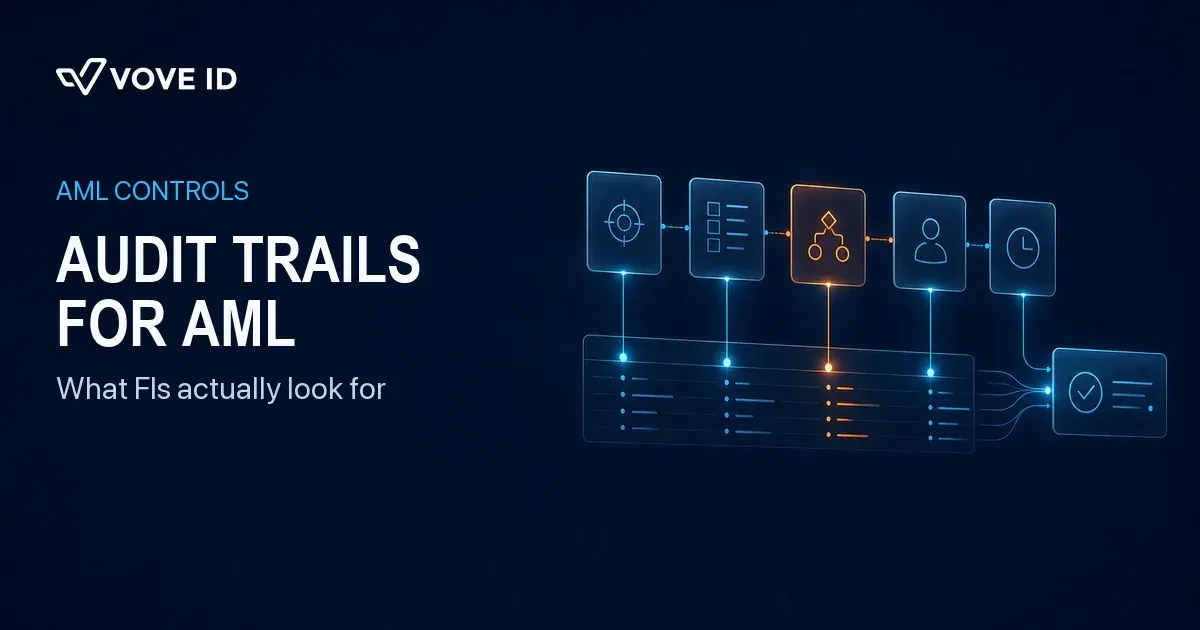
Financial institutions look for a reproducible decision chain, not a folder of screenshots. A strong trail links the alert or review trigger to source evidence, rationale, reviewer and approver, timestamps, resulting actions and later changes.
What inspectors and partner banks actually read first
A compliance review usually moves from design to operation. The reviewer reads the policy, selects a sample and asks the team to reconstruct what happened. If the sample cannot be reproduced, the policy has not proved the control.
The review often tests:
- whether the alert or review entered the right queue;
- whether the reviewer saw complete customer and transaction context;
- whether the rationale matches the policy and risk rating;
- whether escalation, approval and follow-up happened on time;
- whether later evidence reopened or changed the decision.
The current EU AML framework requires firms to retain customer due diligence and transaction records. The forthcoming EU AML Regulation, generally applicable from 10 July 2027, is more explicit: Article 77 requires records of the assessment of suspicious activity, including information considered, the result, and a copy of any report, plus supporting transaction evidence. It sets a five-year baseline retention period, subject to specified extensions and other applicable law.
The EBA's AML/CFT compliance-officer guidelines also place clear responsibility on the compliance function and management body. The trail is how that responsibility becomes visible at case level.
For a full breakdown of AML program obligations, see our AML Requirements Explained 2026.
The five fields that close most audit conversations
The best audit trail is not the longest. It is the one that makes the decision reproducible.
1. Trigger and scope
Record the rule, risk event, periodic review or manual referral that opened the case. Include the customer, accounts, transactions and time window in scope.
2. Evidence snapshot
Preserve the information available when the decision was made: identity and KYB data, screening results, transaction context, source documents and relevant external evidence. A live profile that changes later is not a historical snapshot.
3. Decision and rationale
Store the outcome and the reason separately. "False positive" is an outcome label, not a rationale. The note should explain which evidence cleared the match or why the activity remained suspicious.
4. Reviewer and approval
Attribute the decision to a named reviewer and record any escalation, second-line review or MLRO approval. Shared logins and generic queue ownership break accountability.
5. Time and resulting action
Record creation, assignment, review, escalation, closure and reopening timestamps. Link the decision to the action it created: customer outreach, enhanced due diligence, risk-rating change, reporting assessment, restriction or continued monitoring.
A reviewable AML case connects the trigger, evidence, rationale, owner and timing in one traceable chain.
A realistic audit failure: when 22% of alerts have no closure note
A Polish payment institution enters a partner-bank review. Its policy pack is current, approved and professionally formatted. The partner bank selects 50 closed alerts from the previous quarter.
The sample contains eleven alerts with no closure rationale, three reviewer accounts shared by an operations shift, screenshots with no capture timestamp, a customer risk change that does not link to the alert, and two cases closed after the service level with no exception approval.
The operations team can explain most decisions in a meeting. It cannot prove what the reviewer knew at the time or who made the final call.
The issue is not eleven missing sentences. It is a control-design failure: the system allowed closure without the evidence needed to defend closure.
How VOVE ID builds an audit trail FIs can review
VOVE ID keeps identity, KYB, screening and reviewer actions in an audit-ready record. Mandatory fields and time-stamped decision events make the case trail part of the workflow instead of a separate reporting task.
A reviewable operating model should:
- require a structured outcome and rationale before closure;
- retain the evidence version used for the decision;
- attribute review and approval to individual users;
- connect risk changes and customer actions to the originating case;
- log reopening, overrides and late completion;
- export a coherent case chronology for review.
No audit log can make a weak decision correct. It can make the weakness visible early enough to fix the control before a partner bank or inspector finds it.
Want to see how VOVE ID keeps AML evidence and reviewer decisions audit-ready? Most gaps surface the first time someone outside the original review tries to reproduce it.
Practical AML audit-trail checklist
Decisions
- Record the trigger, scope, outcome and policy basis.
- Require a specific rationale before every closure.
- Link resulting customer and risk actions to the case.
Reviewers
- Attribute every action to an individual account.
- Record escalation, approval and override ownership.
- Separate first-line review from required second-line approval.
Time
- Timestamp creation, assignment, evidence capture and closure.
- Flag overdue cases and preserve exception approvals.
- Retain reopening history instead of overwriting the first decision.
Q&A
Is a transaction-monitoring alert log enough for an AML audit?
Usually not. The alert log shows that something fired; the case trail must show the evidence reviewed, decision rationale, ownership, timing and resulting action.
Can screenshots serve as audit evidence?
They can support a case, but they are weak as the only record. Keep the source, capture time, subject, reviewer and relationship to the decision, and prefer structured or immutable evidence where possible.
How long should AML case records be kept?
Apply the law that currently governs the entity and data. The new EU AML Regulation sets a five-year baseline for specified AML records from the relevant relationship or transaction event when it applies, with limited extensions; national rules and other legal duties can affect the final period.
What is the fastest way to test audit-trail quality?
Sample closed cases and ask a reviewer who did not handle them to reproduce the decision without oral context. Missing evidence, rationale, attribution or timing becomes visible immediately.
Conclusion
An AML audit trail is not a system activity log. It is the policy operating in a specific case, with enough evidence for another person to reproduce the decision. Teams should design the five fields into the closure workflow instead of repairing records before a review. Decisions, reviewers and time are one control.
This article is intended for general informational purposes only and does not constitute legal, financial, or regulatory advice. KYC/KYB/AML requirements may vary depending on jurisdiction, industry, and specific business circumstances. For up-to-date and binding compliance obligations, readers should refer to the relevant regulatory authorities or consult qualified professionals.