
PEP Screening Across the EU: Why 90% of Hits Are Noise
High PEP alert volume is a matching problem, not proof of a risky customer base — here's how to fix it without missing real hits.

VOVE ID helps fintechs cut PEP noise in markets where the alert rate hides the signal. On paper PEP screening works. In practice it costs more reviewer hours than every other check combined.
The short answer
High PEP-alert volume is usually a matching problem, not proof that a customer base is unusually risky. A useful process combines identity resolution, relationship context, source quality and risk-based escalation so reviewers spend time on plausible matches instead of repeatedly clearing namesakes.
The "90%" in this title is an operating scenario, not an EU-wide benchmark. The real measure is your own confirmed-match rate, time per clearance and rate of cases reopened after new evidence appears.
Why EU PEP screening hits at high volume
A PEP list is not a single clean register. It is a changing collection of domestic and foreign public functions, family relationships, close associates, aliases, transliterations and source records. A short or common name can match dozens of people before date of birth, nationality, geography or role is considered.
EU rules require enhanced measures for PEP relationships, including senior-management approval, reasonable steps to establish source of wealth and source of funds, and enhanced ongoing monitoring. The rule is risk-based; it does not say that every name resemblance is a confirmed PEP. The EU AML Regulation also preserves attention to continuing risk after a person leaves a prominent public function.
Noise grows when a screening stack:
- treats a name-only result as decision-ready;
- gives every source the same weight;
- ignores script, transliteration and local naming patterns;
- cannot distinguish a listed person from a family member or close associate;
- sends low-information results directly to manual review;
- stores reviewer decisions as free text that cannot improve later matching.
The name-matching mechanics here overlap with sanctions screening, but the PEP problem is not primarily a matching problem — it is a relationship-classification problem. Two records can resolve to the same person and still need a completely different escalation path depending on whether that person is the PEP, a family member or an unrelated namesake. For the entity and beneficial-ownership side of screening — where the challenge is closer to fuzzy matching across business records — see our guide to sanctions screening for SME onboarding.
For a full breakdown of ongoing monitoring and enhanced due diligence obligations, see our AML Requirements Explained 2026.
Domestic, foreign and family PEP: the disambiguation problem
The hard part is not finding a similar string. It is deciding whether the record and the customer represent the same person, and then deciding what risk that relationship creates.
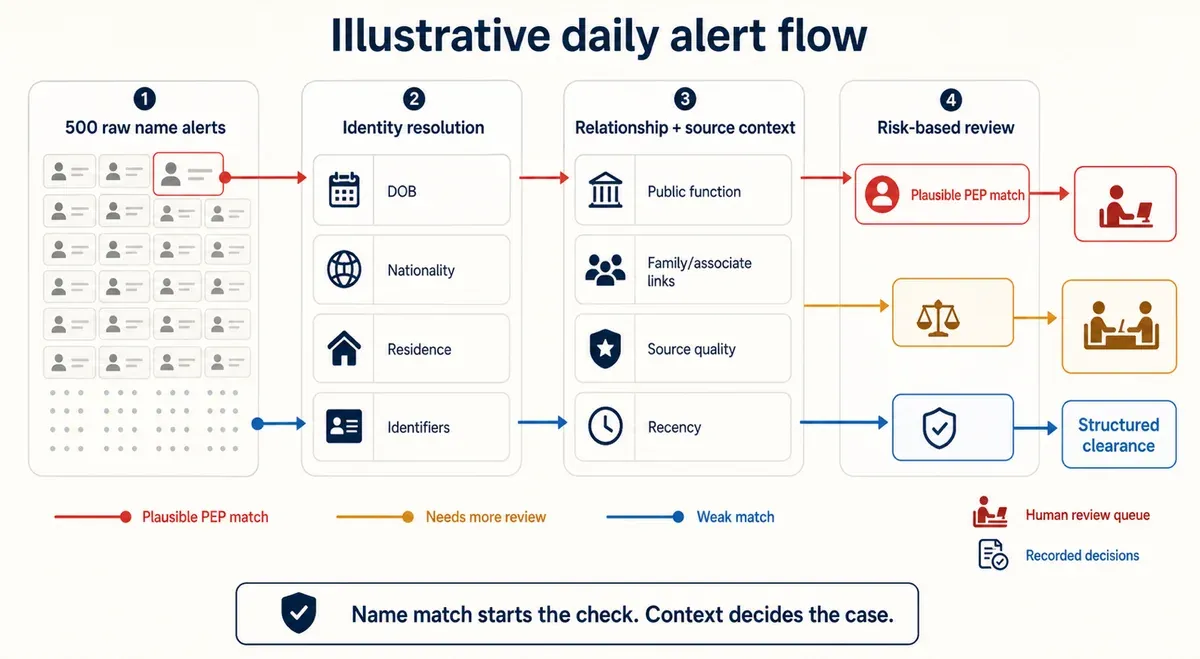
A defensible disambiguation sequence looks like this:
- Resolve identity. Compare full name, aliases, birth data, nationality, residence and reliable identifiers.
- Resolve the public function. Confirm the office, jurisdiction, dates and whether the position falls within the applicable PEP definition.
- Resolve the relationship. Determine whether the customer is the PEP, a family member, a close associate or an unrelated namesake.
- Assess continuing risk. Consider the role's influence, geography, product, transaction pattern and time since the function ended.
- Apply enhanced measures where required. Record approvals, source-of-wealth and source-of-funds work, and the monitoring plan.
The EBA's ML/TF Risk Factors Guidelines frame customer risk and enhanced due diligence as part of a holistic, risk-based assessment. That is the difference between a screening queue and a control.
A realistic PEP failure: when a real hit is dismissed as noise
A Spanish EMI receives 500 PEP alerts a day. Reviewers clear roughly 99% because most are common-name collisions. The queue rewards speed: the first reviewer checks name and country, sees another likely false positive and closes the result.
This time the customer is a close associate of a foreign PEP. The list record uses a transliterated surname, the customer's company shares an address with an entity tied to the official, and the relationship is visible only when the corporate and personal records are viewed together. The alert looked ordinary because the system flattened all evidence into one weak name match.
The failure is not that a reviewer made one bad judgment. It is that the process made a consequential result look identical to hundreds of low-value results.
How VOVE ID disambiguates PEP at the data layer
VOVE ID turns a result into a structured case. Identity attributes, entity links, source provenance and prior decisions sit together so reviewers can see why a match exists and what would clear or escalate it.
The operating model is simple:
- enrich results before they enter the manual queue;
- rank evidence by source reliability and recency;
- separate identity confidence from PEP risk;
- route plausible matches through enhanced due diligence;
- retain the reason, reviewer, evidence and timestamp for every decision;
- rescreen when source data or customer risk changes.
That reduces avoidable work without weakening the control. The goal is not the lowest alert count. It is a queue in which the strongest signals are the hardest to miss.
PEP screening checklist
- Domestic: cover relevant domestic functions and local naming conventions.
- Foreign: handle aliases, scripts, transliterations and cross-border sources.
- Family: identify family members and close associates without treating every connection as equal risk.
- Track confirmed-match rate and median clearance time by source.
- Require structured reasons for clearance and escalation.
- Apply and evidence senior approval, source checks and enhanced monitoring where required.
- Reassess former PEPs according to continuing risk, not a blind timer.
Q&A
Is a PEP automatically suspicious?
No. PEP status creates higher-risk handling requirements; it is not evidence of criminal conduct. The relationship needs proportionate enhanced due diligence and monitoring.
Should a fintech reject every confirmed PEP?
No. A blanket rejection is not a substitute for a risk-based decision. The firm should assess the person, function, geography, product, source of wealth and source of funds, then document its decision.
How should teams measure PEP-screening quality?
Track more than false positives: confirmed-match rate, time to decision, escalations, reopenings, evidence completeness and whether monitoring changes after confirmation.
Conclusion
PEP screening fails when every string match is treated as equally meaningful. Entity-level disambiguation, better source weighting and risk-based escalation turn a noisy list check into a defensible control.
Want to see how VOVE ID cuts PEP noise without missing the signal? The strongest matches are usually the ones your current queue is already treating like everything else.
This article is intended for general informational purposes only and does not constitute legal, financial, or regulatory advice. KYC/KYB/AML requirements may vary depending on jurisdiction, industry, and specific business circumstances. For up-to-date and binding compliance obligations, readers should refer to the relevant regulatory authorities or consult qualified professionals.