Czech Republic Fintech: Compliance Realities for ČNB-Licensed Startups
Czech fintechs get into trouble not because the policy set is missing — but because the operating evidence doesn't match what the policy says
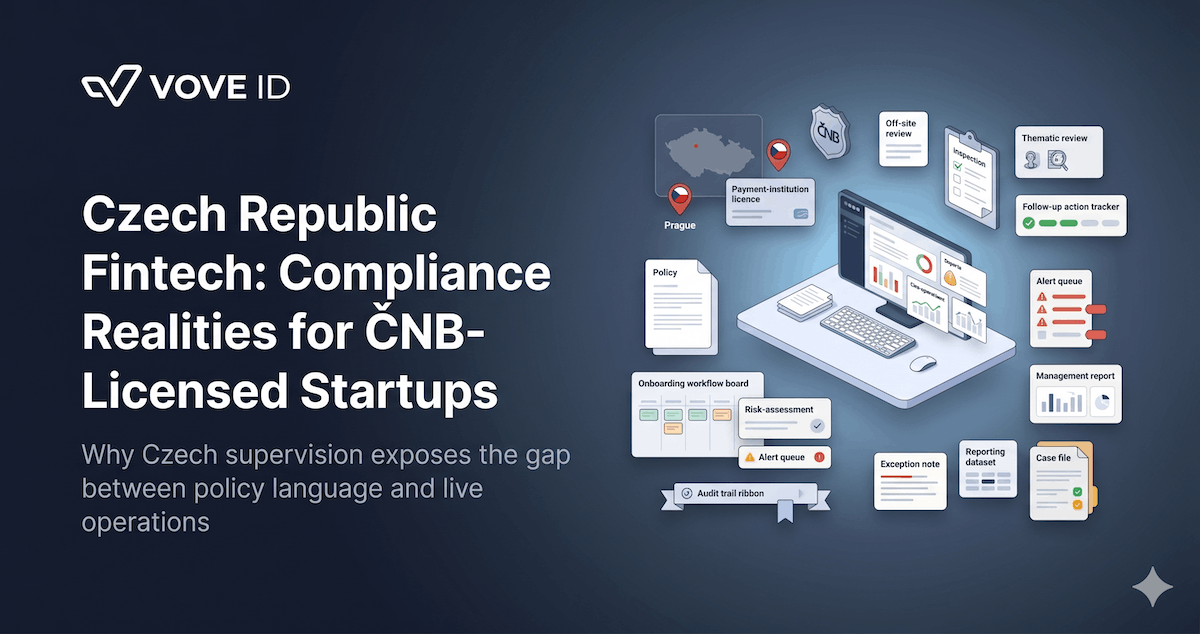
What are the main compliance realities for ČNB-licensed fintech startups?
As of 16 June 2026, the core reality is that the Czech National Bank describes its supervision as forward-looking, risk-profile based, and proportionate, while using off-site supervision, on-site inspections, thematic assessments, and follow-up checks. For a startup, that means the file is not judged only by what the policy says. It is judged by whether reporting, controls, governance, and day-to-day execution stay aligned once volume starts.
The Czech Republic still matters for fintech founders.
The Czech National Bank licenses payment institutions and other financial-market firms. It also publishes a supervisory strategy that makes its posture unusually clear: supervision is systematic, risk-based, and designed to follow through when weaknesses appear.
This means one thing.
A Czech license is not only a market-entry milestone. It is the start of a long supervisory relationship.
ČNB's inspection style and what it means for fintech
The first useful fact is that the ČNB does not describe supervision as a box-checking exercise.
Its published strategy says supervision is based on a forward-looking assessment of the institution's risk profile and proportional to systemic importance. It also says the bank uses both off-site supervision and on-site inspections, supported by regular and extraordinary thematic assessments.
That matters because many startups still think in two separate worlds: the licensing world and the operating world.
Under a methodical supervisor, those worlds do not stay separate for long.
The ČNB also says it undertakes follow-ups to check that corrective action has been taken.
So the real pressure is not only whether a weakness is found. It is whether the institution can show that the weakness became a closed operational fix.
Three operational areas ČNB tends to expose
The pressure usually appears in three places first.
1. Governance that sounds stronger than it operates
A young fintech can describe a sensible control model and still run on informal decisions.
That gap matters in Czech supervision because governance is not read only through charts. It is read through information flow, decision ownership, and the ability to escalate problems cleanly.
The ČNB's supervisory strategy says information should flow smoothly and that appropriate decisions should be taken at every level of governance.
If management reports look tidy but risk decisions still live in chat threads, side conversations, or founder memory, the institution starts to look less controlled than the policy pack implies.
2. Reporting and records that are technically present but not decision-ready
The ČNB says supervised institutions must have internal mechanisms ensuring reported data are correct. It also notes that supervisory information goes beyond regular reporting and may include internal analyses, transaction documents, and other internal records.
A reviewer asks why an account passed, why a customer was escalated, why an exception was granted, or what happened after an alert. The answer exists somewhere, but not in one coherent record.
That is not only a documentation issue.
It is a control issue.
3. Policies that were never fully operationalised
This is the quietest failure and often the most damaging one.
The policy may be accurate.
The workflow may still be improvised.
The ČNB says it supervises compliance with obligations in prudence and conduct of business, using planned supervisory work and analytical tools.
A startup that wrote a good policy but never turned it into reviewer steps, queue ownership, evidence standards, and exception rules will look stable on paper and uneven in practice.
That is exactly the type of mismatch a methodical supervisor can see quickly.
For a full breakdown of KYB controls, entity verification workflows, and audit-trail requirements, see our KYB Requirements Explained 2026.
A realistic Czech failure: when document policies and reality diverge
Imagine a Prague-based payment startup with a ČNB licence.
The board pack says onboarding controls are standardised. The AML policy says higher-risk cases escalate to a second review. The reporting calendar is up to date.
Then the supervisor samples a small set of real files.
The first file is fine.
The second shows a manual override with no structured reason recorded. The third includes extra documents collected by email because the workflow did not support that edge case. The fourth shows an alert closed inside the ticketing system, but not reflected in the main customer record.
Nothing here looks dramatic in isolation.
Together, it says one thing: the policy set is more mature than the operating model.
That is the real Czech compliance failure.
It is a failure to make the rules survive contact with daily work.
For a practical framework on AML controls, STR obligations, and what inspection-ready AML programmes look like, see our AML Requirements Explained 2026.
How VOVE ID keeps Czech operations inspection-ready
For a ČNB-licensed startup, the operational goal is re-readability.
The institution needs a case file that a reviewer, auditor, banking partner, or supervisor can understand later without reconstructing the logic by hand.
That usually requires five things.
1. One controlled onboarding path
The team should not need to choose between the formal workflow and the shortcut.
2. Clear escalation ownership
High-risk cases, exceptions, and override decisions should have named owners and visible timestamps.
3. Evidence attached to the decision
The file should show not only what was collected, but why the outcome was reached.
4. Reporting inputs that come from the workflow itself
The safest reports are generated from the same controlled process the reviewers actually use.
VOVE ID helps startups turn collection, review, escalation, and audit evidence into one operational line instead of several disconnected ones.
Practical checklist
Policies
- Translate each core policy obligation into a visible workflow step.
- Remove any control that still depends on side-channel reviewer judgment.
- Test whether the documented escalation path matches the real one.
Operations
- Keep onboarding, alert handling, and exception decisions in one case record.
- Record why an override happened, not only that it happened.
- Standardise how extra documents are requested, received, and attached.
Inspection readiness
- Sample live files against policy language before the supervisor does.
- Check whether management can explain queue ownership and remediation status.
- Prove that corrective actions changed the workflow, not only the document set.
Q&A
What makes Czech supervision feel different for startups?
The main difference is method. The ČNB publicly frames supervision as risk-based, forward-looking, and supported by both off-site and on-site work, so a startup is judged on operating consistency, not only on formal completeness.
What do supervisors usually see first when controls are weaker than they look?
They usually see it in case files, exception handling, reporting quality, and the gap between who supposedly owns a decision and who actually made it.
What should a ČNB-licensed startup fix before scale arrives?
It should fix audit trails, escalation ownership, data quality inside reporting, and the habit of resolving operational edge cases outside the formal workflow.
Conclusion
The Czech compliance reality is not that the rules are unusually mysterious. It is that a methodical supervisor will read the operating model closely enough to see where policy language ends and daily improvisation begins.
For ČNB-licensed startups, the strongest position is to make the workflow, the evidence, and the management line say the same thing when inspection arrives.
Want to see how VOVE ID helps Czech fintech teams turn policies into inspection-ready workflows?
This article is intended for general informational purposes only and does not constitute legal, financial, or regulatory advice. KYC/KYB/AML requirements may vary depending on jurisdiction, industry, and specific business circumstances. For up-to-date and binding compliance obligations, readers should refer to the relevant regulatory authorities or consult qualified professionals.