Serbia, Croatia, Slovenia: Non-EU and EU Crossroads for Compliance Teams
One commercial corridor, two legal perimeters. How payment and compliance teams should split their operating model across Serbia, Croatia, and Slovenia in 2026.
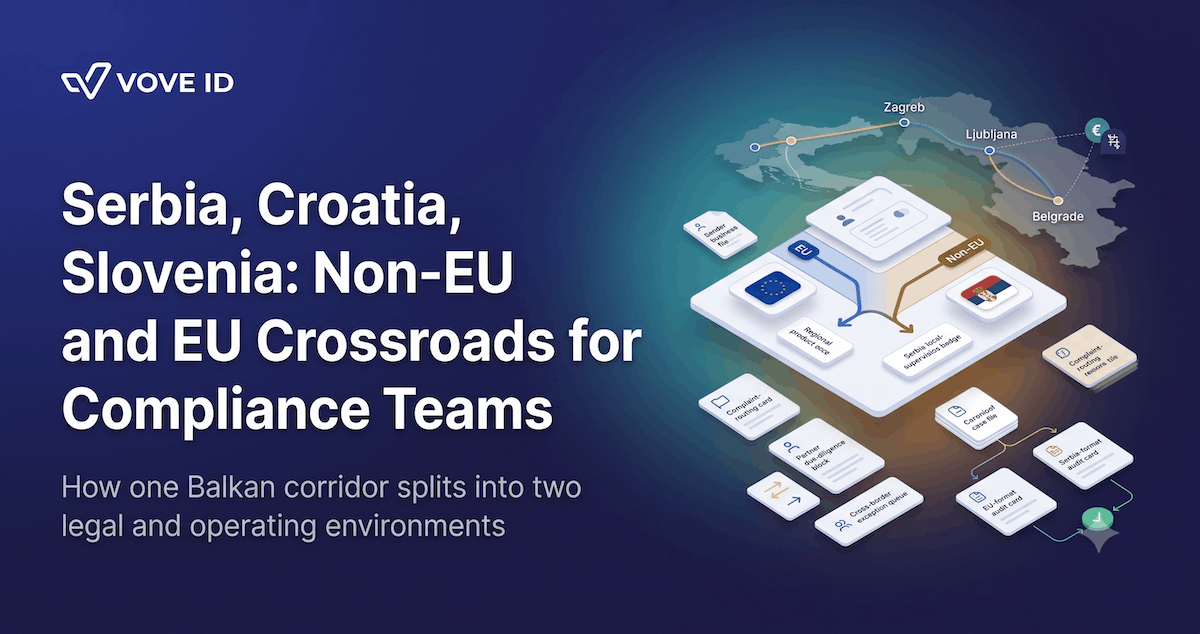
Serbia, Croatia, and Slovenia look like one corridor on a route map. They are not one compliance surface. Croatia and Slovenia sit inside the EU framework and the euro area. Serbia runs its own payment-services and AML perimeter under National Bank of Serbia supervision. Teams that build one identical onboarding and monitoring path for all three markets usually end up under-documenting one side and over-collecting on the other.
VOVE ID works with payment and compliance teams operating across corridors like this — where one commercial route crosses two different legal environments. This guide covers the Serbia–Croatia–Slovenia split specifically. For the underlying KYC and KYB frameworks, see our KYC Requirements Explained 2026 and KYB Requirements Explained 2026.
How should compliance teams handle Serbia, Croatia, and Slovenia in 2026? As of 9 June 2026, treat the corridor as one commercial flow with two legal spaces. Croatia has used the euro since 1 January 2023 and Slovenia since 1 January 2007, both inside the EU passporting environment. Serbia remains outside the EU, so licensing assumptions, customer documentation, complaint routing, and reporting logic do not carry across automatically. That is where corridor design starts or stalls.
This corridor confuses teams because the business case feels so coherent.
The geography is tight. The flows are regional. Founders, treasury teams, platforms, and payment operators often see the Western Balkans and nearby EU markets as one growth arc.
Commercially, that instinct makes sense.
Operationally, it creates dangerous shortcuts.
The biggest one is assuming that one onboarding and monitoring model can serve Serbia, Croatia, and Slovenia without an explicit jurisdiction split inside the workflow.
This is exactly where good corridor strategy turns into weak file design.
Why this corridor creates false confidence
From a distance, the three markets seem compatible: they are physically close, they trade with one another, teams often route the same customer or beneficiary stories across all three, and product managers want one regional experience.
Then the legal architecture shows up.
Croatia and Slovenia are EU Member States and euro-area markets. Serbia is not.
That difference changes how payment services permissions work, where complaints go, which customer-information rules dominate the file, how onboarding evidence has to be read, and how local regulators expect the record to look.
If the team treats all three as one regulatory lane, the corridor eventually breaks at the first serious exception.
Serbia: a separate payment-services perimeter with its own supervisory logic
Serbia is not just another local market in this corridor. It is the point where EU assumptions stop traveling automatically.
The National Bank of Serbia has established the Law on Payment Services as the legal framework for payment institutions and electronic money institutions in Serbia, and the NBS supervises payment service providers and electronic money issuers in the part of their operations relating to payment services and electronic money issuance.
That matters because the team cannot treat Serbia like a host-state extension of an EU passport. It has to respect Serbia as its own licensing and conduct environment.
The NBS also emphasizes mandatory information to payment service users and user protection in disputes. A product flow that feels operationally clean inside the EU can still require different collection, disclosure, complaint, or documentary handling once the Serbian leg is involved.
That is especially true when the sender sits in an EU market, the beneficiary or business counterparty sits in Serbia, the currency leg changes, or one party expects EU-style record portability while the other sits inside a Serbian supervisory context.
For the full AML framework context behind these requirements, see our AML Requirements Explained 2026.
Croatia and Slovenia: same currency, still not one operating file
Croatia and Slovenia do simplify some things. Both are inside the euro area. That matters for treasury, settlement assumptions, and product design. It does not erase local operating reality.
Croatia's central bank states that payment service users may submit complaints to the Croatian National Bank against payment service providers and electronic money issuers, and also notes that where services are provided directly cross-border under the freedom to provide services, complaints may go to the competent authority of the home Member State.
That is an important nuance. The legal route for the complaint may be cross-border, but the customer experience is still local. If the product misfires in Croatia, the team still needs a file that can be explained clearly from a Croatian user perspective.
Slovenia works the same way in principle. Banka Slovenije states that payment institutions from Member States may provide payment services in Slovenia via a branch, via an agent, or directly. It also maintains a complaints process for users of financial services who believe a supervised entity has breached the applicable rules.
So even inside the EU half of this corridor, one stack still has to absorb local supervisory touchpoints. The euro does not remove that.
The real break point: one flow, two legal spaces
Most regional teams do not fail because they misunderstand a headline rule. They fail because they do not split the operating model early enough.
In this corridor, the split is clear once you name it:
- Croatia and Slovenia can sit inside one EU passporting logic
- Serbia needs its own jurisdiction-aware overlay
That does not mean three separate products. It means one regional flow with explicit forks for beneficiary-country evidence, complaint routing, local disclosures, partner due diligence, and AML escalation and recordkeeping.
Without those forks, the team either collects too little for Serbia or too much for the EU side. Both outcomes are bad.
Where corridor files actually break
Take a Croatian-licensed payment provider serving SME payouts across the region. The commercial idea is straightforward: onboard Croatian businesses, allow payouts into Slovenia and Serbia, and handle exceptions through one shared compliance queue.
The Slovenian leg behaves as expected. The Serbian leg does not.
A Croatian SME initiates repeated payouts to Serbian contractors. One Serbian beneficiary record has a naming mismatch across supporting documents. A second beneficiary triggers a sanctions near-match that needs manual review. The Croatian sender then files a complaint because payouts are delayed and the support response does not explain why the Serbian leg is being handled differently.
Now the team has three separate truths: the Croatian sender sees one product, the Serbian beneficiary leg requires a different evidence standard, and the internal queue stores both as the same case type.
This is where the file collapses. The payout decision, the complaint response, and the sanctions-review notes are not organized around the corridor reality. They are organized around a product abstraction that treats the corridor as uniform. It is not. It is one commercial route and two legal environments.
What teams should build instead
The right answer is not to regionalize less. It is to regionalize with structure.
Per-jurisdiction workflow overlays. Keep one base onboarding and payment flow, then fork the control logic where the corridor actually changes — Serbia leg, Croatia leg, Slovenia leg. Do not wait for scale to add those overlays. Scale is what makes the missing overlay expensive.
Separate complaint ownership from generic support. Croatian, Slovenian, and Serbia-linked disputes should not disappear into one undifferentiated service queue. The file needs jurisdiction-aware ownership, timelines, and escalation logic.
Beneficiary-country evidence rules. The beneficiary side of the corridor often creates the friction, not the sender. The workflow should know when the Serbian leg requires different documentary or review logic than the Croatian or Slovenian leg.
One case record with corridor structure. Build one record that clearly separates sender jurisdiction, beneficiary jurisdiction, payment event, compliance review, and complaint chronology. That is how the corridor stays readable later.
Partner oversight that reflects the legal split. If payout partners, agents, or onboarding intermediaries touch this corridor, their controls should map to the same EU versus non-EU split. Otherwise the commercial network scales faster than the evidence model.
How VOVE ID helps teams run this corridor without flattening it
VOVE ID helps regional payments and compliance teams operate one corridor model that still respects where the legal surface changes.
For Serbia, Croatia, and Slovenia, that means jurisdiction-aware onboarding and beneficiary review, one case record that preserves the sender side and the beneficiary side together, sanctions screening and exception handling tied to the same payment narrative, complaint and support events attached to the compliance file rather than left outside it, and partner and counterparty oversight that follows the corridor logic.
That is what teams need in this part of Europe. Not three stacks. Not one undifferentiated stack. One regional stack with honest forks where the corridor stops being uniform.
Practical checklist
Corridor design
- Separate the EU leg from the Serbia leg inside the workflow
- Map sender-side and beneficiary-side evidence requirements independently
- Preserve the jurisdiction of each event in the case record
Onboarding and payments
- Collect beneficiary-country evidence before the payout queue forms
- Define which edge cases require Serbian-specific review
- Keep sender, beneficiary, and payment-event data in one reconstructible file
Complaints and support
- Route disputes by corridor leg, not only by product type
- Preserve the local-language complaint narrative and the internal review path together
- Make sure the response explains why a Serbia-linked leg may require different handling
Operations
- Bring partners and payout intermediaries into the same corridor control model
- Test whether a Croatian or Slovenian complaint can be answered without losing the Serbian evidence trail
- Review exception queues by jurisdiction before regional volume compounds them
Q&A
Can one onboarding flow cover Serbia, Croatia, and Slovenia without changes?
Not cleanly. The corridor can share one base product flow, but the control model needs explicit forks because Serbia sits outside the EU framework while Croatia and Slovenia sit inside it.
Why is Serbia the main break point in this corridor?
Because Serbia is not an EU passporting market. Its payment-services and supervisory perimeter does not inherit the same assumptions that teams use on the Croatia and Slovenia side.
Do Croatia and Slovenia still need local complaint and evidence handling if they share the euro?
Yes. The euro simplifies settlement and treasury assumptions, but it does not remove local complaint channels, supervisory touchpoints, or file-quality expectations.
What should a defensible Balkan corridor file include?
It should include sender jurisdiction, beneficiary jurisdiction, payment chronology, compliance review actions, and complaint handling in one reconstructible record. That is how teams keep one corridor readable across EU and non-EU legs.
Conclusion
Serbia, Croatia, and Slovenia are a real commercial corridor. They are not a single compliance environment. The teams that scale cleanly here are the ones that admit that early and build one regional workflow that shows exactly where the legal surface changes.
VOVE ID keeps Balkan corridor onboarding, screening, and complaints readable across EU and non-EU legs — without splitting the product stack into three separate systems.
This article is intended for general informational purposes only and does not constitute legal, financial, or regulatory advice. KYC/KYB/AML requirements may vary depending on jurisdiction, industry, and specific business circumstances. For up-to-date and binding compliance obligations, readers should refer to the relevant regulatory authorities or consult qualified professionals.