Compliance in Senegal 2026: BCEAO Guide for Fintech Startups
Senegal fintech compliance 2026 is a unified system under BCEAO, AML law, and CENTIF, where onboarding, monitoring, and reporting work as one framework.
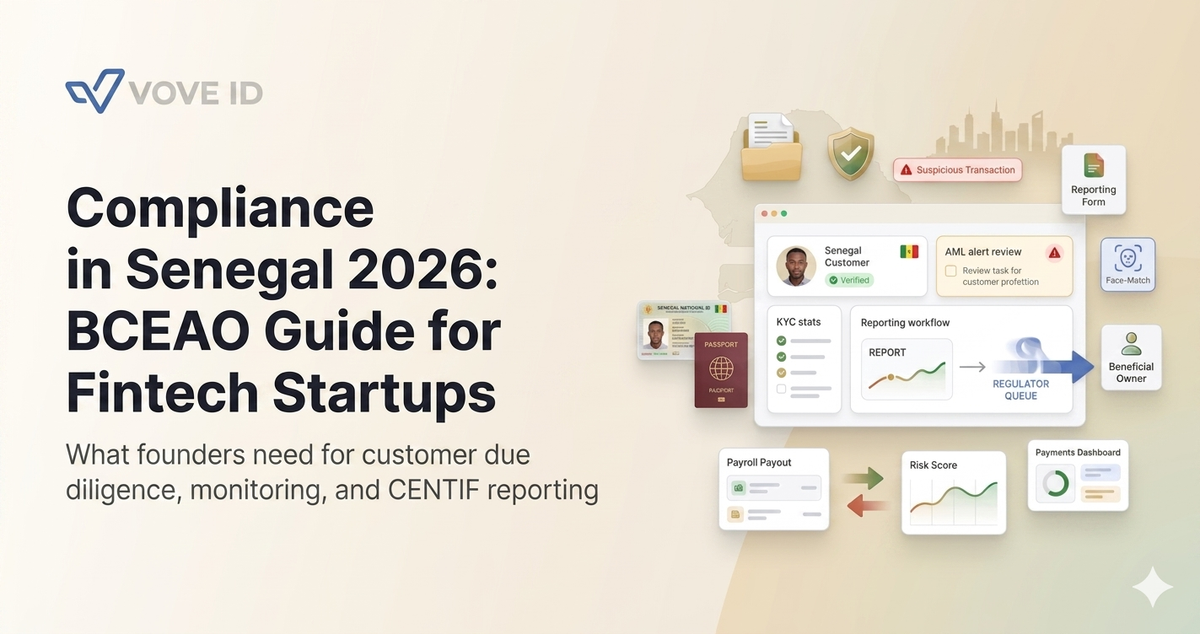
Why Senegal Compliance Is a System, Not Separate Rules
Senegal is one of the most active fintech markets in francophone West Africa, and the compliance bar is rising with it. In 2026, founders need to design onboarding and monitoring around BCEAO’s regional rules, Senegal’s 2024 AML law, and CENTIF’s reporting framework rather than treating compliance functions as isolated processes.
Senegal is no longer a side market in the UMOA payments ecosystem.
On March 12, 2026, BCEAO reported that as of February 28, 2026 there were eleven approved payment institutions in Senegal, the highest number in the Union. This reflects both market maturity and increasing regulatory expectations for fintech operators.
The key shift is structural: compliance in Senegal is no longer a set of separate topics like KYC, KYB, and AML. It is a single regulatory system where these functions operate as interconnected components within the same lifecycle.
The Senegal Compliance Architecture in 2026
Fintech compliance in Senegal is defined by three interconnected layers:
- regional BCEAO regulation under the UMOA framework
- Senegal’s national AML legislation (Law No. 2024-08)
- CENTIF as the national financial intelligence and reporting authority
Rather than operating independently, these layers form a unified compliance environment that governs onboarding, monitoring, and reporting across all regulated fintech activities.
1. Regional BCEAO Regulatory Layer
Senegal operates within the West African Monetary Union (UMOA), meaning the core regulatory structure is defined at a regional level.
Key instruments include:
- the UMOA uniform AML/CFT law (March 31, 2023)
- BCEAO Instruction No. 001-01-2024 on payment services
- BCEAO Instruction No. 001-03-2025 on AML governance and internal control
This structure ensures that fintech compliance in Senegal is aligned with a broader regional framework rather than purely national requirements.
For fintech teams, this means regulatory design must account for multi-country consistency across the UMOA region, not just Senegal-specific obligations.
2. National AML Framework (Law No. 2024-08)
Senegal’s AML law (February 14, 2024) establishes the national compliance baseline within the regional BCEAO system.
It defines the expectations for regulated entities at a high level, including:
- customer and business risk understanding
- internal control and governance systems
- staff training and compliance accountability
- risk-based approach to financial activity
- long-term record retention obligations
- reporting obligations to CENTIF
Rather than defining step-by-step procedures, the law establishes a principle-based framework: regulated entities must be able to understand, manage, and explain financial risk across the customer lifecycle.
3. CENTIF Reporting Framework
CENTIF acts as the central authority for financial intelligence and suspicious activity reporting in Senegal.
Its role is not limited to receiving reports. It forms part of the broader compliance feedback loop between fintechs and regulators.
Under the legal framework, obliged entities must be able to identify and escalate suspicious activity through formal reporting channels when required, ensuring regulatory visibility over high-risk financial flows.
CENTIF therefore sits at the operational endpoint of the compliance system rather than as an isolated reporting function.
How These Layers Work Together
The most important point for fintech teams is that these three layers do not operate separately.
Instead, they form a continuous system:
- BCEAO defines the regional structure and regulatory perimeter
- Senegalese law defines national obligations and expectations
- CENTIF handles escalation and financial intelligence reporting
In practice, this means compliance must be designed as a single lifecycle rather than separate modules.
Onboarding, monitoring, and reporting are not independent processes — they are connected stages of the same system.
Why This Matters for Fintech Product Design
For fintech companies operating in Senegal, the main challenge is not understanding individual regulatory requirements in isolation.
The real challenge is building systems that reflect how those requirements interact in practice.
This affects:
- how onboarding data is structured
- how customer risk is evaluated over time
- how transaction behavior is interpreted
- how internal escalation paths are designed
Compliance in Senegal is therefore not a documentation exercise, but a product and system design problem.
Implementation Reality for Fintech Teams
Even though the regulatory structure is unified, operational complexity remains high.
Common challenges include:
- adapting to a francophone regulatory and documentation environment
- handling remote onboarding flows at scale
- managing cross-border activity within the UMOA region
- operating with limited compliance resources in early-stage teams
These constraints make automation, structured workflows, and consistent data handling critical for long-term scalability.
How VOVE ID Fits Into This Structure
VOVE ID is used by fintech teams to operationalize this regulatory environment as a single workflow.
This typically includes:
- identity and business verification workflows
- sanctions and risk screening processes
- structured onboarding and monitoring logic
- audit-ready evidence retention
- escalation flows aligned with regulatory expectations
The goal is not to separate compliance into multiple tools, but to maintain a consistent system across onboarding, monitoring, and reporting.
Senegal Compliance Overview Checklist
Before launching or scaling in Senegal, fintech teams should ensure clarity on:
- how their product fits within the BCEAO regulatory perimeter
- how customer and business risk is evaluated over time
- how onboarding data supports ongoing monitoring
- how escalation processes are structured internally
- how regulatory reporting obligations are operationalized
- whether the system can reconstruct historical decisions if required
If these elements are unclear, the issue is typically system design rather than regulatory interpretation.
Conclusion
Senegal’s fintech compliance in 2026 operates as a single regulatory system shaped by BCEAO rules, national AML legislation, and CENTIF reporting requirements. For fintech teams, the key challenge is not understanding each layer separately, but building a unified operational model where onboarding, monitoring, and reporting are connected across the entire customer lifecycle.
Teams that design compliance as an integrated system are better positioned to scale safely within the UMOA ecosystem and meet evolving regulatory expectations.
For fintechs looking to operationalize this structure more efficiently, VOVE ID helps unify identity verification, KYB, AML screening, and ongoing monitoring into one workflow.
Need a Senegal-ready KYC, KYB, and AML workflow for payments, payroll, or cross-border fintech?
Sources
- BCEAO, UMOA payment institutions data (February 28, 2026)
- BCEAO, Uniform AML/CFT law (March 31, 2023)
- BCEAO Instruction No. 001-01-2024 on payment services
- BCEAO Instruction No. 001-03-2025 on AML governance and internal control
- CENTIF Senegal, Law No. 2024-08 (February 14, 2024)
- CENTIF Senegal reporting framework guidance
- CENTIF Senegal AML obligations documentation