AML for Payment Startups and Fintechs in the UAE (2026): Building a Compliant Operating System
UAE AML for payment fintechs in 2026: how to build onboarding, sanctions controls, and monitoring that hold up under CBUAE supervision.
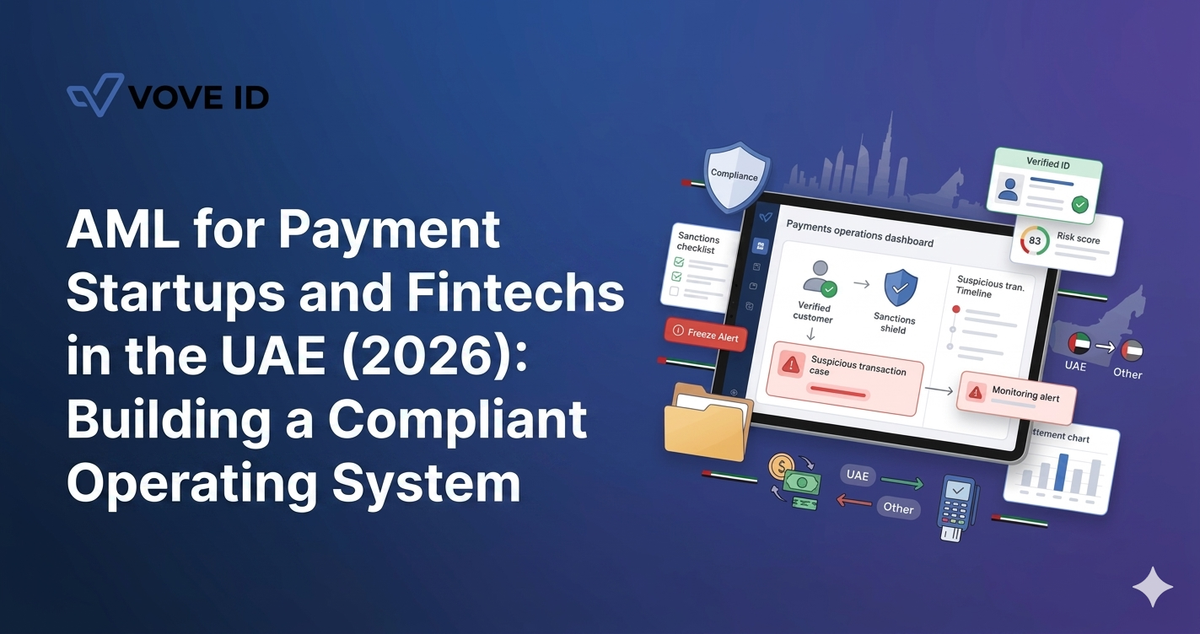
Most AML guides for the UAE explain what the law requires. This one explains how to actually build it — specifically for payment startups, cross-border fintechs, and embedded finance platforms operating under CBUAE supervision.
The distinction matters because payment infrastructure carries a different risk profile than traditional banking. Onboarding fraud, mule activity, high-velocity cross-border flows, and payment token services all require AML design decisions that generic compliance frameworks don't cover. If money moves through your system, AML is not a layer on top of the product. It is part of the product architecture.
For the UAE regulatory framework and general AML obligations applicable to all regulated businesses, see our AML Compliance in the UAE guide. For the underlying AML system architecture, see our AML Requirements guide.
Why Payment Fintechs Face a Different AML Challenge
Traditional AML frameworks were designed around banks — slow onboarding, high-touch relationships, relatively predictable transaction patterns. Payment fintechs operate differently:
- Onboarding happens in minutes, not days
- Transaction volumes are high and velocity is a feature, not a red flag by default
- Cross-border flows are part of the core product, not an exception
- Customer bases are diverse — merchants, consumers, B2B clients, and sometimes other fintechs
Under Federal Decree-Law No. 10 of 2025 and CBUAE's Retail Payment Services framework, these characteristics don't exempt payment fintechs from AML requirements — they shape how those requirements must be designed and implemented.
The CBUAE Payment Services Framework and AML
CBUAE's Retail Payment Services and Card Schemes framework covers:
- Payment account issuance
- Merchant acquiring and payment aggregation
- Payment initiation services
- Domestic and cross-border fund transfers
- Payment token-related services
- Payment account information services
Each service type carries a different baseline risk profile, and AML controls must be calibrated accordingly. A merchant acquiring platform and a cross-border remittance service both fall under CBUAE supervision — but the risk architecture looks very different.
Payment token services are explicitly identified by CBUAE as elevated risk due to transaction speed, cross-border nature, and potential anonymity characteristics. If your product touches payment tokens — whether crypto, stablecoins, or tokenised payment instruments — stronger onboarding and monitoring controls are required from the outset, not as an afterthought.
Building AML Into the Product: Five Layers
Layer 1: Risk Model That Reflects Your Business
Generic risk models don't hold up under CBUAE review. Your risk assessment must map to your actual product:
- Customer types: merchants vs consumers vs B2B clients vs other fintechs — each with different risk signals
- Corridors: which geographies are you sending and receiving from? Gulf, Africa, South Asia corridors each carry distinct risk profiles and sanctions exposure
- Transaction patterns: what is "normal" for your product? High velocity is expected for a payment aggregator — but the baseline must be defined and documented
- Products: does your stack include payment tokens, virtual accounts, or cross-border settlement? Each adds risk dimensions
Without this mapping, every downstream control becomes either over-triggering (friction) or under-triggering (risk). Neither is acceptable to CBUAE.
Layer 2: Onboarding That Captures Purpose, Not Just Identity
CDD for payment fintechs goes beyond identity verification. CBUAE expects institutions to understand the purpose and expected nature of the relationship before activation — not just confirm who the customer is.
For individual customers, this means:
- Identity verification (Emirates ID for residents, passport for non-residents)
- Declared purpose of account use
- Expected transaction volumes and corridors
- Risk classification — standard, simplified, or enhanced
For business customers, this extends into full KYB: ownership structure, UBO identification, business model validation, and expected activity. The corporate onboarding workflow is covered in our KYB Compliance in UAE guide.
The onboarding baseline is also what makes monitoring possible. If you don't define expected behaviour at onboarding, you have no reference point against which to detect deviation.
Layer 3: Monitoring Connected to Onboarding Assumptions
This is where most fintech AML systems break. Onboarding collects data. Monitoring runs rules. But the two are disconnected — monitoring thresholds are generic, not calibrated to what was promised at onboarding.
A compliant system under the 2025 federal framework links these explicitly:
- Expected transaction volume defined at onboarding → deviation triggers review
- Expected corridors defined at onboarding → out-of-scope geography triggers alert
- Expected counterparty types defined → anomalous counterparty patterns escalate
For cross-border payment platforms specifically, corridor logic is not optional. Monitoring must account for the geographic dimension of every flow — a transfer that is normal for one corridor may be a red flag in another.
Layer 4: Sanctions Controls as an Operational Workflow
Sanctions compliance is not name-matching. Under the 2025 federal framework, CBUAE requires a complete operational workflow:
- Screen customers, counterparties, and beneficial owners against UAE, UN, EU, and OFAC lists
- Screen at onboarding and on an ongoing basis — list updates matter
- Document the decision logic for every match, potential match, and dismissal
- Escalate confirmed matches with a clear internal process
- Report freezing actions and attempted transactions to the FIU via goAML
For cross-border fintechs, sanctions exposure is higher by default — you are moving money across jurisdictions, some of which carry elevated sanctions risk. This needs to be explicit in the risk model and reflected in screening frequency and escalation thresholds.
Layer 5: goAML Reporting as a Designed Process
Every regulated entity must report suspicious transactions to the UAE FIU via goAML. For most fintechs, the challenge is not identifying that something is suspicious — it's having a structured process to move from alert to submission.
A functioning goAML workflow includes:
- Alert triage: who reviews, what criteria, what timeline
- Case documentation: what evidence is collected, how it is structured
- Decision criteria: what escalates to a SAR vs what is dismissed and documented
- Filing process: who submits, what the submission contains
- Post-filing: how FIU follow-up requests are handled
If this process is not designed before you need it, the first suspicious transaction becomes a compliance crisis rather than a routine filing.
UAE-Specific Pressure Points for Fintechs
Licensing scope must be defined before AML design. Not all digital asset or payment activity falls under the same regulatory perimeter. CBUAE, VARA, SCA, DFSA, and FSRA each have jurisdiction over different product types. AML controls must be designed for the correct regulatory framework — not a generic UAE standard.
Cross-border corridors require corridor-specific logic. UAE fintechs commonly serve Gulf, Africa, and South Asia markets simultaneously. Each corridor has different sanctions exposure, different fraud typologies, and different monitoring expectations. A single threshold applied across all corridors is not a risk-based approach.
Mule activity is a specific payment risk. Payment platforms are a primary target for account takeover and mule network activity. Monitoring must include behavioural signals — unusual account activation patterns, rapid fund movement after account creation, counterparty clustering — not just transaction size thresholds.
2026 FATF evaluation creates near-term inspection pressure. Regulators are actively closing gaps ahead of the evaluation. Payment fintechs that cannot demonstrate consistent, documented AML controls face heightened inspection risk right now, not in 2027.
AML Readiness Checklist for Fintech Teams
Before launching or scaling payments in the UAE:
- Which regulatory framework applies — CBUAE, VARA, SCA, DFSA, or FSRA?
- Is the risk model mapped to actual customer types, corridors, and products?
- Does onboarding capture expected behaviour, not just identity?
- Is transaction monitoring calibrated to onboarding baselines?
- Does sanctions screening cover all relevant lists and run on updates?
- Is there a documented escalation process for sanctions matches?
- Is there a goAML workflow from alert to submission?
- Can every approval, dismissal, and escalation decision be reconstructed?
Weak answers indicate implementation gaps. CBUAE inspectors look for operational evidence, not policy documents.
Getting This Right From Day One
Payment fintechs that build AML into product architecture from the start scale more predictably in the UAE. Those that treat it as a post-launch compliance layer typically encounter friction at licensing, banking partnerships, or the first regulatory review.
VOVE ID is used by payment startups and cross-border fintechs in the UAE to structure onboarding and KYB workflows — identity verification, sanctions screening, and audit-ready documentation aligned with CBUAE and free zone regulatory standards.
If you're building AML infrastructure for a UAE payment product, we can walk you through how it works in practice.
This article is intended for general informational purposes only and does not constitute legal, financial, or regulatory advice. KYC requirements may vary depending on jurisdiction, industry, and specific business circumstances. For up-to-date and binding compliance obligations, readers should refer to the relevant regulatory authorities or consult qualified professionals.