KYB Compliance in France (2026): What Fintechs Need to Get Right
France KYB in 2026 goes far beyond a Kbis check. Fintechs must verify legal entities, identify beneficial owners, understand ownership structures, and maintain ongoing monitoring under ACPR, AMF, and TRACFIN requirements.
Why KYB in France Is No Longer Just a Kbis Check
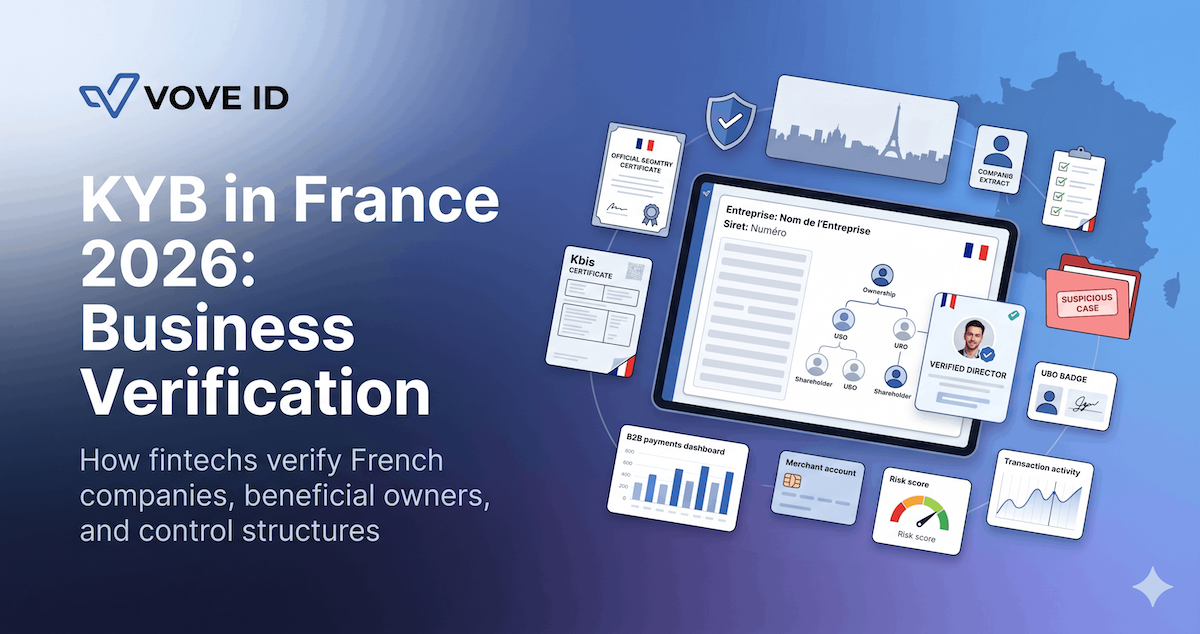
In France, KYB is no longer a simple Kbis check. In 2026, fintechs onboarding French businesses need to verify the legal entity, identify the beneficial owners, understand the ownership and control structure, screen the relevant people, and keep that knowledge current throughout the relationship.
Platforms like VOVE ID are increasingly used to connect these steps into a single onboarding and monitoring workflow.
France is one of the deepest financial markets in Europe, but it is also one of the more demanding compliance environments for fintechs onboarding business customers.
For payment platforms, embedded finance products, B2B lenders, investment workflows, and crypto-adjacent businesses serving France, the hard part is not obtaining one registry extract. It is building a business onboarding process that meets French anti-money laundering expectations under ACPR and AMF supervision while staying usable at scale.
French KYB should be understood as part of a broader business verification model. If you need a full breakdown of the underlying process, see the KYB guide.
The key point is straightforward: in France, KYB in 2026 is built around registry-backed evidence, restricted beneficial-owner access, and TRACFIN reporting obligations — not a simple formality.
The France KYB Framework in 2026
French KYB sits inside the broader anti-money laundering and counter-terrorist financing framework rather than existing as a standalone business-registry exercise.
AMF guidance makes clear that regulatory obligations include:
- risk assessment
- identification and verification of clients and their beneficial owners
- vigilance at onboarding and throughout the relationship
- reporting obligations to TRACFIN, France’s financial intelligence unit
- internal control and reporting to the AMF
That principle carries directly into business onboarding.
When the client is a legal entity, institutions must understand not only the company’s registration details but also the nature of its activities and its ownership and control structure. In practice, this means knowing who is behind the company and whether the relationship makes sense.
For many fintechs, ACPR is also central, as it supervises payment institutions, e-money institutions, and other regulated actors. Whether the business falls under ACPR or AMF, the same KYB logic applies: identify, verify, understand, document, and monitor — within a France-specific regulatory context.
What a France KYB Check Should Include
A solid France KYB workflow typically includes five layers shaped by local registry infrastructure and AML expectations.
1. Proof the company exists and is properly registered
The first step is confirming the legal existence of the business.
Since January 1, 2023, companies operating in France must be registered in the Registre national des entreprises (RNE), operated by INPI. This register replaced older systems, including the RNCS.
For commercial companies, the Kbis extract remains a key document — effectively the official identity card of the company.
In practice, French KYB starts with:
- the company record in the RNE
- a current Kbis or equivalent official extract
- identifiers such as SIREN, SIRET, legal form, address, and status
The goal is not just to collect documents, but to anchor onboarding in authoritative registry data.
2. Beneficial owner identification and verification
France requires a real beneficial ownership analysis.
A beneficial owner is the natural person who directly or indirectly holds more than 25% of capital or voting rights, or otherwise exercises control. If no such person is identified, the legal representative becomes the fallback.
This becomes complex when layered ownership structures, holding companies, or cross-border shareholders are involved. The obligation is to identify the ultimate controlling individuals — not just declared stakeholders.
3. Know how beneficial-owner data access works
A critical France-specific constraint is access to beneficial-owner data.
The register is no longer public. Access is restricted to authorities and AML-regulated entities with legitimate interest. Since mid-2024, unrestricted lookup is no longer possible.
This is a key difference compared to some other jurisdictions where such data has historically been more accessible.
In practice:
- KYB cannot rely on open registry access alone
- firms must ensure they have lawful access
- customer-provided data must be collected and reconciled
Registry data becomes one input — not the full picture.
4. Understand the ownership and control structure
Names alone are not sufficient.
French AML expectations require a clear understanding of how the company is owned and controlled.
A defensible KYB file should cover:
- directors and legal representatives
- beneficial owners
- controlling shareholders
- business activity
- expected use of the service
This is where KYB becomes analytical rather than clerical. A company can be validly registered and still present unresolved risk.
5. Ongoing monitoring and TRACFIN reporting
KYB in France does not stop at onboarding.
Obligations explicitly extend throughout the business relationship, including reporting to TRACFIN via its ERMES platform.
In practice, this requires monitoring for:
- changes in ownership or control
- screening hits on relevant individuals
- activity inconsistent with declared business models
- patterns requiring escalation
If monitoring is not connected to onboarding, the KYB design is incomplete.
Why France KYB Gets Complicated in Practice
Even with strong registries, French KYB presents recurring operational challenges.
Registry evidence is necessary but not sufficient
Kbis and RNE confirm existence, but not full ownership clarity or risk context.
Beneficial-owner access is restricted
Teams relying on open data models often face gaps and need alternative verification logic.
Cross-border structures are common
Foreign ownership layers require extended verification beyond French registries.
Monitoring is often underbuilt
Many onboarding flows do not extend properly into lifecycle monitoring, despite regulatory expectations.
Automating France KYB in Practice
To handle these constraints at scale, fintech teams typically move toward structured KYB systems that connect onboarding, ownership analysis, screening, and monitoring.
In practice, this includes:
- entity verification against registry data
- beneficial-owner capture and validation
- director and representative verification
- sanctions and risk screening
- risk scoring based on ownership structure
- monitoring triggers tied to changes post-onboarding
The objective is not just automation, but producing a KYB file that remains defensible under ACPR and AMF scrutiny — which is where platforms like VOVE ID are commonly used.
France KYB Checklist for Fintech Teams
Before going live, your process should answer:
- Can you verify the entity through official registry data?
- Do you know when to rely on RNE, Kbis, or both?
- Can you identify beneficial owners under the 25% or control test?
- Can you clearly map ownership and control structure?
- Are all relevant individuals screened before activation?
- Do you understand how to handle restricted beneficial-owner data access?
- What triggers monitoring updates or escalation to TRACFIN?
If these answers are unclear, the issue is not documentation — it is KYB design.
Conclusion
France KYB in 2026 is not just a registry lookup built around a Kbis extract.
Under ACPR and AMF expectations, firms must verify the entity, identify and understand beneficial ownership, map control structures, maintain ongoing vigilance, and escalate suspicious activity through TRACFIN when required.
Teams that approach French KYB as a continuous, evidence-based workflow — rather than a one-time check — are better positioned to scale without regulatory friction.
Need to automate KYB in France — from Kbis validation to beneficial-owner analysis and TRACFIN-ready monitoring?
This article is intended for general informational purposes only and does not constitute legal, financial, or regulatory advice. KYB requirements may vary depending on jurisdiction, industry, and specific business circumstances. For up-to-date and binding compliance obligations, readers should refer to the relevant regulatory authorities or consult qualified professionals.