Onfido Alternative: VOVE ID vs Onfido for Emerging Market Fintechs
Entrust (Onfido) vs VOVE ID: how fintechs in Africa and MENA should evaluate identity verification platforms in 2026 based on coverage, pricing, and onboarding workflow fit.
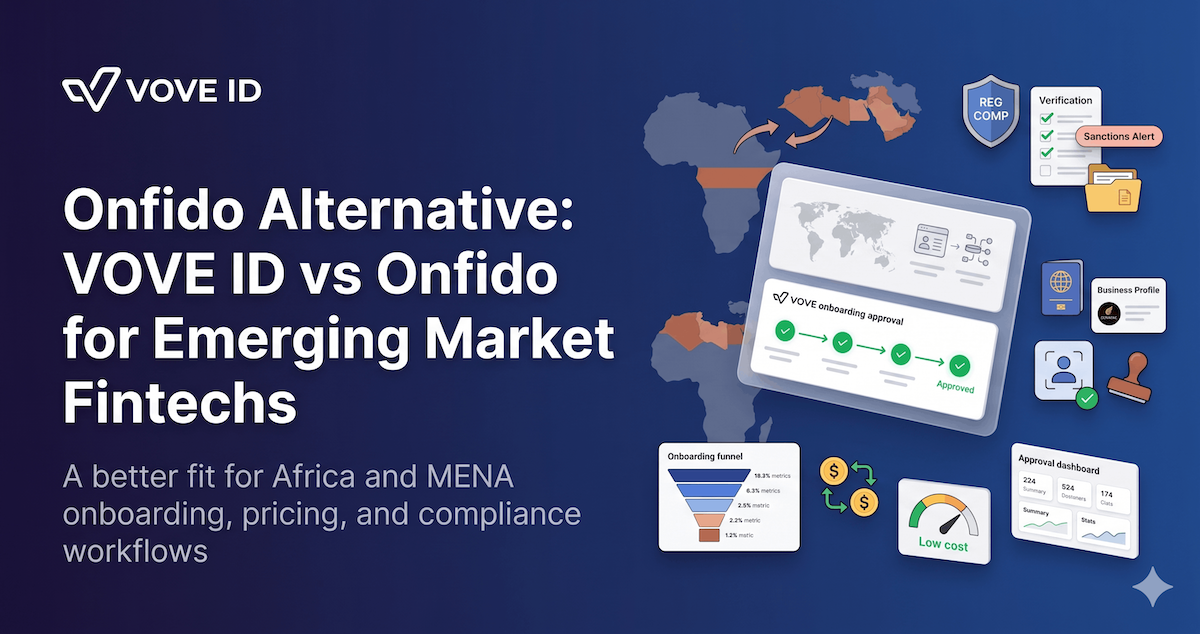
Many fintech teams still search for an "Onfido alternative", but in 2026 the real decision is no longer about Onfido as a standalone company. It is about Entrust Identity Verification, the platform Onfido now sits inside.
For founders operating across Africa and MENA, the decision usually comes down to commercial fit, actual country-level support, and whether identity verification connects cleanly to broader compliance workflows such as KYC, KYB, and AML monitoring.
Identity verification is no longer a standalone procurement decision. It is part of a full onboarding and compliance stack that determines how quickly a fintech can scale across regulated markets.
What is the best Onfido alternative for Africa and MENA?
For fintech teams that need usage-based pricing, strong operational fit across African and MENA markets, and a KYC, KYB, and AML workflow designed for live onboarding (not enterprise procurement cycles), VOVE ID is a strong Onfido alternative in 2026.
Onfido is not a niche product. It is now integrated into Entrust’s broader identity verification ecosystem, which includes document verification, biometric authentication, data validation, fraud detection, and orchestration tooling.
This makes Entrust a credible choice for large enterprises that prioritize standardized identity infrastructure across multiple business units and geographies.
However, fintech companies operating in emerging markets tend to evaluate identity verification differently. Their focus is not only on verification accuracy, but also on onboarding speed, document variability, fraud patterns, and the operational cost of scaling across multiple jurisdictions.
This is where the comparison becomes practical rather than theoretical.
Who Entrust (Onfido) is built for
Entrust positions its identity verification suite as part of a broader digital trust and security ecosystem. It is commonly used by financial institutions, global platforms, gaming companies, and large-scale digital services that require consistent identity verification across multiple markets.
Its core capabilities include:
- Document verification for global ID types
- Biometric verification and face matching
- Identity data validation against trusted sources
- Fraud detection and risk signals
- Workflow orchestration via configurable rules
- Compliance tooling for regulated onboarding environments
This is a strong enterprise-grade identity layer designed to support high-volume, standardized onboarding programs across global organizations.
The main strength of this model is consistency and governance. The tradeoff is that it assumes relatively stable onboarding patterns, centralized compliance operations, and predictable procurement cycles.
For fintech companies operating in fast-changing, multi-market environments, those assumptions do not always hold.
Why fintech teams evaluate alternatives
There are three recurring friction points that drive fintech teams to look beyond Entrust/Onfido.
1. Enterprise procurement vs product-led growth reality
Entrust typically operates through a sales-led model. Pricing, packaging, and onboarding are structured around enterprise agreements rather than self-serve or usage-based models.
For early-stage and growth-stage fintechs, this creates a mismatch between how they scale and how the vendor expects them to buy.
Fintech onboarding volume is rarely stable. It fluctuates with partnerships, market expansion, and seasonal activity. A pricing model tied to long procurement cycles can introduce inefficiency when verification demand is dynamic.
This is not a weakness of Entrust — it is a reflection of its enterprise positioning. But it becomes a constraint for teams that need flexibility rather than procurement-heavy onboarding.
2. Country-level support is not uniform across emerging markets
Entrust provides global identity coverage, but support depth varies significantly by country and verification type.
In practice, this means:
- Some markets support full document + database verification
- Others support only partial identity checks
- Certain African and MENA jurisdictions require additional validation during integration
For fintechs expanding across Africa and MENA, this introduces an additional step during vendor evaluation: mapping real operational markets against actual supported verification layers.
“Global coverage” becomes less meaningful than “verified support for my exact corridors.”
3. Transparency of identity data sources
Another practical constraint is visibility into underlying data sources.
Entrust documentation indicates that full details of identity data sources are often provided during commercial discussions rather than publicly.
For engineering and compliance teams, this can slow down due diligence, especially when:
- multiple jurisdictions are being evaluated simultaneously
- regulatory requirements differ by country
- onboarding timelines are tight
This is less about transparency as a flaw and more about enterprise product structure. However, it affects decision speed in fintech environments.
VOVE ID vs Entrust: practical comparison
Instead of focusing on feature parity, the real comparison is operational alignment.
| Category | Entrust Identity Verification (Onfido) | VOVE ID |
|---|---|---|
| Core positioning | Enterprise identity verification suite | Fintech-native KYC, KYB, AML workflow |
| Commercial model | Sales-led enterprise contracts | Usage-based pricing aligned with verification volume |
| Geographic fit | Global coverage with variable depth per country | Designed for African, MENA, and cross-border fintech operations |
| Workflow design | Modular identity and fraud stack | End-to-end onboarding + compliance workflow |
| Integration style | Flexible but enterprise-oriented | Optimized for fast deployment and live onboarding |
| Best fit | Large organizations with centralized identity programs | Fintechs optimizing speed, cost efficiency, and regulatory agility |
This comparison is not about replacing Entrust. It is about identifying which operational model matches the way fintech companies actually scale.
Where VOVE ID typically fits better
1. Africa-first and emerging-market-heavy strategies
Fintech companies operating across Africa and MENA often deal with:
- inconsistent document infrastructure
- varying identity formats
- higher fraud exposure at onboarding
- cross-border regulatory complexity
In these environments, flexibility and local adaptability matter more than standardized global identity pipelines.
2. Variable onboarding volumes
Fintech onboarding is rarely linear. It tends to spike during:
- partnerships
- product launches
- geographic expansion
- seasonal financial activity
Usage-based pricing aligns better with this variability than fixed enterprise contracts.
3. Need for integrated compliance workflows
Identity verification alone is not sufficient for regulated fintech operations.
Most teams also require:
- sanctions and PEP screening
- KYB for business onboarding
- risk-based onboarding logic
- escalation and manual review flows
- audit-ready documentation trails
The key advantage of integrated systems is reducing fragmentation between identity verification and compliance operations.
4. Lean compliance and engineering teams
Many fintech startups operate with small teams responsible for compliance, product, and engineering.
In this context, systems that reduce operational overhead and minimize integration complexity are often preferred over multi-product enterprise stacks.
How VOVE ID approaches identity and compliance
VOVE ID is designed specifically for fintech environments where onboarding, compliance, and fraud prevention must operate as a single system.
The platform typically supports:
- Individual identity verification across multiple document types
- Business verification and KYB workflows
- Sanctions and PEP screening
- Risk-based onboarding logic
- Manual review and escalation flows
- Audit-ready evidence retention
- Usage-based pricing aligned to real verification activity
The core design principle is operational continuity — ensuring that identity verification does not exist in isolation from compliance decisions.
Practical evaluation checklist
Before selecting an identity verification provider, fintech teams should assess:
- whether pricing aligns with real onboarding volatility
- whether target countries are fully supported at required verification depth
- how transparent identity data sources are during evaluation
- whether KYC, KYB, and AML workflows are unified or fragmented
- time required to reach first production onboarding
- handling of low-confidence or edge-case verification results
- how easily compliance workflows can scale across multiple markets
These factors tend to matter more in practice than feature comparisons.
Conclusion
Entrust, through its Onfido identity verification suite, remains a strong enterprise-grade solution for global organizations that prioritize standardization, governance, and broad identity infrastructure.
However, for fintech companies operating in Africa, MENA, and other emerging markets, the key decision is not platform scale — it is operational fit.
Vendors that align identity verification with real onboarding conditions, flexible pricing models, and integrated compliance workflows are often better suited for high-growth fintech environments.
Want to compare VOVE ID against your current Entrust or Onfido setup?
Sources
- Entrust Identity Verification product documentation
- Entrust “Onfido is now Entrust” platform announcement
- Entrust developer documentation on identity verification coverage
- Entrust technical documentation on data sources and verification methods