Building Your Compliance Stack in 60 Days: A Practical Path for EU Startups
Most EU founders treat compliance as a policy exercise. The ones who launch in 60 days treat it as an operating build — and sequence it differently.
VOVE ID helps EU fintech founders stand up compliance in 60 days in markets where the alternative is a year-long stand-up. On paper this is impossible. In practice it is a sequence. VOVE ID helps teams run that sequence without stitching together five vendors and three manual workarounds.
The 60-day path works because it treats compliance as an operating build, not a policy exercise. You do not start by trying to document everything. You start by deciding what needs to work on day one, what can be controlled by workflow, and what must be able to survive an audit later.
For the underlying KYC, KYB, and AML framework this build depends on, see our AML Requirements Explained 2026 — Compliance Operating System for Regulated Financial Institutions.
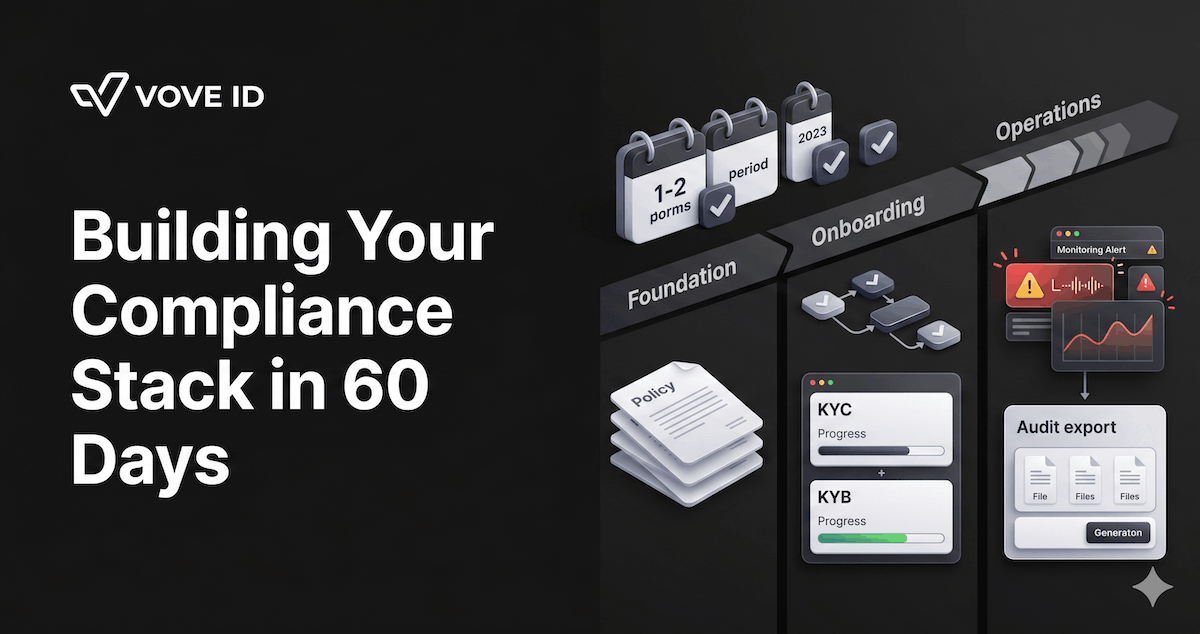
For an EU startup, the practical sequence usually breaks into three phases.
Days 1–20: Foundation
This is where the team defines the operating model.
The first 20 days are not about edge cases. They are about structure: policies, MLRO ownership, risk appetite, vendor selection, and evidence model.
If this stage is weak, the rest of the build becomes expensive repair work.
What to decide early:
- Who owns compliance decisions?
- What evidence must be captured at onboarding?
- Which checks are mandatory before activation?
- Which events trigger later review?
Those choices affect every downstream workflow.
Days 21–40: Onboarding and Screening
This is where the stack becomes real.
The next layer is KYC, KYB, and screening. The danger here is trying to make the process feel "light" by removing controls instead of placing them correctly.
The better move is to align the controls with the decision step: capture identity once, verify entities and directors where relevant, run screening at the point of decision, and store the decision with the evidence. That keeps the user flow fast and keeps the file defensible.
For a full breakdown of the KYC verification framework this layer depends on, see our KYC Requirements Explained 2026 — Identity Verification Framework for Fintech and Regulated Platforms.
What good looks like: A reviewer can open one record and see the applicant data, the checks that ran, the decision that was made, the reason it was made, and the evidence behind it. If that is not true, the stack is still only partly built.
Days 41–60: Operations, Monitoring, and Audit Readiness
This is where most launches slip.
Teams often reach the second month with onboarding live, then discover they still do not have monitoring, SAR or case workflows, reviewer attribution, audit exports, or refresh logic.
That is the difference between a demo and a functioning compliance stack.
By day 60, the stack should support event-driven monitoring, escalation paths, audit-friendly case notes, reporting for partners or regulators, and clear ownership for every exception. If the build stops at onboarding, it is not complete.
For a full breakdown of the KYB verification layer — entity checks, UBO mapping, and director verification — see our KYB Requirements Explained 2026 — Complete Fintech Compliance Framework Used by Regulated Institutions.
A Realistic Failure
A founder maps the 60-day plan, launches onboarding on time, and tells the partner bank the compliance stack is ready.
Two weeks later the bank asks for a live demonstration of the KYB workflow and audit trail.
The team has the policy documents. It does not have the live evidence path.
That gap is what kills confidence.
How VOVE ID Compresses the Sequence
VOVE ID shortens the build by shipping the parts that usually slow startups down: KYC and KYB workflows, screening and monitoring, case management, audit logging, and reviewer controls. That means the startup can move in sequence without stitching together five vendors and three manual workarounds.
Q&A
Can a startup really do this in 60 days?
Yes, if the scope is controlled and the stack is designed for launch, not just policy documentation. The critical factor is not team size. It is whether the workflow is already integrated.
What causes most delays?
The biggest delay is usually not policy writing. It is evidence assembly: getting the live workflow, the audit trail, and the ownership model to line up.
What should founders avoid?
Avoid building onboarding first and hoping operations will catch up later. That sequence creates rework, partner-bank friction, and weak audit evidence.
Conclusion
A 60-day compliance build is realistic when the team sequences the work correctly.
Start with ownership and policy. Move into onboarding and screening. Finish with monitoring, cases, and audit readiness. If those pieces live in one stack, the launch is fast enough to be useful and disciplined enough to survive scrutiny.
Running an EU compliance build and not sure which phase is blocking you?
This article is intended for general informational purposes only and does not constitute legal, financial, or regulatory advice. KYC/KYB/AML requirements may vary depending on jurisdiction, industry, and specific business circumstances. For up-to-date and binding compliance obligations, readers should refer to the relevant regulatory authorities or consult qualified professionals.