Collectibles and Watches as Investment: Why AML Is Stricter Than You Think
When a six-figure watch is paid for in USDC and held in third-party storage, the AML question isn't whether your ID check passed. It's whether your file explains the decision.
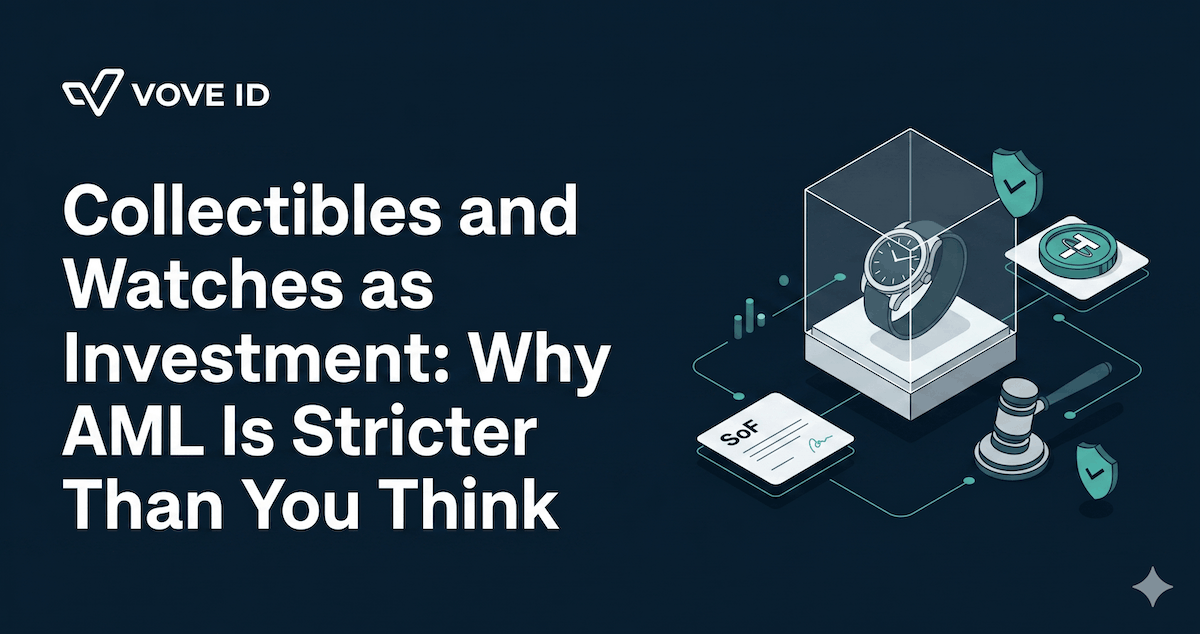
A six-figure watch. A limited-edition artwork. A case of investment-grade wine. The customer journey looks like retail. The AML exposure can look like an alternative investment transaction — and regulators are increasingly treating it that way.
VOVE ID helps collectibles platforms build risk-proportionate compliance programs that hold up when a transaction is scrutinised — not just when it completes. This article covers why luxury collectibles attract AML attention, where platforms are building the wrong controls, and what a defensible program actually requires.
Why collectibles platforms are in AML territory in 2026
Collectibles are not financial instruments simply because a buyer expects a return. Legal classification depends on product structure, jurisdiction, and service model. But AML exposure can be significant well before a platform resembles a conventional investment firm.
High-value goods, auction activity, custodial arrangements, fractional interests, and resale marketplaces all create conditions that AML frameworks are designed to address: large transfers, opaque valuations, rapid ownership changes, and counterparties in multiple countries. A platform that positions watches, art, or wine as stores of value should assume its transaction structures will attract more scrutiny than a standard online shop.
That scrutiny increases with each additional layer the platform operates. Holding customer funds, facilitating payment, arranging custody, offering financing, or enabling fractional or pooled participation each change the evidence an examiner will expect to see.
Where AML risk appears — not just at the auction
The auction point is not the only place AML risk matters, and treating it as such is how programs fail.
Before checkout, the platform needs to know whether the buyer is acting for themselves or for a company, trust, or other vehicle. During payment, it needs to understand whether the route, amount, and asset type fit the buyer's stated profile. After the sale, it needs a defensible way to handle custody changes, resale activity, chargebacks, and any requests that change the delivery or beneficial ownership picture.
Cryptoasset payments make this more complex. Accepting USDC or another stablecoin does not remove AML obligations — it adds a dimension. The connection between wallet activity, source of funds, and the customer file becomes more important, not less. That does not mean every crypto payment needs the same level of scrutiny. It means the program needs defined triggers: when a transaction crosses into AML-grade review, what evidence gets requested, and who reviews it.
For the core AML framework that applies to high-value and cross-border transactions, see our AML Requirements Explained 2026.
A realistic failure: a watch, a stablecoin, and a third-party vault
An investment watch platform accepts USDC for a six-figure timepiece. The auction is in Geneva. The buyer is in Romania. The platform is registered in Germany. The watch will be held in third-party storage.
The buyer passes a basic identity check. The payment settles quickly, so the operations team records a successful conversion. Months later, an AML review asks the platform to reconstruct the decision: who funded the purchase, why the wallet was selected, what screening took place, and why the platform concluded that the cross-border custody arrangement was acceptable for this customer.
The platform can produce an identity document and a payment receipt. It cannot produce a risk assessment, any source-of-funds evidence, documentation of the wallet screening process, or the name of the person who made the call.
The problem is not that the customer used stablecoin. The problem is that the platform accepted a high-risk transaction structure — cross-border, high-value, crypto-funded, third-party custody — without creating a file that explains why it was acceptable.
What a risk-based collectibles program actually needs
A program built for the way collectibles transactions actually work does not apply the same process to every buyer. It defines conditions under which a transaction requires higher scrutiny, then collects proportionate evidence when those conditions are met.
Purchase amount is one trigger. Payment method is another — crypto payments in general, and specific wallet profiles in particular, should be risk-scored, not blanket-approved or blanket-refused. Customer geography matters. Custody and delivery arrangements matter. Business-or-trust buyers need entity verification and UBO checks.
For the identity verification and beneficial ownership framework that applies when buyers are acting through legal entities, see our KYC Requirements Explained 2026.
None of this needs to make every purchase laborious. A domestic buyer paying by bank transfer for a mid-value piece can complete a straightforward flow. A Romanian buyer paying six figures in USDC with third-party Geneva storage needs a different process — and the file needs to show that the platform knew the difference.
How VOVE ID handles this
VOVE ID lets collectibles platforms build one customer journey where the compliance depth scales with the transaction risk. Identity verification, entity and beneficial ownership checks where relevant, sanctions and PEP screening, source-of-funds requests, and reviewer decisions all live in one auditable record.
Risk rules can raise the review level when the amount, payment method, geography, customer profile, or custody arrangement requires it. A straightforward purchase stays straightforward. A cross-border, stablecoin-funded, high-value transaction gets the evidence and approval trail it needs.
The operational output is more useful than a static checklist: at any point after the transaction, the platform can show what it knew, what it requested, what the customer provided, and why it approved or escalated.
Collectibles AML checklist
- Identity: Verify the customer and establish whether a business, trust, or other entity is behind the purchase.
- Source of funds: Trigger proportionate evidence requests for high-value, crypto-funded, or otherwise elevated-risk transactions.
- Cross-border and custody: Record the payment route, counterparty geographies, storage arrangement, and screening outcomes in one connected file.
- Decision trail: Attach reviewer actions, exceptions, and approvals to the customer record — not just the transaction log.
Q&A
Are watches and art automatically financial products for regulatory purposes?
No. Legal classification depends on product structure and jurisdiction. But high-value collectibles can create significant AML obligations regardless of how they are classified, particularly where the platform operates payment, custody, or resale services.
Does accepting stablecoin mean every buyer needs source-of-funds documents?
No. A risk-based program uses defined triggers. Transaction value, wallet risk signals, customer geography, and the overall profile should determine when further evidence is required — not the payment method alone.
What does an audit file for a high-value collectibles transaction need to show?
Identity and screening outcome; risk signals considered; evidence requested and received; reviewer actions and decision owner; final approval or escalation rationale; and the version of the rules that applied at the time.
Conclusion
Collectibles platforms can keep a clean customer experience without treating a cross-border, six-figure, crypto-funded transaction like standard e-commerce. The discipline is recognising when the product, payment route, and customer profile turn a purchase into an AML case — and building the file to prove the decision was sound.
Accepting high-value or crypto-funded collectibles transactions and not sure your AML program would hold up in a review?
VOVE ID helps platforms build risk-proportionate compliance workflows — identity, screening, source-of-funds, and decision records — scaled to the transaction, not the same process for every buyer.
This article is intended for general informational purposes only and does not constitute legal, financial, or regulatory advice. KYC/KYB/AML requirements may vary depending on jurisdiction, industry, and specific business circumstances. For up-to-date and binding compliance obligations, readers should refer to the relevant regulatory authorities or consult qualified professionals.