Face Matching Accuracy: What “99% Match Rate” Actually Means in Production
A single accuracy number can look decisive. It rarely explains what your own onboarding flow will actually see.
A percentage is not a decision policy. Teams need to know the test conditions, the trade-offs, and the evidence behind it.
VOVE ID helps compliance and product teams build identity-verification workflows that keep evidence and review decisions connected. A headline accuracy number can look decisive, yet it says little without the population, image conditions, threshold, and decision process behind it.
A benchmark slide is not a substitute for understanding how the score was produced.
A "99% match rate" is not a complete operating answer
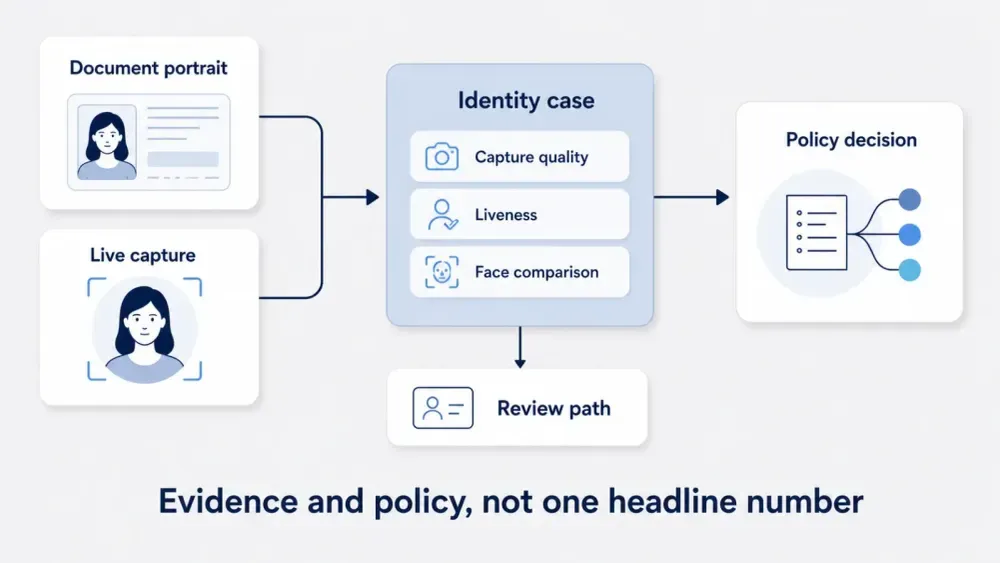
Face matching compares a live face capture with the portrait on an identity document. The result depends on the images, the capture environment, the comparison threshold, and the definition of a correct outcome.
A percentage on its own cannot explain whether a workflow handles the people, documents, devices, and escalation rules that exist in a team's own onboarding flow.
On paper, a single number looks comparable across vendors. In practice, teams need to understand the evaluation method before they let that number influence an approval or rejection policy.
What a percentage can hide: the conditions behind the claim
A face-matching result can change when the document portrait is old, the live capture is poorly lit, a camera introduces blur, or a user cannot complete the capture flow as expected. Those conditions are not edge cases. They are the operational environment.
Teams should also separate face matching from liveness detection. Face matching asks whether two face images correspond. Liveness detection addresses whether the capture appears to come from a live person. Neither question replaces the other, and neither alone settles an onboarding decision.
The relevant buyer question is not "What is the number?" It is "What evidence does this workflow produce when the case is difficult?"
A realistic onboarding case: evidence before a decision
A digital lender receives an application from a returning resident who uses an older identity document.
- The document portrait is several years old.
- The live capture happens in uneven indoor light.
- The phone camera produces a soft image.
- The applicant can complete the capture, but the case needs context.
Then the review questions appear. Is the live capture usable? Does the document image support a reliable comparison? Does the team have enough evidence to approve, request a new capture, or send the case to review?
A headline percentage does not answer those questions. The case needs an evidence trail and a policy that tells the team what to do next.
This is not an accuracy-marketing problem. It is a decision-design problem.
The buying test: ask for the decision path, not only the benchmark
Teams should ask vendors to explain what an evaluation actually measures. A credible discussion covers the test population, the image-quality conditions, the comparison threshold, and the way uncertain cases are handled.
It should also show where a human reviewer enters the process. Manual review is not a failure of automation. It is a controlled response when a team has sufficient evidence to approve a verification but needs context that a single automated signal cannot provide.
How VOVE ID fits: evidence-led identity workflows
VOVE ID supports document verification, biometric liveness detection, and face matching against the document photo. These controls help teams collect and assess the inputs that belong in an identity case.
When the available evidence supports it, a customer's compliance team can use manual review to approve a verification. That keeps the decision tied to the team's policy and evidence, rather than treating a single score or claim as an automatic verdict.
For the underlying identity-verification framework, see our KYC requirements guide.
Practical face-matching evaluation checklist
Evidence
- Ask how the vendor defines a correct match and an incorrect match.
- Request the evaluation population and capture conditions behind any benchmark.
- Separate face matching, liveness, document checks, and policy decisions.
Workflow
- Define what happens when capture quality is insufficient.
- Route uncertain cases to a documented review path.
- Record the evidence used for each approval or escalation.
Governance
- Test the flow with representative devices and document types.
- Set policy thresholds with compliance ownership.
- Reassess the workflow when your audience or risk profile changes.
FAQ
Does a 99% face-match claim prove a KYC workflow is reliable?
No. A percentage needs its test conditions, threshold, population, and decision context before a team can assess what it means for its own workflow.
Is face matching the same as liveness detection?
No. Face matching compares the live capture with the document portrait. Liveness detection addresses whether the capture appears to come from a live person.
Should an uncertain match always be rejected?
No. Teams should define a policy-led path that can request another capture or send the case to review when there is sufficient evidence to assess it.
What should a vendor demo show?
Ask to see the evidence collected, the handling of difficult captures, and the policy path for uncertain cases — not only a benchmark slide.
Conclusion
Face matching is not a headline number. It is one control in an identity decision that must stand up to real capture conditions and clear policy.
Ask for the population, the threshold, and the escalation path before the benchmark earns a place in your policy.
Want to see how VOVE ID turns a face-match score into an evidence-backed decision?
This article is intended for general informational purposes only and does not constitute legal, financial, or regulatory advice, and does not state VOVE ID accuracy, false-acceptance, false-rejection, or performance results.