How to Choose a KYC Vendor: An RFP Checklist for Fintech Founders
Most KYC vendor selections fail on the exception path, not the demo. This RFP checklist shows founders what to actually ask before signing.
A useful KYC vendor RFP tests whether a provider can support your evidence, decision, exception, and audit workflow—not whether its demo has the longest feature list.
VOVE ID helps fintech founders turn identity evidence into controlled onboarding decisions. The failure starts when a buying team selects a vendor on a polished approval flow, then discovers that the real work sits in incomplete submissions, unclear outcomes, review queues, privacy obligations, and audit evidence.
This is exactly where vendor selection becomes an operating-model decision.
Direct answer
Choose a KYC vendor by writing an RFP around your actual user journey and asking for evidence of how the provider handles documents, liveness, decision states, exceptions, security, support, and change control. Score the answers against your regulated use case; do not treat a generic coverage list or an approval-rate claim as proof that the workflow fits.
As of August 12, 2026, this is a vendor-neutral procurement guide. The EBA's remote-onboarding guidance is useful context for EU-regulated teams because it expects institutions to assess the adequacy and reliability of remote onboarding tools without prescribing one technology.
Start with the decision: what must KYC allow, block, or escalate?
Do not begin with a provider shortlist. Begin with the product actions that require identity assurance: opening an account, moving value, receiving a payout, lending, trading, or changing a beneficiary.
For each action, define the evidence required, the permitted outcome, the owner of an exception, and the customer message. A vendor can return evidence or a result; your team still owns the decision that follows.
The NIST Digital Identity Guidelines separate identity resolution, evidence and attribute validation, and verification that the applicant is the evidence holder. That sequence is a practical RFP test. Ask vendors to explain which part of the workflow each output supports and what remains your policy decision.
For the underlying framework, see our KYC requirements explained.
The RFP: questions that expose the operating model
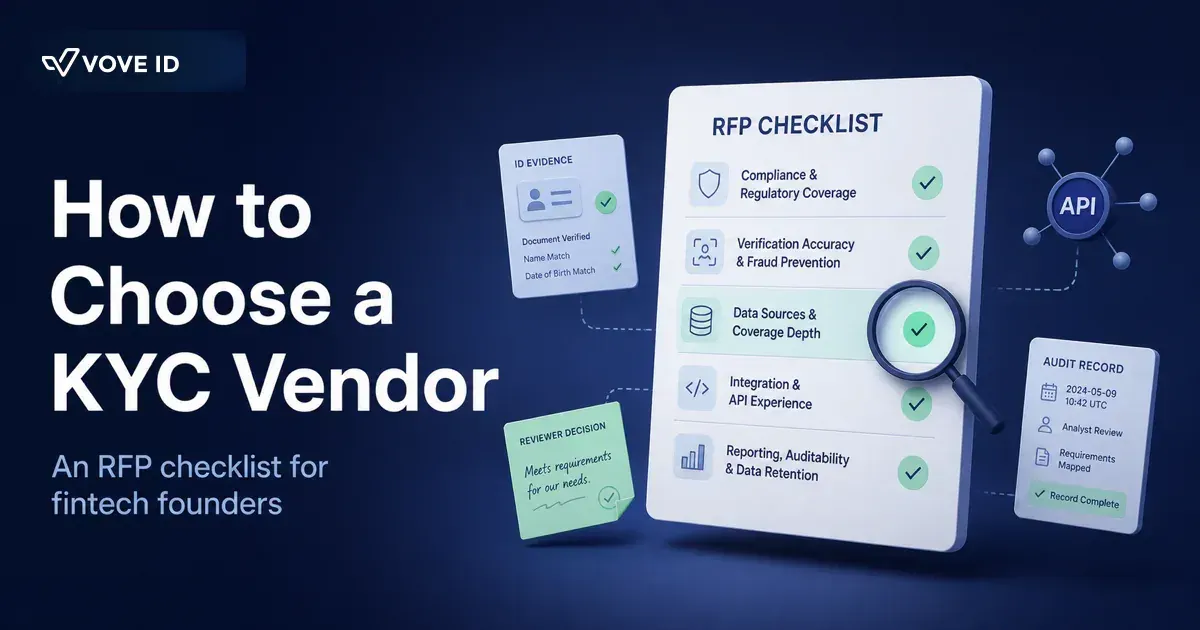
Coverage and evidence. Ask which document types, countries, scripts, and user pathways are relevant to your launch markets. Request the exact definition of coverage. A document listed in a catalogue is not automatically proof that it fits your policy, risk level, or user population.
Decision states and exceptions. Ask for every possible case state, including pending review, additional evidence required, approved, declined, cancelled, and expired where applicable. Ask how the product surfaces those states to an applicant, reviewer, support agent, and your application.
Fraud and evidence controls. Ask what evidence the vendor returns to support a decision and how a reviewer can understand a document or liveness exception. Do not ask for a marketing score in isolation. Ask how the control is configured, what its limits are, and what evidence is retained.
Integration and security. Request the documented API contract, authentication approach, data flows, test environment, callback or status-retrieval approach, error handling, and logs. The OWASP API Security Top 10 is a useful review prompt: identity APIs carry sensitive data and need more than a working form submission.
Operations and auditability. Ask who can review an exception, what decision record exists, how access is controlled, how a case can be exported for a review, and how policy changes are documented. A vendor cannot replace your compliance ownership, but it should make that ownership operable.
Commercial and exit terms. Ask for a model you can map to your volume, support needs, and contract term. Confirm data-return, retention, migration, and change-notice processes with your legal, procurement, privacy, and security owners. These are contract questions, not assumptions to infer from a demo.
This checklist assumes the team has already decided to buy rather than build. For the cost-model decision itself, see our KYC compliance cost guide: build vs. buy vs. API.
A realistic selection failure: the approval demo passes, the queue does not
A payments fintech is preparing to launch in two markets. The buying team has:
- A document and selfie demo that returns an approval
- A short feature comparison from three vendors
- A target launch date
Then the team asks what happens when a valid customer submits an unfamiliar document, a liveness result needs review, or a name mismatch requires additional evidence. One vendor can show the happy path but cannot explain the application states, reviewer evidence, or support handoff in the team's required flow.
Product cannot write a safe customer message. Compliance cannot define a review decision from the information shown. Engineering has no tested contract for the exception path.
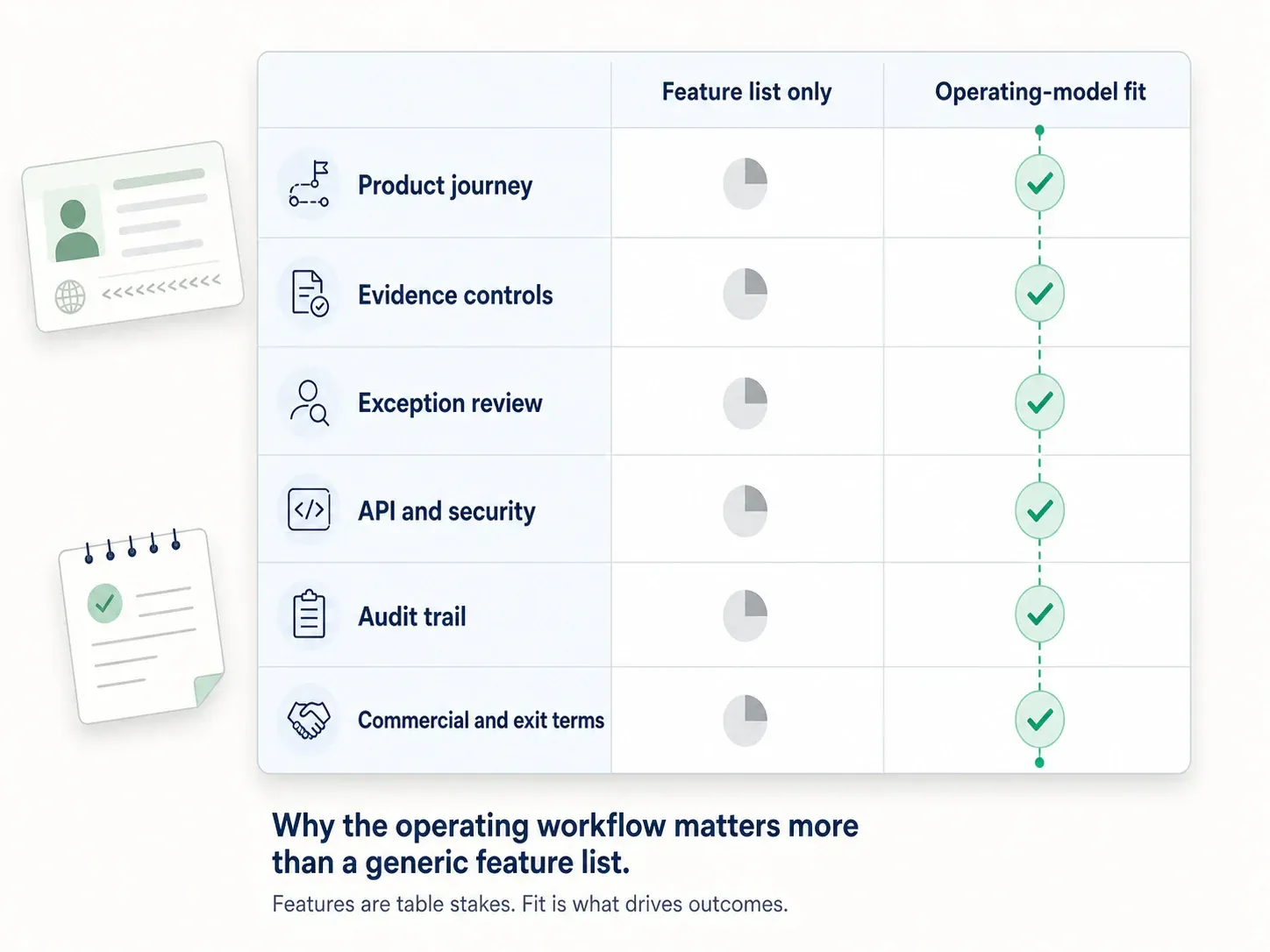
This is not a vendor-feature failure. It is an RFP failure.
How VOVE ID fits: controls that support a defined workflow
VOVE ID supports identity verification, biometric liveness, face matching, AML screening, KYB, and transaction monitoring, with document coverage spanning a broad range of countries and document types (exact figures available on request), plus checks for document-template inconsistencies, invalid MRZ checksums, barcode or QR inconsistencies, and image manipulation.
Those capabilities should be tested against the team's own policy and evidence requirements. AML screening is customer-configurable, and where a compliance team has sufficient evidence, manual review may support an approval decision. A buyer should confirm the relevant configuration, documentation, and contract terms for its use case before relying on any workflow.
The better selection outcome is not "the vendor with the most checks." It is the provider whose evidence, integrations, and review path let the team make and defend the right decision.
Practical KYC vendor RFP checklist
Product and policy
- Map each product action to its required identity outcome before issuing the RFP.
- Require vendors to explain every case state and the owner for each exception.
- Test the workflow against your launch countries, customer types, and risk appetite.
Evidence and review
- Ask what evidence supports document, liveness, and identity outcomes.
- Define the information a reviewer and support agent need for a defensible case.
- Confirm how policy changes, overrides, and decisions are recorded.
Engineering and security
- Review the documented API contract, authentication, errors, events, and logs.
- Test unhappy paths, not only an approved demo submission.
- Bring security and privacy owners into data-flow and access-control review early.
Commercial and governance
- Model pricing against the volumes and support model you can actually forecast.
- Confirm service, retention, data-return, migration, and change-notice terms in writing.
- Assign one internal owner for vendor governance after launch.
FAQ
What should a KYC vendor RFP include?
It should cover the product journey, evidence and decision states, document and market fit, review operations, integration, security, privacy, commercial terms, and exit planning. The questions should come from your workflow, not a generic feature grid.
Is document coverage enough to choose a provider?
No. Coverage is only one input. Confirm how the evidence fits your policy, how exceptions are surfaced, and how the result becomes a controlled product decision.
Should founders run the RFP alone?
No. Product, compliance, engineering, security, privacy, operations, and procurement own different parts of the risk. A compact cross-functional review is usually faster than discovering those gaps after selection.
Can a KYC vendor guarantee regulatory compliance?
No vendor replaces a firm's legal and compliance responsibilities. A provider can supply tools and evidence, while the firm defines its risk-based policy, customer journey, governance, and required controls.
Conclusion
Choosing a KYC vendor is not a purchase of an approval screen. It is a choice about what evidence your team can collect, review, act on, and explain.
Teams make better decisions when their RFP tests the whole workflow: product state, evidence, exceptions, integration, and audit trail. The right vendor makes that workflow easier to run — it does not run it for you.
This article is intended for general informational purposes only and does not constitute legal, financial, or regulatory advice. KYC/KYB/AML requirements may vary depending on jurisdiction, industry, and specific business circumstances. For up-to-date and binding compliance obligations, readers should refer to the relevant regulatory authorities or consult qualified professionals.