VOVE ID vs Jumio for Emerging-Market Fintechs: A Buyer’s Evaluation Framework
A generic coverage list doesn't tell you if your customers' real documents and exception paths work in production. Here's how to test before you sign.
A generic coverage list does not tell a fintech whether its real documents, exception paths, and review requirements will work together in production.
VOVE ID helps fintech teams verify customers and keep an auditable identity workflow when the documents, scripts, and review conditions differ by market. The failure starts when a team buys "global coverage" before it tests the exact IDs and operating controls it needs.
Jumio and VOVE ID can both belong on a fintech's identity-verification shortlist. The decision should turn on evidence from your live markets, not a generic vendor ranking.
This is exactly where vendor selection loses contact with production reality.
For a full breakdown of identity-verification controls, see our KYC requirements framework.
Start with the operating question: what must the workflow prove?
Jumio publicly describes identity-verification, screening, and monitoring products. Its screening materials describe configurable sanctions, PEP, and adverse-media checks, plus ongoing monitoring options. That is useful context, not a reason to assume the product fits every corridor or onboarding flow.
For VOVE ID, the approved product fact base includes identity verification, biometric liveness, face matching, AML screening, KYB, and audit-ready logging, with document coverage spanning a broad range of document types and countries (exact figures available on request). A team still needs to confirm the exact documents, rules, and commercial terms for its launch.
This means one thing: a buyer should compare proven workflow fit, not marketing scope.
Emerging-market evaluation: the tests that change a shortlist
The first test is document reality. Collect a controlled sample from the markets you will launch in: national IDs, passports, residence permits, proof-of-address documents, and the capture conditions your customers actually use. Include low-light mobile captures, mixed scripts, damaged documents, and older document versions where lawful to test.
The second test is the review path. A clean automated result is only part of onboarding. Your compliance team needs to see what happens when a document requires further evidence, a face match needs review, or a screening hit needs disposition. Ask for the decision record, reviewer handoff, and audit trail — not just the demo approval screen.
The third test is controls. Confirm how sanctions screening fits the customer lifecycle, what lists and risk settings your program needs, and how teams document a decision. Do not treat screening, monitoring, and transaction monitoring as interchangeable terms.
A realistic buyer review: the cross-border wallet launch
A payments team is preparing to launch a wallet for customers in two African markets and one European corridor. It receives a normal-looking vendor proposal and a broad coverage list.
Its test pack includes:
- National identity cards from each launch market
- Passports and residence permits from diaspora customers
- Low-bandwidth mobile captures and mixed-script documents
- A small set of deliberately incomplete onboarding cases
- Sanctions-screening and manual-review scenarios approved by compliance
Then the practical differences appear.
One document type parses cleanly but needs a defined exception path. A screening match needs a reviewer decision with an evidence trail. An embedded flow has to return a decision to the wallet without leaving the customer uncertain about what happens next.
This is not a coverage failure. It is an operating-model test.
The comparison matrix: evaluate evidence, not claims
| Buyer question | What to request from Jumio | What to request from VOVE ID | Decision evidence |
|---|---|---|---|
| Can the launch documents be handled? | A test of the exact documents and capture conditions | A test of the exact documents and capture conditions | Document-level outcomes and exception reasons |
| Can the workflow meet risk policy? | A walkthrough of verification, screening, review, and records | A walkthrough of verification, screening, review, and records | Written control mapping and reviewer path |
| Can engineering integrate safely? | The integration pattern, events, and ownership model | The API flow, events, and ownership model | A sandbox pilot with failure cases |
| Can operations close exceptions? | Review queues, escalation, and evidence retention process | Review queues, escalation, and audit logging process | A timed case walkthrough |
| Can the contract support the forecast? | Pricing basis, minimums, retries, and change terms | Pricing basis, minimums, retries, and change terms | A low-, base-, and high-volume model |
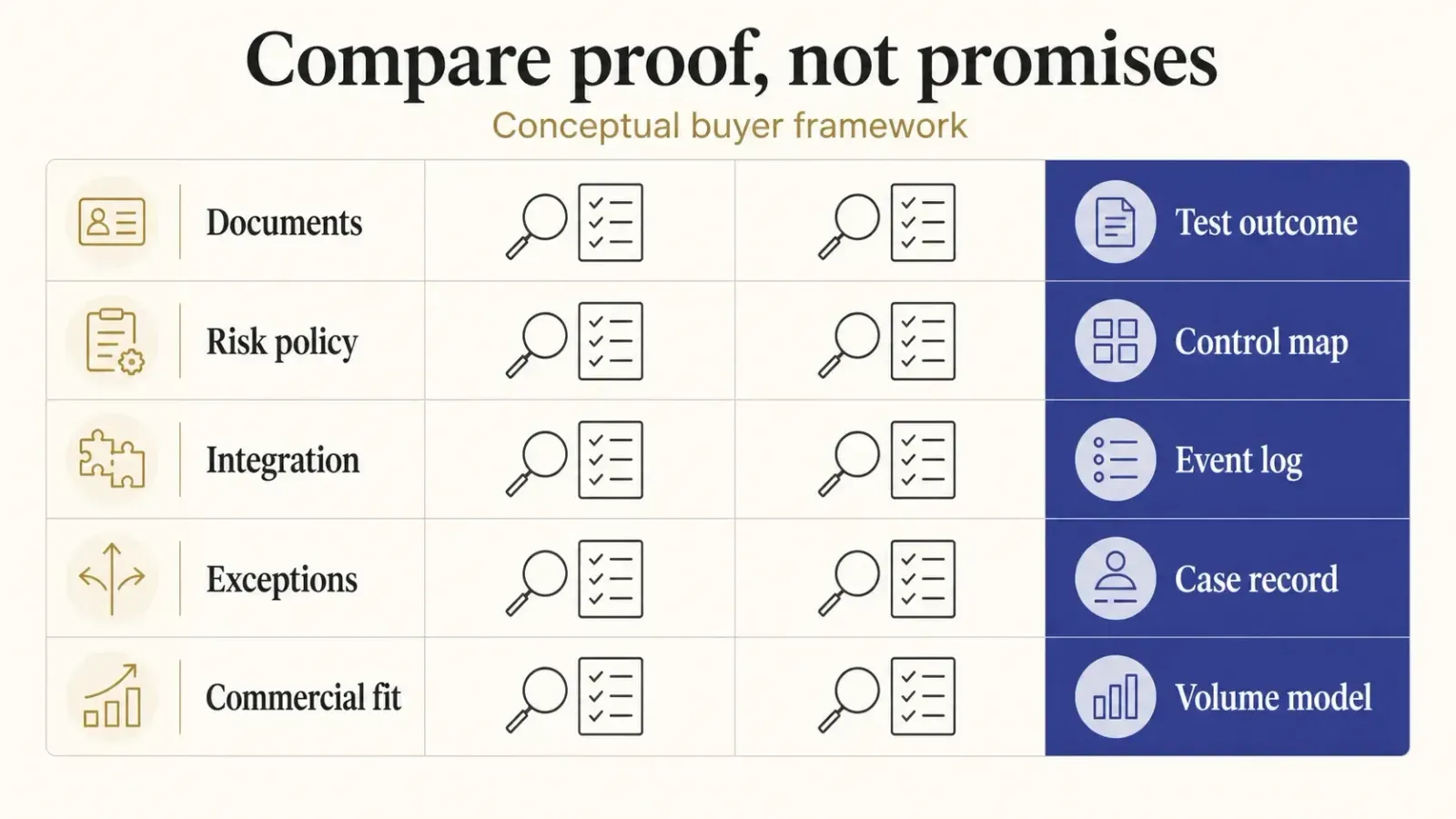
This table is deliberately not a scorecard. A point score hides the conditions that matter most: which documents were tested, what policy applied, and who owns a failed or inconclusive result.
How VOVE ID approaches fit: one auditable operating layer
VOVE ID is relevant when a fintech needs document verification, biometric liveness, face matching, AML screening, KYB support, and a decision record that a risk team can review. The product discussion should begin after the team has mapped its actual onboarding and review exceptions.
That is especially important in cross-border launches. A vendor may be able to accept a document, while the team still needs to decide whether the evidence meets its policy, how to handle a mismatch, and how to record the outcome.
The right rollout is therefore a short, controlled pilot. Give both vendors the same approved test set, run the same exception scenarios, and compare the operational evidence before signing a long-term agreement.
Practical vendor-evaluation checklist
Coverage
- Test every launch-market document type in the planned capture conditions.
- Confirm the treatment of older, damaged, mixed-script, and low-quality documents.
- Record unsupported and inconclusive outcomes separately from declines.
Compliance
- Map identity, screening, and review steps to the written risk policy.
- Confirm the evidence available to reviewers for a screening or identity decision.
- Verify audit-log access and retention requirements with legal and compliance teams.
Engineering
- Run the actual embedded or hosted flow in a sandbox.
- Test approval, decline, timeout, retry, and manual-review events.
- Assign ownership for integration changes and exception handling.
Commercial fit
- Model low-, base-, and high-volume months before comparing prices.
- Confirm what counts as a billable attempt, retry, or manual review.
- Review change-control and support terms before launch.
FAQ
Is Jumio a credible option for fintech identity verification?
Yes. Jumio publicly offers identity-verification and AML-screening products. The buyer's question is whether the tested workflow, controls, and commercial terms fit the team's exact launch conditions.
Is VOVE ID a replacement for every Jumio deployment?
No. A replacement decision should follow a documented pilot. VOVE ID is a relevant option for teams that need the approved identity, liveness, face-matching, AML, KYB, and audit-log capabilities in one operating workflow.
What should an emerging-market pilot include?
Use real, lawfully obtained document samples from planned markets, realistic mobile capture conditions, policy-approved screening cases, and a manual-review walkthrough.
Why is a generic coverage list not enough?
Coverage lists do not show whether your customers' real documents, exception paths, and review requirements work together in production.
Conclusion
VOVE ID versus Jumio is not a contest between a "global" vendor and a local one. It is a decision about evidence.
Teams should test the documents they will receive, the cases they must review, and the commercial model they will operate under. What separates a real evaluation from a coverage list is whether collection, review, screening, and case ownership hold together as one workflow, not three.
Want to test VOVE ID against your live-market requirements?
This article is intended for general informational purposes only and does not constitute legal, financial, or regulatory advice. KYC/KYB/AML requirements may vary depending on jurisdiction, industry, and specific business circumstances. For up-to-date and binding compliance obligations, readers should refer to the relevant regulatory authorities or consult qualified professionals.