KYB Compliance in Côte d'Ivoire: 2026 Guide for Fintech & PSPs
Côte d'Ivoire's registry is digitizing fast and a new beneficial-ownership register just went live — here's what that means for verifying business partners.
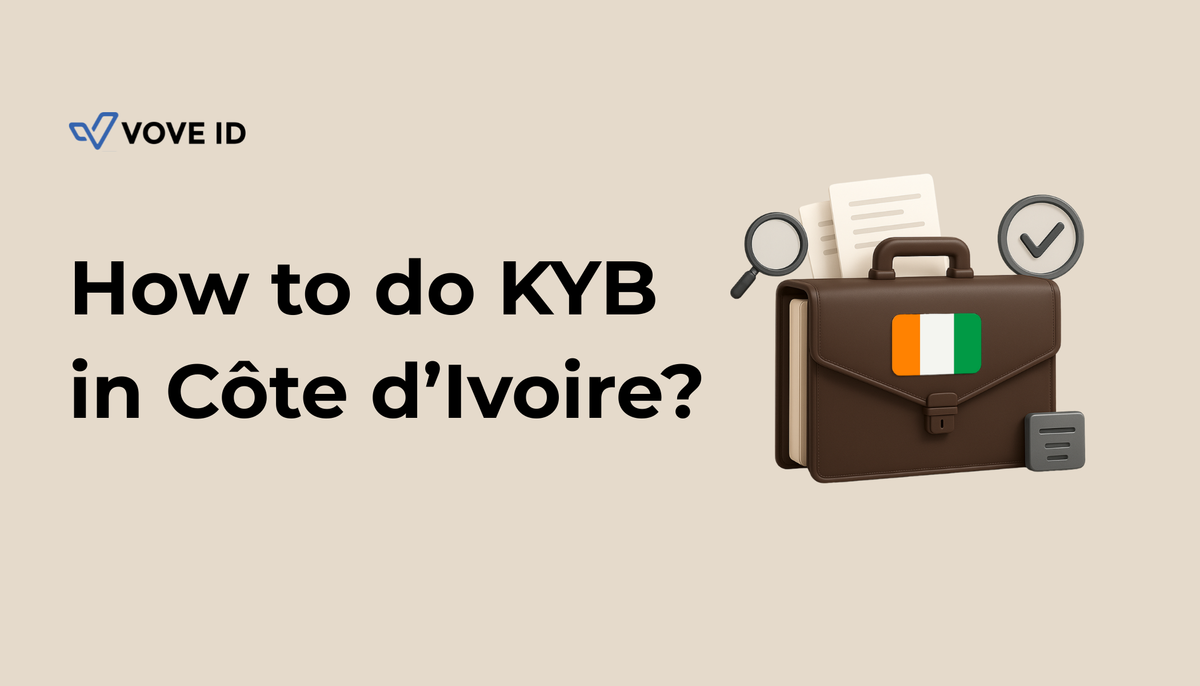
Côte d'Ivoire is a fintech and payments hub for West Africa, with the World Bank projecting continued strong GDP growth through 2026 and digital wallets and PSPs attracting sustained investment. That growth is exactly why Know Your Business (KYB) — verifying merchants, partners, and vendors — matters: it's the control that keeps AML/CFT obligations enforceable and keeps fraud out of a fast-growing digital economy. VOVE ID works with fintechs and PSPs building that verification layer for Côte d'Ivoire.
This guide covers business verification requirements in Côte d'Ivoire. For the underlying KYB framework, see our KYB Requirements Explained 2026.
The Regulatory Landscape for KYB in Côte d'Ivoire
- CENTIF-CI: the Financial Intelligence Unit requiring KYB and customer due diligence (CDD) from financial institutions, and STR filing for suspicious activity.
- BCEAO: sets KYB standards for banks, e-money issuers, and PSPs through instructions including No. 001-01-2024 (payment services in UMOA) and No. 003-03-2025 (customer identification and verification, including the beneficial-ownership threshold).
- OHADA & RCCM: OHADA provides a unified commercial code across the region; businesses register in the Registre du Commerce et du Crédit Mobilier (RCCM) for legal and ownership verification.
- A national Register of Beneficial Owners (Loi n° 2024-362), operational since June 2025, is centralizing UBO data — though in practice, self-declarations and enhanced due diligence still fill the gaps for entities not yet fully reflected in the registry.
- GIABA & FATF: Côte d'Ivoire has been under FATF increased monitoring since October 2024, with beneficial-ownership transparency named as one of the areas under active remediation.
For customer due diligence requirements for individual customers, see our KYC guide for Côte d'Ivoire.
What KYB Means in Practice
- Confirming legal existence: validating RCCM registration, including the Tax Identification Number (TIN) and legal status.
- Identifying beneficial owners: natural persons with ownership above 25%, or control, via self-declaration or enhanced CDD for high-risk cases.
- Validating licenses and business purpose: confirming regulatory approvals (e.g., BCEAO licenses for fintechs) and alignment with declared business activity.
- Ongoing monitoring: periodic re-verification of partners, transaction monitoring, and STR filing with CENTIF-CI where warranted.
A PSP onboarding a cocoa exporter, for example, needs to verify RCCM registration, screen UBOs against sanctions lists, and set monitoring thresholds calibrated to that exporter's typical transaction volume.
Why KYB Is Crucial in Côte d'Ivoire
- AML/CFT compliance: KYB prevents misuse by shell companies — a known focus area for CENTIF-CI and BCEAO in real estate and informal trade.
- Global credibility: alignment with FATF via GIABA supports correspondent banking relationships and cross-border partnerships.
- Business integrity: a verified business ecosystem reduces risk for the foreign direct investment the country is actively courting.
- Risk-based approach: BCEAO mandates risk classification for business clients, tailoring KYB depth to industry, location, or transaction volume.
Non-compliance carries fines, license suspension, or legal action under Ordinance No. 2023-875 and the administrative sanctions regime set out in Ordinance No. 2022-237.
Digital KYB Trends
- RCCM digitization: since OHADA's 2019 reforms, a large majority of new company registrations are filed digitally, with partial access via portals like cepici.gouv.ci — though full API access to registry data is still limited.
- Mobile-first onboarding: PSPs are increasingly digitizing merchant KYB to match how mobile money adoption is reshaping the merchant base.
- API-driven verification: fintechs are layering third-party tools on top of RCCM and sanctions checks, though comprehensive registry APIs are not yet widespread.
KYB in Action: Onboarding a Retail Merchant
Consider a PSP in Abidjan onboarding an electronics retailer:
- Pull RCCM records to verify TIN and registration.
- Check ownership — identify UBOs through shareholder declarations, screened against PEP and sanctions lists (UN, WAEMU).
- Validate licenses and confirm sector compliance.
- Monitor transactions, flagging patterns inconsistent with the merchant's declared activity and filing STRs with CENTIF-CI if irregularities appear.
Merchants in high-traffic commercial areas may warrant enhanced checks given cash-intensive operating patterns.
Where KYB Still Breaks Down
- UBO data maturity: the new beneficial-ownership register is live, but coverage is still building — self-declarations remain a practical necessity for many entities in the meantime.
- Registry inconsistencies: partial RCCM digitization still means manual searches or in-person verification, especially outside Abidjan.
- Language barrier: legal documents in French require KYB tooling localized for that context.
- Fragmented oversight: overlapping mandates between CENTIF-CI, BCEAO, and local authorities complicate reporting.
- Informal sector: verifying unregistered SMEs in a large informal economy remains genuinely hard.
Hybrid KYB models — digital-first with manual fallback — are still the realistic approach for navigating these gaps.
How VOVE ID Supports KYB in Côte d'Ivoire
VOVE ID gives fintechs, PSPs, and digital platforms a single workflow for business verification:
- Document extraction: pulls structured data from RCCM registration documents, TINs, and corporate filings submitted at onboarding.
- Sanctions and PEP screening: checked against UN and WAEMU lists.
- UBO verification workflows: risk-based scoring to streamline beneficial-owner checks in a still-maturing registry environment.
- French-localized, mobile-first onboarding, built for Côte d'Ivoire's overwhelmingly mobile user base.
- Audit-ready logging for CENTIF-CI and BCEAO inspections.
FAQ
Is KYB mandatory in Côte d'Ivoire? Yes — financial institutions, e-money issuers, and PSPs must conduct KYB under BCEAO and CENTIF-CI AML/CFT rules.
Where can I verify a business in Côte d'Ivoire? Through the RCCM via online portals or CEPICI, with licenses validated through BCEAO or the relevant sector ministry.
Does Côte d'Ivoire have a UBO register? Yes, as of June 2025 (Loi n° 2024-362) — though coverage is still maturing, and enhanced due diligence with self-declarations remains necessary for entities not yet fully reflected in it.
What are the penalties for non-compliance? Fines up to 100M CFA, license suspension, or legal action, depending on the severity of the violation.
For the complete, sourced requirement-by-requirement checklist, see VOVE ID's Côte d'Ivoire compliance checklist.
Conclusion
KYB compliance in Côte d'Ivoire is the foundation for scaling securely in one of West Africa's fastest-growing fintech markets. With CENTIF-CI, BCEAO, and OHADA setting the rules, a digitizing RCCM, and a new UBO register still building coverage, the businesses that verify partners properly now are the ones that won't have to rebuild their compliance stack when enforcement tightens further.
A verified partner today doesn't guarantee a clean file tomorrow — Côte d'Ivoire's UBO register is still filling in. VOVE ID helps fintechs and PSPs keep beneficial-ownership checks, sanctions screening, and audit trails current as that picture changes.
This article is intended for general informational purposes only and does not constitute legal, financial, or regulatory advice. KYC/KYB/AML requirements may vary depending on jurisdiction, industry, and specific business circumstances. For up-to-date and binding compliance obligations, readers should refer to the relevant regulatory authorities or consult qualified professionals.