KYC Compliance in Côte d'Ivoire: 2026 Guide for Regulated Businesses
A grey-listed FATF status and a fast-digitizing biometric ID system make Côte d'Ivoire's KYC rules move faster than most compliance calendars.
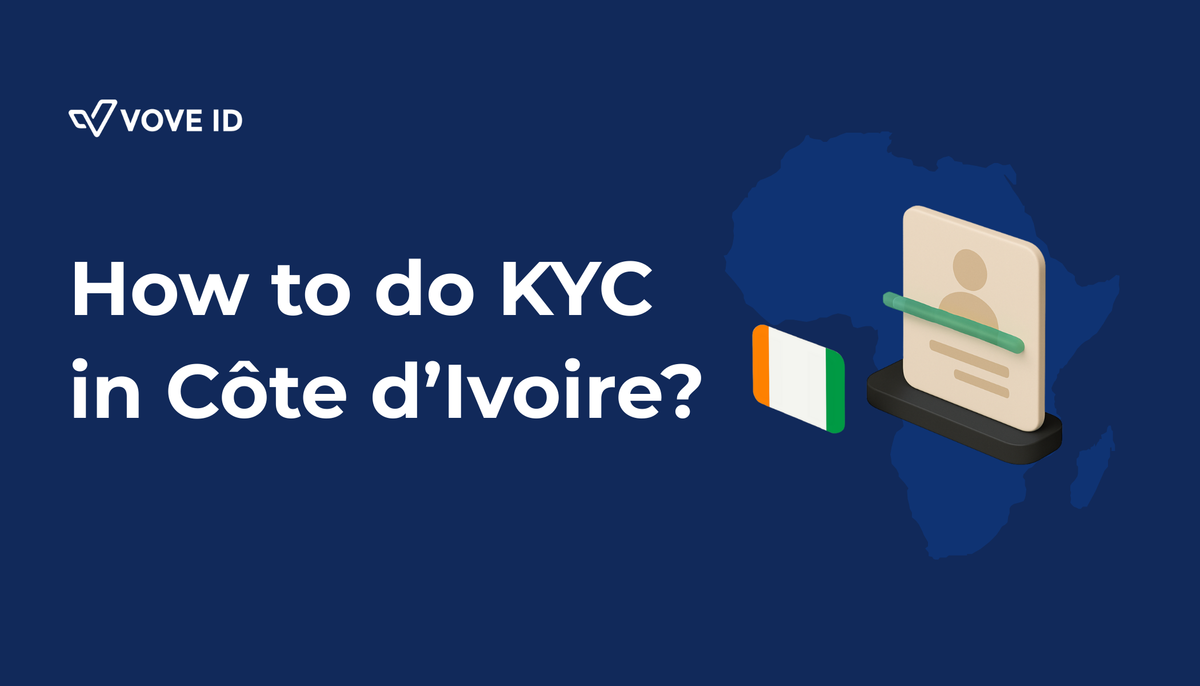
Côte d'Ivoire anchors West Africa's fintech growth, with mobile-first banking and a fast-expanding biometric ID system reshaping how regulated businesses onboard customers. VOVE ID works with fintechs, telecoms, and digital platforms building customer due diligence into onboarding flows across Abidjan and beyond — this guide breaks down what that requires in 2026.
This guide covers customer due diligence for individuals in Côte d'Ivoire. For the underlying KYC framework and workflow fundamentals, see our KYC Requirements Explained 2026.
Who Oversees KYC in Côte d'Ivoire
- CENTIF-CI (Cellule Nationale de Traitement des Informations Financières): the Financial Intelligence Unit collects and analyzes suspicious transaction reports (STRs) to combat money laundering and terrorist financing.
- BCEAO (Banque Centrale des États de l'Afrique de l'Ouest): the UEMOA central bank enforces AML/CFT rules for banks, fintechs, and mobile money providers, including Instruction No. 003-03-2025 on customer identification and verification.
- Ordinance No. 2023-875 (23 November 2023) on combating money laundering, terrorist financing, and proliferation financing is the current legal basis for KYC, risk assessment, record-keeping, and STR filing — it replaced the earlier Law No. 2016-992.
- ARDP (Autorité de Protection des Données à Caractère Personnel): enforces the 2013 Data Protection Law over KYC-related personal data.
- GIABA & FATF: Côte d'Ivoire has been under FATF increased monitoring (the "grey list") since October 2024, with mandates to strengthen prosecutions, asset recovery, and beneficial ownership verification — a status still in force in 2026.
For the AML enforcement structure behind these obligations, see our AML Requirements Explained 2026.
What Due Diligence Looks Like in Practice
For individuals
- Full name, date/place of birth, nationality: verified via official ID.
- Residential address: validated with utility bills, lease agreements, or local authority letters.
- Official ID: the Carte Nationale d'Identité (CNI), biometric passport, or residence permit issued by ONECI.
- Source of funds: required for high-risk profiles.
For legal entities
- Business registration certificate issued by CEPICI.
- Company statutes and ownership structure.
- Tax Identification Number (TIN).
- Details of directors and beneficial owners, including IDs and address proof.
- Board resolution authorizing use of the financial service.
For business verification, beneficial ownership, and RCCM requirements, see our KYB guide for Côte d'Ivoire.
Enhanced Due Diligence (EDD)
High-risk clients — politically exposed persons (PEPs) or cross-border entities — require senior management approval, source-of-wealth verification, and continuous transaction monitoring. A PEP managing a cross-border remittance platform, for example, needs rigorous fund-source checks and real-time monitoring of activity.
Record-Keeping
Ordinance No. 2023-875 requires retaining KYC and transaction records for 10 years after the client relationship ends, accessible for CENTIF-CI and BCEAO audits. This is longer than the 7-year standard under the previous legal regime — businesses still applying the old retention window should update their policies.
Digital Onboarding and eKYC
Côte d'Ivoire's biometric ID rollout, led by ONECI, has reshaped digital onboarding for banks, mobile money operators, and lending platforms:
- Biometric verification: facial recognition, fingerprint matching, and liveness checks are increasingly standard.
- Mobile-first onboarding: the large majority of internet access in the country is via mobile devices, pushing onboarding flows to be mobile-native by default.
- AI-driven fraud detection: used to flag fake documents and spoofing attempts.
The country's biometric ID program now covers a majority of the adult population, which is materially raising eKYC match rates compared to document-only verification.
Where KYC Still Breaks Down
- Document fraud: counterfeit IDs persist, though biometrics reduce the risk.
- Data mismatches: ONECI's database can conflict with older, legacy registries, causing verification errors.
- Rural connectivity gaps: reliable internet access outside urban centers remains limited, constraining eKYC adoption.
- Cost of compliance tech: API and AI-based solutions can be a real barrier for early-stage startups.
- Regulatory pace: CENTIF-CI, BCEAO, and FATF-driven changes (tied to the grey-list remediation plan) require ongoing adjustment.
Hybrid models — automated checks backed by manual review for edge cases — remain necessary for reaching customers outside the biggest cities.
How VOVE ID Supports KYC in Côte d'Ivoire
VOVE ID gives regulated businesses a single onboarding layer built for this environment:
- OCR-based document extraction, including French-language CNI, passport, and residence permit data.
- Biometric liveness detection and face matching against the document photo, to catch spoofing and fraud attempts.
- Sanctions and PEP screening at onboarding and on an ongoing basis.
- Audit-ready logging, structured for CENTIF-CI and BCEAO review.
FAQ
Is eKYC legally accepted in Côte d'Ivoire? Yes, provided it includes biometric checks, audit logs, and ARDP-compliant data handling.
Is KYC mandatory for mobile money platforms? Yes — under BCEAO rules, all regulated financial services must implement KYC.
What are the penalties for non-compliance? Fines, license suspension, or legal sanctions from CENTIF-CI or BCEAO, scaled to the severity of the breach.
How long must KYC records be kept? At least 10 years after the customer relationship ends, under Ordinance No. 2023-875.
For the complete, sourced requirement-by-requirement checklist, see VOVE ID's Côte d'Ivoire compliance checklist.
Conclusion
KYC compliance in Côte d'Ivoire now runs on a tighter clock than it did even a year ago — a live FATF grey-list status and a fast-maturing biometric ID system mean the standard for "acceptable" onboarding keeps moving. Businesses that build for audit-ready, biometric-backed verification now avoid rebuilding under pressure later.
Côte d'Ivoire's KYC rules are moving with the FATF grey-list clock, not the calendar year. VOVE ID helps regulated businesses keep identity verification, biometric checks, and audit trails ready for CENTIF-CI and BCEAO review — not just fast onboarding.
This article is intended for general informational purposes only and does not constitute legal, financial, or regulatory advice. KYC/KYB/AML requirements may vary depending on jurisdiction, industry, and specific business circumstances. For up-to-date and binding compliance obligations, readers should refer to the relevant regulatory authorities or consult qualified professionals.