KYB Compliance in Gabon: 2026 Guide for Regulated Businesses
Verifying a Gabonese business entity means navigating the RCCM registry, fragmented UBO documentation, and COBAC's beneficial ownership rules — with no public UBO register to fall back on.
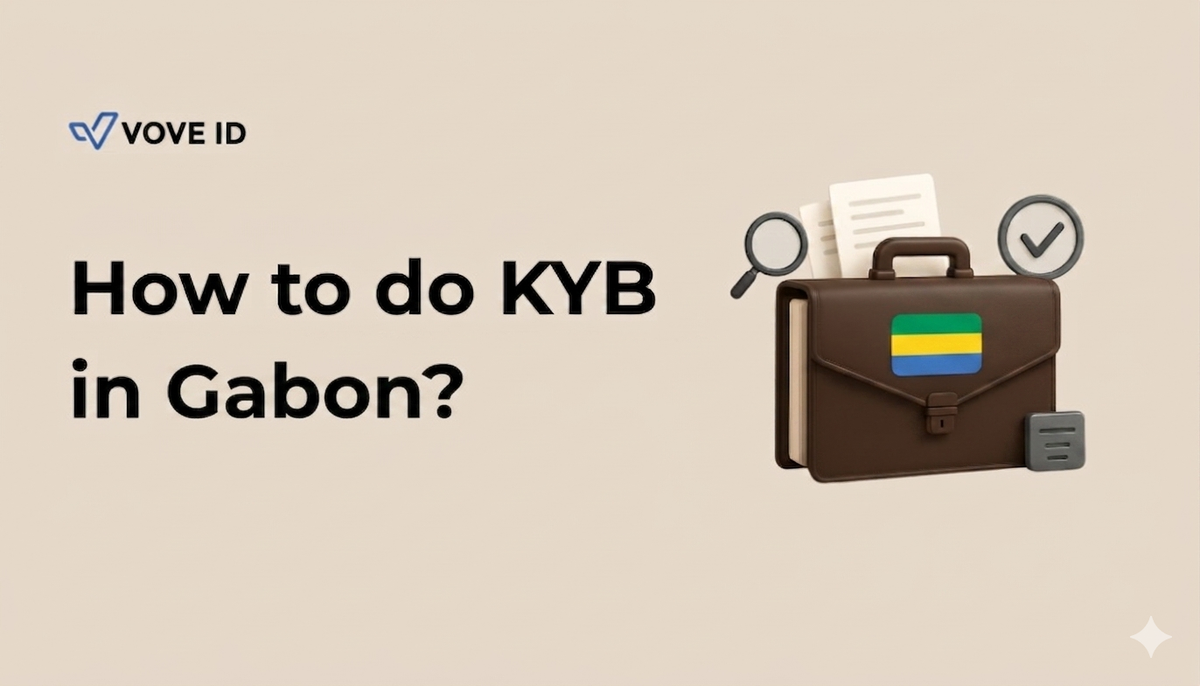
Verifying a Gabonese business entity is not a one-database exercise. The country's commercial registry (RCCM) holds incorporation records, but there is no publicly accessible UBO register, beneficial ownership declarations are submitted to tax authorities rather than publicly disclosed, and the quality of registry data varies by registration date. For any regulated institution onboarding a Gabonese corporate customer or counterparty, the practical friction starts early.
VOVE ID supports KYB workflows in CEMAC jurisdictions — covering beneficial ownership identity verification where registry data runs out.
This guide covers Gabon's business verification requirements specifically. For the underlying framework on entity due diligence, see our KYB Requirements Explained: 2026.
The Regulatory Basis for KYB
Gabon does not have a standalone KYB law. Business verification obligations flow from the same CEMAC/COBAC AML framework that governs individual customer due diligence — primarily COBAC Regulation R-2005/01 and the CEMAC Regulation No. 01/03/CEMAC/UMAC/CM on AML/CFT. These require financial institutions to:
- Identify and verify the legal status and constitution of any corporate customer
- Identify beneficial owners with a controlling interest
- Understand the nature and purpose of the business relationship
- Conduct ongoing monitoring appropriate to the risk profile
The UBO threshold under CEMAC guidance follows the FATF standard: 25% ownership or control triggers beneficial ownership identification. In practice, many institutions apply a lower working threshold given the complexity of nominee and holding structures common in Gabon's oil services and real estate sectors.
ANIF (Agence Nationale d'Investigation Financière), Gabon's FIU, has increased scrutiny of corporate structures used to hold natural resource concession payments — a risk vector that directly affects KYB processes for financial institutions active in the sector.
The RCCM: What It Contains and What It Doesn't
The Registre du Commerce et du Crédit Mobilier (RCCM) is Gabon's primary commercial registry, administered under the OHADA legal framework. Gabon is a member of OHADA (Organisation pour l'Harmonisation en Afrique du Droit des Affaires), meaning its commercial law — including company formation rules — follows the Acte Uniforme sur les Sociétés Commerciales.
The RCCM records:
- Company name, legal form, and registration number (RCCM number)
- Registered address
- Date of incorporation
- Declared share capital
- Names of statutory managers (gérant or directeurs généraux)
- Registered agent information
What it does not reliably contain:
- Beneficial owners behind nominee shareholding structures
- Real-time updates when directors or shareholders change
- Electronic access to underlying constitutional documents (statuts)
The RCCM in Libreville has made partial progress toward digitization, but remote registry searches are not available for all entity types, and records for older companies — pre-2010 registrations in particular — may be incomplete or require in-person retrieval.
Legal Forms You'll Encounter
Under OHADA rules, the main corporate forms in Gabon are:
SA (Société Anonyme) — the standard structure for larger enterprises, regulated financial entities, and listed companies. Requires a minimum capital of XAF 10 million. Has a board of directors (conseil d'administration).
SARL (Société à Responsabilité Limitée) — the most common form for SMEs. Minimum capital XAF 1 million. One or more gérants manage the entity.
SAS (Société par Actions Simplifiée) — flexible structure gaining adoption for startup and holding company contexts. Fewer mandatory governance requirements than SA.
Succursale (Branch) — foreign companies operating in Gabon may register a branch rather than incorporating locally. Branches are common in the oil and gas sector. For KYB purposes, the parent company's documentation is required alongside the branch's RCCM filing.
GIE (Groupement d'Intérêt Économique) — a cooperative structure used in agriculture and small-scale trade. Less common in regulated financial contexts but occasionally encountered.
Required Documentation for Corporate Onboarding
A standard KYB document pack for a Gabonese SARL or SA typically includes:
- Statuts constitutifs (articles of incorporation and statutes)
- Procès-verbal de constitution (minutes of formation meeting)
- Extrait RCCM (registry extract, ideally dated within 3 months)
- NIU (Numéro d'Identification Unique) — the Gabonese tax identification number
- Liste des actionnaires (shareholder register) with ownership percentages
- Piece d'identité for each beneficial owner and director above the threshold
- Justificatif de siège social (proof of registered address)
- For financial institutions: agrément (operating license) from COBAC
For branches of foreign companies, add the parent's equivalent documents, translated into French where necessary, and apostilled if originating from non-OHADA jurisdictions.
UBO Identification: The Practical Gap
The gap between declared and actual beneficial ownership is widest in three areas:
Holding chains through offshore entities. Gabonese operating companies are frequently held through intermediaries in jurisdictions like Mauritius, France, Dubai, or Seychelles. Walking that chain back to a natural person requires requesting constitutional documents from each layer — and those documents arrive in varying formats, languages, and states of completeness.
Nominee shareholding. In the oil services sector, it is common for a local Gabonese partner to hold a declared stake on behalf of a foreign investor under informal nominee arrangements. These are not reflected in RCCM filings.
Family holding structures. Gabonese business culture includes significant family ownership, with shares distributed across relatives to comply with the letter of partnership requirements while concentrating effective control. Identifying who actually controls a family-held SARL requires going beyond the shareholder list.
For these cases, beneficial ownership verification requires collecting identity documents from each declared UBO — and verifying those identities with liveness and face matching checks rather than relying on unverified document copies. VOVE ID's biometric verification covers UBO identity checks for individuals regardless of the nationality of their identity document.
Cross-Border Onboarding Considerations
A meaningful share of corporate entities doing business in Gabon are registered elsewhere — in France, Cameroon, Equatorial Guinea, or further afield — and simply operate locally. For institutions onboarding these entities, the same CEMAC rules apply: identify the entity, understand its structure, identify beneficial owners.
The OHADA framework creates partial harmonization across member states, meaning company documents from Cameroon or Côte d'Ivoire follow similar structural conventions. But harmonization is formal, not operational — documents still need to be verified, and registry data from neighboring jurisdictions has the same access limitations.
For KYC on the natural persons behind these entities, see our KYC Compliance in Gabon: 2026 Guide for accepted documents and verification standards.
Ongoing Monitoring Requirements
Entity due diligence is not a one-time exercise. COBAC rules require periodic refresh of corporate documentation and continuous monitoring of transactions against the declared business profile. In practice, this means:
- Triggering re-verification when a change in directors, shareholders, or ownership structure is detected
- Re-running UBO checks when a customer's risk classification changes
- Monitoring transactions for patterns inconsistent with the entity's declared activity
Gabon has no automated company event notification system. Changes filed with the RCCM are not proactively communicated to financial institutions. Compliance teams must rely on periodic document refresh cycles or transaction pattern monitoring to detect material changes.
Sector Risks That Affect KYB Decisions
Oil and gas services: Hundreds of subcontractors and service companies operate in Gabon's hydrocarbon sector. Many are thinly capitalized, recently incorporated, and difficult to trace to natural persons. The sector's procurement chains are historically opaque.
Logging and forestry: Concession-based forestry creates corporate structures specifically designed to manage permit relationships with the government. Shell company risk is higher here than in most other sectors.
Public procurement: Companies winning government contracts represent a specific risk category given Gabon's history of politically connected contracting. PEP exposure is common in the ownership structures of procurement-active companies.
For AML implications of these sectors, see our AML Compliance in Gabon: 2026 Guide.
Building a Defensible KYB Process
The combination of limited registry digitization, no public UBO register, and grey list pressure means Gabon KYB cannot rely on automated registry lookups alone. A defensible process needs:
- Manual or hybrid document collection with authenticated constitutional documents
- Biometric identity verification for declared UBOs
- Clear escalation paths for complex ownership structures
- Documented risk rationale for each entity's risk classification
VOVE ID supports the identity verification layer — verifying UBO identities against their documents with liveness and face matching — and produces the audit trail that COBAC examiners expect during on-site reviews.
Gabon KYB cannot rely on automated registry lookups alone. If your current process stops at the RCCM extract, the UBO layer is where it breaks.
This article is intended for general informational purposes only and does not constitute legal, financial, or regulatory advice. KYC/KYB/AML requirements may vary depending on jurisdiction, industry, and specific business circumstances. For up-to-date and binding compliance obligations, readers should refer to the relevant regulatory authorities or consult qualified professionals.