KYB for Crypto Businesses and VASPs in France (2026): AMF Registration and MiCA Compliance
France was one of the first EU jurisdictions to build a structured licensing regime for crypto businesses — and one of the first to enforce it seriously. For virtual asset service providers (VASPs) operating in France, KYB is not a generic compliance exercise.
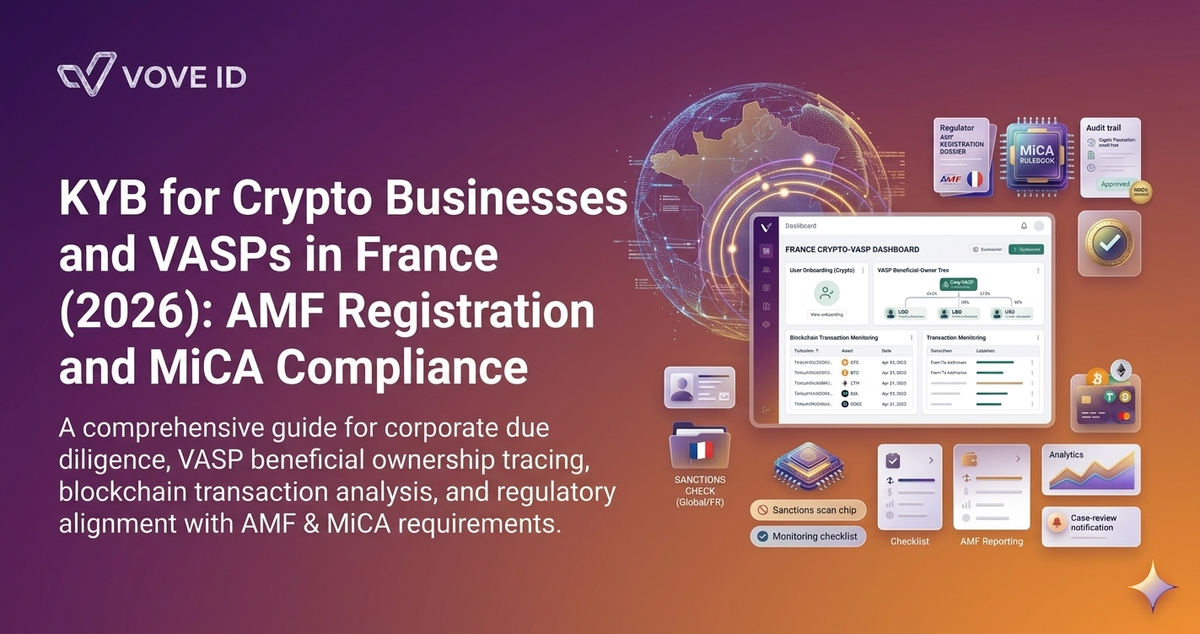
France was one of the first EU jurisdictions to build a structured licensing regime for crypto businesses — and one of the first to enforce it seriously. For virtual asset service providers (VASPs) operating in France, KYB is not a generic compliance exercise. It sits inside a specific regulatory framework built around AMF registration, MiCA alignment, and TRACFIN reporting obligations that go beyond what most other business categories face.
This guide covers KYB as it applies specifically to crypto businesses and VASPs in France: what the AMF requires, how MiCA changes the picture, and where business verification breaks in practice for this sector. For the general French KYB framework covering all regulated entities, see our KYB Compliance in France guide.
The Regulatory Context for Crypto in France
France introduced its VASP registration regime under the Pacte Law (2019), creating a two-tier system:
- Mandatory registration with the AMF for all VASPs — required to operate legally
- Optional AMF licence (PSAN licence) — a more rigorous approval that signals stronger compliance posture and enables broader market access
Since 2023, the AMF has significantly tightened registration requirements. New applicants face stricter KYC/KYB review, and the regulator has been increasingly explicit about what "robust business verification" means for crypto platforms. High-profile enforcement actions — including investigations into crypto platforms for weak CDD controls — have sharpened industry attention.
MiCA (Markets in Crypto-Assets Regulation) is the next major shift. France is aligning its existing DASP framework with MiCA, which introduces a harmonised EU-wide licensing regime for crypto asset service providers (CASPs). For French VASPs, this means:
- Existing AMF registrations will need to be converted to MiCA authorisations
- KYB and AML obligations become more prescriptive at EU level
- Cross-border passporting becomes available for MiCA-authorised entities
The transition timeline makes 2026 a critical year for French crypto businesses to have their compliance infrastructure in order.
KYB Requirements Specific to VASPs Under AMF Supervision
Business Client Verification
For crypto platforms onboarding business customers — exchanges onboarding institutional clients, B2B payment flows, or embedded crypto products — KYB obligations mirror those of other regulated entities but with heightened scrutiny from AMF.
The AMF expects:
- Full legal entity verification via RNE and Kbis
- UBO identification at the 25% threshold, with documentation of the verification method
- Business activity assessment — does the corporate client's declared activity make sense for a crypto platform relationship?
- Sanctions and PEP screening on all relevant individuals before activation
For businesses onboarding other VASPs or crypto-adjacent entities as clients, risk classification must explicitly account for the counterparty's own regulatory status. An unregistered VASP as a business client is itself a red flag requiring escalation.
The Restricted UBO Register Problem
Since mid-2024, France's beneficial ownership register is no longer publicly accessible. For crypto platforms, this creates a specific operational challenge: the client base often includes structures — holding companies, SPVs, offshore entities — where UBO chains are deliberately complex. The closed register means customer-provided declarations become the primary input, which must be reconciled against other available data and fully documented.
TRACFIN Reporting for Crypto Transactions
VASPs are obliged entities under the CMF and must report suspicious activity to TRACFIN via the ERMES platform. In practice, crypto-specific red flags that TRACFIN has highlighted include:
- Business accounts receiving large volumes of crypto from unidentified sources
- Corporate clients whose declared business model does not align with transaction patterns
- Rapid layering through multiple business accounts
- Use of privacy coins or mixing services by business clients
France's TRACFIN received over 165,000 suspicious transaction reports in 2022, with reports from payment institutions and fintechs growing the fastest. Crypto platforms are under increasing expectation to contribute meaningfully to this reporting volume.
MiCA KYB Implications for French Crypto Businesses
MiCA introduces specific requirements that affect how French VASPs handle KYB for their business relationships:
Travel Rule compliance becomes mandatory for crypto asset transfers. For B2B transactions, this means capturing and transmitting originator and beneficiary information for transfers above €1,000 — which requires robust KYB on the business counterparties in those flows.
CASP-to-CASP relationships — when a French crypto business transacts with another crypto service provider — require verification that the counterparty is MiCA-authorised or operating under an equivalent regime. This adds a regulatory status check to the standard KYB workflow.
White-label and embedded crypto products — increasingly common in French fintech — require KYB not just on end business clients but on the platform partners distributing the crypto product. AMF has been explicit that regulated entities cannot outsource compliance responsibility through white-label arrangements.
Enforcement Context: What AMF Has Actually Done
France's enforcement record in crypto compliance is worth understanding concretely:
- In 2023, prosecutors launched investigations into crypto platforms for weak CDD controls. Binance's French operations were among those scrutinised.
- The AMF has been increasingly active in denying or revoking registrations for platforms unable to demonstrate adequate KYB and AML infrastructure.
- ACPR and AMF have imposed compliance penalties on firms failing to identify UBOs — a finding that applies directly to business onboarding processes.
The pattern is clear: registration does not insulate French VASPs from enforcement. The AMF expects ongoing operational compliance, not just a documentation package at registration time.
Where VASP KYB Breaks in Practice
Offshore business clients. Crypto platforms frequently receive onboarding requests from businesses incorporated in low-transparency jurisdictions. Tracing ownership through these structures requires verification beyond French registries. VOVE ID supports document verification and entity checks across 190+ countries — relevant when KYB chains run through non-EU holding structures.
Crypto-native business models. DeFi protocols, DAOs, and crypto infrastructure businesses don't always map cleanly onto standard legal entity categories. KYB workflows need to account for non-standard ownership structures and governance models.
Speed vs. depth tension. Institutional crypto clients often expect fast onboarding. French regulatory expectations for KYB depth create real friction here. Automating the structured parts of KYB — entity verification, registry checks, sanctions screening — is the only way to resolve this without cutting corners.
MiCA transition uncertainty. As the French DASP regime converts to MiCA, some compliance requirements are still being finalised. KYB infrastructure built now needs to be flexible enough to adapt as implementing regulations are confirmed.
Building KYB Infrastructure for French Crypto Compliance
For VASPs operating in France, KYB infrastructure needs to handle:
- Entity verification against RNE and international registries
- UBO identification with documented verification methodology — not just form collection
- Regulatory status checks on crypto counterparties (AMF registration, MiCA authorisation)
- Travel Rule data capture for B2B crypto flows
- Sanctions and PEP screening before activation and ongoing
- TRACFIN-ready audit trails
VOVE ID is used by crypto businesses and fintechs operating under AMF supervision to build onboarding workflows that meet this standard — from entity verification to ongoing monitoring, with documentation structured for regulatory review.
Are you building or reviewing KYB for a crypto business in France?