South Africa AML Operations in 2026: Why KYC Alone Fails Under FICA
South Africa AML compliance in 2026 breaks after onboarding — when monitoring, ownership tracking, and reporting operate as disconnected systems instead of a single FICA lifecycle control.
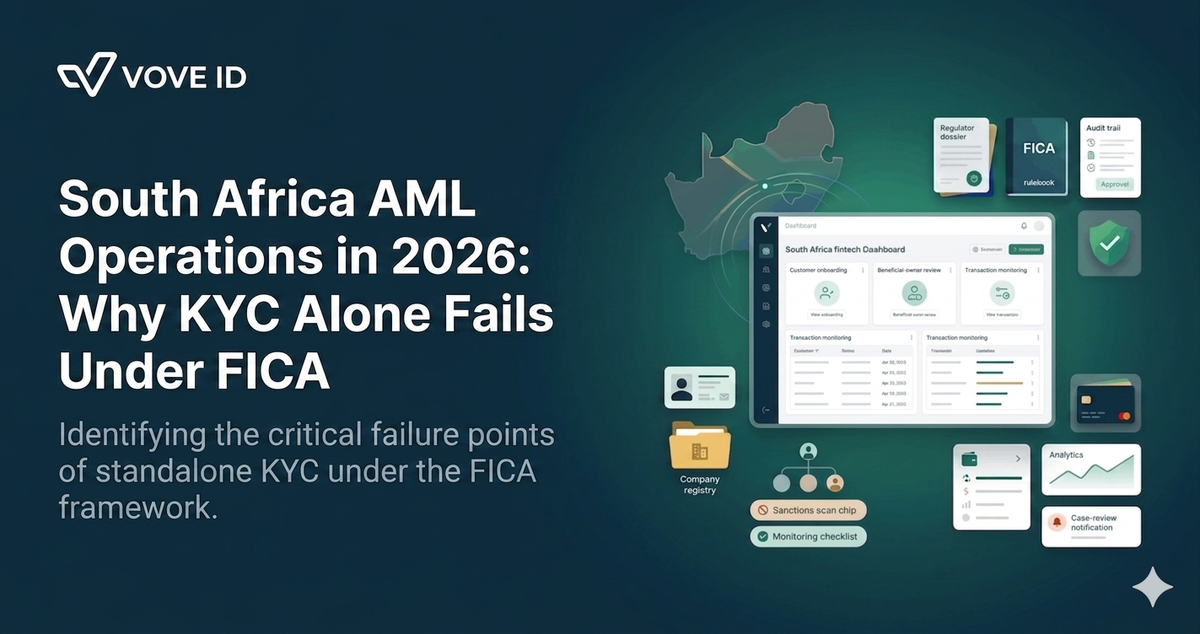
South Africa compliance in 2026 does not fail at onboarding. It fails after onboarding, when customer data, transaction activity, and risk signals stop connecting into a single control system under the Financial Intelligence Centre Act. KYC can be completed correctly and still produce a fragile outcome if monitoring, reporting, and risk management do not operate on the same customer context.
South Africa is one of the most operationally mature fintech environments on the continent.
That maturity exposes a specific weakness.
Many teams build onboarding that satisfies identity and beneficial-ownership requirements, but fail to extend that logic into live AML controls. The result is a clean onboarding file that cannot support monitoring decisions, escalation, or regulatory review.
For more information about AML, read our guide:
 Anastasiia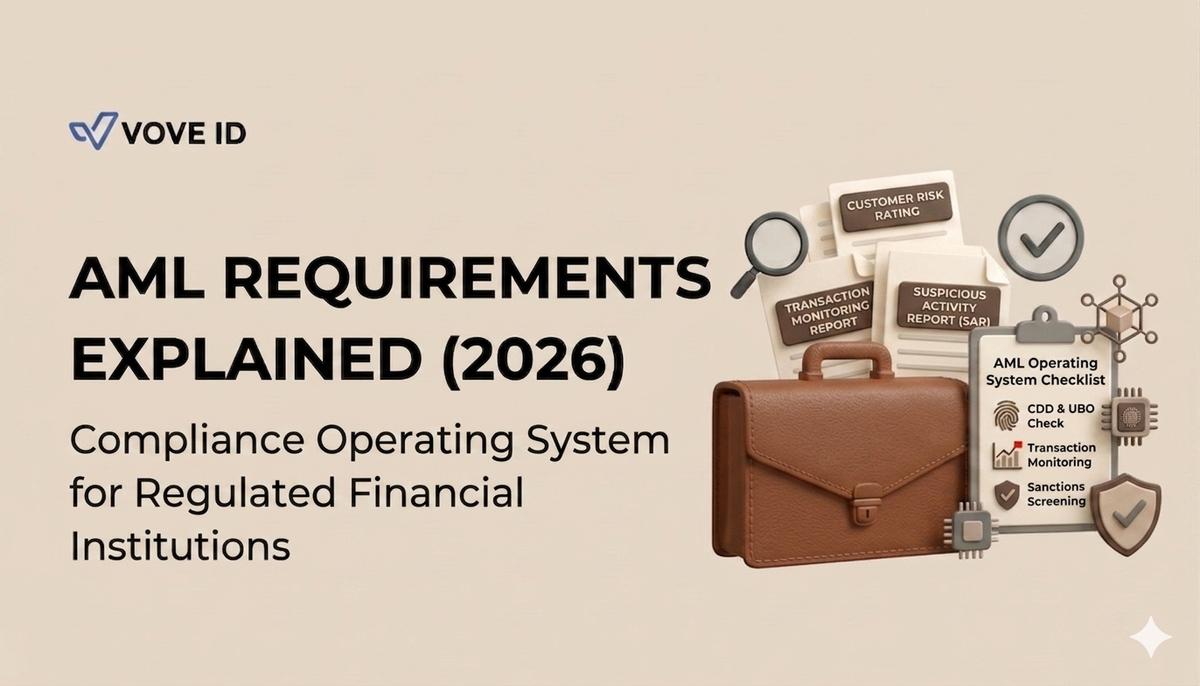
This is where compliance stops being a checklist and becomes an operating system.
Why KYC-complete onboarding still fails under FICA
A strong onboarding process is necessary.
It is not sufficient.
Under the Financial Intelligence Centre Act, compliance is defined as a lifecycle that connects due diligence, ownership understanding, sanctions controls, monitoring, reporting, and governance. Each layer depends on the others. Remove one connection and the whole structure becomes brittle.
In practice, most fintech systems are built in phases. Onboarding is implemented first, monitoring later, and reporting logic often last. Each layer works in isolation. The system as a whole does not.
This creates a predictable failure mode: the onboarding file becomes a static snapshot of the customer at one moment in time, while the AML system must respond to a continuously changing reality. If the two cannot communicate, compliance becomes reactive instead of controlled.
What makes this especially dangerous in the South African context is that FICA enforcement does not distinguish between a team that ignored compliance and a team that built a thorough onboarding system but never connected it to anything downstream. The regulatory expectation is a functioning lifecycle. Partial implementation does not satisfy that standard.
How the South Africa regulatory framework creates post-onboarding pressure
FICA defines lifecycle obligations, not onboarding outcomes
The Financial Intelligence Centre Act establishes that compliance is not limited to the moment a customer is accepted onto a platform.
Institutions are required to:
- maintain an ongoing understanding of the customer relationship
- monitor transactions on a continuous basis
- reassess risk when material conditions change
- report suspicious or unusual activity within defined timelines
These are not one-time tasks. They are standing obligations that apply for the full duration of the customer relationship. An onboarding-complete file that is never revisited is, from a FICA perspective, a compliance gap waiting to surface.
The Financial Intelligence Centre enforces operational consistency
The FIC does not only review whether a policy exists. It examines whether controls operate consistently across time — whether decisions are reproducible, whether risk assessments can be explained, and whether data can be traced across systems.
A team that can demonstrate a sound onboarding process but cannot explain how a monitoring alert was handled, or why a risk score changed, or when a customer's ownership structure was last reviewed, will struggle under scrutiny.
The expectation is coherence. Not just documentation.
SARB and payment flows increase scrutiny
Where fintechs handle money movement — payments, remittances, payroll disbursements — the South African Reserve Bank adds another layer of pressure. Transaction flows create higher exposure to financial crime risk, which translates into stronger expectations around anomaly detection, counterparty screening, and the ability to reconstruct payment chains on request.
Fintechs operating in payments cannot rely on static compliance models. The risk profile of a payment product changes with every transaction.
The grey list exit context
South Africa was grey-listed by the Financial Action Task Force in February 2023. The process of addressing the action items associated with that listing has pushed regulatory expectations upward across the board — not just for the institutions directly named in enforcement actions, but for the entire sector.
Supervisors are demonstrating that they are serious about operational compliance, not just formal policy. That shift changes what an adequate AML program looks like in practice.
Where South Africa compliance breaks after onboarding
Customer profiles are not used during monitoring
This is the most common and most consequential gap.
Customer data is collected at onboarding. It then sits in a separate system, disconnected from the monitoring layer. Alerts are generated against fixed thresholds and generic rules — not against what this specific customer was expected to do, based on their stated business, their ownership structure, and their historical transaction patterns.
The result is low signal quality. Alerts that should fire do not. Alerts that fire do not carry enough context to support a decision. The compliance team receives volume without clarity.
This is the gap that VOVE ID is designed to close — connecting the onboarding profile directly to the monitoring layer so that alerts carry customer context from the moment they fire, not after a manual reconstruction exercise.
Ownership structures are not revisited
Ownership is dynamic. A company that onboarded with one shareholder structure can change significantly within twelve months — new investors, restructured holding entities, changes in control rights, disposal of subsidiaries. Each of those changes can alter the risk profile materially.
If the monitoring system is still operating against the ownership context captured at onboarding, it is making decisions based on information that may no longer be accurate. This is particularly relevant in South Africa given the FIC's renewed focus on beneficial ownership transparency following the grey list period.
Sanctions exposure is not continuously assessed
Sanctions lists change. New designations are added. Geopolitical developments alter which counterparties, jurisdictions, and financial institutions carry elevated risk. A customer or counterparty that was clean at onboarding may not remain so.
Static screening — run once, filed, never repeated — does not capture this. Continuous screening is not a premium feature. In an environment like South Africa's, it is a baseline expectation.
Risk models do not adapt to behavior
Many systems assign a risk score at onboarding and update it infrequently, if at all. The problem is that actual risk is behavioural. A customer rated low-risk at onboarding based on their stated business profile may generate transaction patterns over time that are inconsistent with that rating.
Without a mechanism that connects transaction behaviour back to the risk model and updates it accordingly:
- high-risk activity may go undetected
- low-risk customers may be over-screened
- the risk model drifts further from reality with every month that passes
What AML operations in South Africa actually require
RMCP as a working system, not a document
The Risk Management and Compliance Programme required under FICA must reflect actual workflows. Not aspirational ones.
A functioning RMCP defines how customers are classified, how monitoring rules are applied to different product types and risk tiers, how escalation decisions are made, and who is responsible for each step. If the RMCP exists as a document that does not match what teams actually do, it will not hold up under review — and it will not serve as a usable guide when something goes wrong.
Building the RMCP as a living operational document, reviewed and updated as the business changes, is one of the clearest signals of operational maturity.
Monitoring tailored to product behaviour
Generic monitoring is, by definition, miscalibrated for every product it covers.
Different products generate different transaction patterns. A mobile wallet used for daily consumer payments looks nothing like a marketplace handling merchant settlements, which looks nothing like a payroll platform disbursing salaries in bulk.
Effective monitoring is built around the actual usage patterns of each product:
- wallets → transaction frequency, velocity, recipient diversity
- marketplaces → merchant-level behaviour, refund patterns, counterparty risk
- payroll platforms → batch anomalies, recipient count changes, timing irregularities
- cross-border products → corridor risk, counterparty jurisdiction, currency exposure
VOVE ID's monitoring layer is built around this logic — rules that can be configured to the actual product type and customer profile, rather than applied uniformly across a portfolio where no single threshold fits any product well.
Escalation and reporting as structured processes
An alert that does not reach a decision is operational noise. Most alert fatigue problems are not caused by too many alerts — they are caused by alerts that arrive without context, route to teams without authority, and close without documentation.
A structured escalation process defines:
- what triggers an alert
- what context is attached to that alert when it fires
- who receives it
- what investigation steps are expected
- how decisions are documented
- when a Suspicious Transaction Report is required and within what timeline
Without that structure, individual judgment replaces process. That is a risk in itself.
goAML reporting integration
South Africa's reporting framework runs through goAML, the platform used by the Financial Intelligence Centre for receiving Suspicious Transaction Reports and Cash Transaction Reports.
Institutions must identify reportable events, compile the required data, and submit within defined timelines — fifteen days for STRs in most cases. That is a tight window when the underlying data is fragmented across systems.
Effective goAML compliance requires that the monitoring and case management layer can pull complete, accurate, structured data on demand. If that connection does not exist, reporting becomes a manual reconstruction exercise every time — slow, error-prone, and difficult to defend if the timeline is later reviewed. VOVE ID's case management output is structured to support goAML submissions directly, reducing the gap between alert and filed report.
A realistic failure scenario
A fintech onboards a mid-sized SME operating in cross-border trade.
At onboarding, the file looks strong:
- identity is verified against Home Affairs
- beneficial ownership is documented to the ultimate natural person
- sanctions screening is completed
- risk is rated medium, consistent with the business profile
Three months later, the picture changes:
- transaction volume increases significantly above the stated baseline
- new counterparties appear in jurisdictions with elevated risk
- payment patterns shift — larger individual transactions, irregular timing, new recipient profiles
The monitoring system fires alerts. But the system cannot connect those alerts to the customer's onboarding context. It does not know what transaction volume was expected. It cannot assess whether the new counterparties represent a change in the ownership risk. It has no record of what the business said it would use the account for.
The compliance team must manually reconstruct the customer file to make a decision on whether to file an STR, escalate internally, or continue monitoring.
That reconstruction takes time. It introduces inconsistency depending on who conducts it. And it cannot be repeated reliably at scale.
This is where operational cost increases and decision quality decreases simultaneously. And it is not a rare edge case. It is the default outcome when onboarding is built as a standalone system.
Why onboarding-first compliance models fail at scale
The time gap between onboarding and risk
Customer relationships lengthen. The longer the relationship, the further the live customer drifts from the snapshot taken at onboarding. A model built around that snapshot becomes less useful with every month that passes — unless the data is actively maintained.
This is not a technology problem. It is a design problem. Systems that treat onboarding as the endpoint of data collection are architecturally unsuited for ongoing compliance.
Tool fragmentation breaks data continuity
Separate systems for onboarding, monitoring, and case management are common. They are also expensive in a way that rarely appears on a technology budget.
When data does not flow between systems, every handoff becomes a potential gap. Compliance teams compensate by building manual bridges — spreadsheets, shared drives, email chains — that are neither auditable nor scalable. The system looks integrated from a tool inventory perspective. It is not integrated in practice.
Manual processes do not scale with volume
As the customer base grows, manual review becomes slower, more expensive, and less consistent. Automation helps — but only if it is applied to a connected system. Automating individual steps in a fragmented workflow produces faster fragmentation, not functional compliance.
The scale problem arrives faster than most teams expect. By the time it is obvious, the cost of rebuilding the architecture is significantly higher than the cost of building it correctly in the first place.
How a South Africa AML workflow should actually operate
A robust system is not a sequence of tools. It is a set of connected decisions.
The architecture should connect:
- Onboarding (KYC / KYB) — identity, ownership, authority, initial risk rating
- Ownership and authority context — updated as changes occur, not filed and forgotten
- Sanctions and risk screening — continuous, not point-in-time
- Monitoring and behavioural analysis — calibrated to product type and customer profile
- Escalation and investigation — structured, documented, time-bounded
- Reporting and audit trail — connected to goAML, complete, reproducible
The critical design principle is continuity. Each layer must use shared data and update it. A change captured in one layer — a new beneficial owner, a sanctions match, a behavioural anomaly — must propagate to the others automatically, not through a manual review cycle.
South Africa AML checklist: post-onboarding control view
- Onboarding data actively feeds monitoring systems
- Ownership information is reviewed and updated on a defined schedule
- Sanctions screening runs continuously, not only at onboarding
- Risk models adapt as transaction behaviour develops
- Monitoring rules reflect the actual product and customer profile
- Escalation workflows are documented, assigned, and followed
- Reporting processes are integrated with goAML and can meet timeline requirements
- Audit trails are complete and reproducible across all layers
Conclusion
South Africa compliance in 2026 is not defined by onboarding alone.
It is defined by the ability to maintain control across the full customer lifecycle under the Financial Intelligence Centre Act — from the first identity check through every transaction, every ownership change, every risk signal, and every reporting obligation that follows.
Fintech teams that treat onboarding as the end of compliance will continue to discover that FICA does not. The obligation is ongoing. The system needs to be too.
Teams that connect onboarding to monitoring, escalation, and reporting build something that satisfies not just the letter of FICA, but the operational standard that regulators in a post-grey-list environment are actually looking for.
Want to see how a unified South Africa AML workflow can be structured in a single system — from onboarding through monitoring, reporting, and audit trail?