KYB for Crypto Counterparties: The Travel Rule's B2B Edge
The Travel Rule forces crypto businesses to get explicit about counterparties. This piece explains why wallet metadata and packet exchange are no longer enough — and how KYB closes the gap between a wallet address and a verified legal entity.
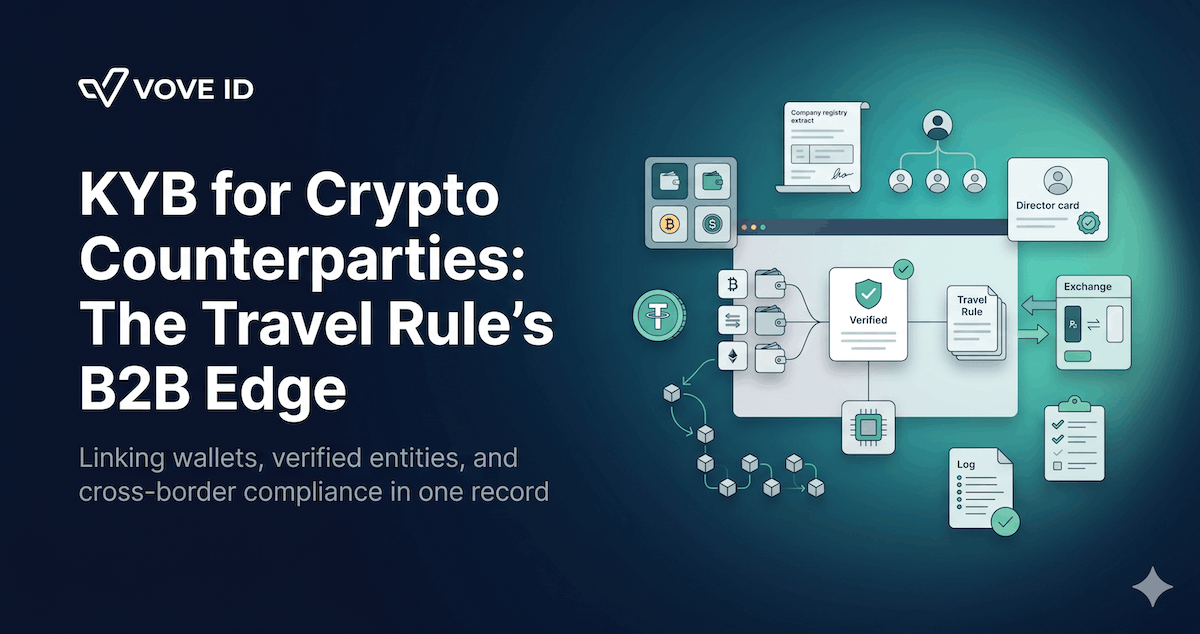
The Travel Rule is often framed as a data-transfer problem between wallets, exchanges, and payment flows. In practice, it is also a business-verification problem. Once large crypto transactions move between institutions, OTC desks, stablecoin operators, payment firms, and treasury counterparties, the question is no longer only "who controls this wallet?" It becomes "which legal entity are we really dealing with?" That is where KYB becomes the Travel Rule's B2B edge.
Why does KYB matter for crypto counterparties under the Travel Rule?
Because the Travel Rule makes it harder to treat high-value crypto flows as if they happen between anonymous technical endpoints. Once a counterparty is actually a business, teams need more than wallet metadata. They need entity verification, beneficial-owner visibility, screening on controllers, and a clean audit trail linking wallets to verified companies. Without that, Travel Rule compliance stays partial and business risk stays high.
For years, many teams treated crypto counterparty review as a transaction problem.
The questions sounded mostly technical:
- which wallet sent the funds?
- which wallet received them?
- what VASP is involved?
- did the Travel Rule packet arrive?
Those questions still matter.
But in 2026, they are no longer enough.
The more serious the flow, the more likely the counterparty is not merely a wallet address or a retail user. It is a business:
- an OTC desk
- a stablecoin liquidity partner
- a treasury management vehicle
- a B2B payments operator
- a market-making firm
- a foreign exchange or settlement partner
- another financial intermediary
At that point, the compliance file needs to answer a deeper question:
Who is the entity behind the flow?
That is why KYB is becoming one of the most important parts of Travel Rule operations.
The Travel Rule changed what "good enough" looks like
A weak counterparty file used to hide more easily.
If a team knew the sending VASP, stored a wallet address, and kept a transaction record, that might have felt operationally acceptable.
The Travel Rule raised the standard because it pushed institutions toward more explicit information exchange around originators and beneficiaries in cross-border and virtual-asset flows.
That does not automatically solve counterparty risk.
What it does do is expose how incomplete many B2B crypto files still are.
When an institution receives Travel Rule data that points to a company relationship, it needs to understand:
- which legal entity it is interacting with
- whether the entity is properly verified
- who owns or controls it
- whether that entity matches the wallet relationship in practice
- whether the stated business activity fits the flow profile
Without that, the Travel Rule packet is only partial comfort.
The hidden problem: wallet-to-entity ambiguity
This is where crypto counterparty KYB becomes difficult.
A wallet is not a company.
A VASP name is not always enough to explain the actual legal relationship behind a flow.
The compliance team may still need to determine:
- whether the counterparty is acting for itself or for a client
- which legal entity within a group controls the wallet
- whether the wallet is being used by a corporate treasury, a trading desk, or a service provider
- whether the beneficial-owner and sanctions file exists for the real business counterparty
That gap between a wallet and an entity is one of the most important B2B crypto risks in 2026.
Teams often know there is a business involved.
They do not always know they have verified the right business.
Why this matters more for stablecoin and cross-border businesses
The problem is especially important for:
- stablecoin issuers and distributors
- OTC desks
- cross-border payment operators
- treasury and settlement providers
- embedded crypto infrastructure businesses
- hybrid fiat-crypto payment firms
These businesses do not only process sporadic transfers.
They build repeat institutional relationships.
That means counterparty quality has direct consequences for:
- sanctions exposure
- fraud exposure
- Travel Rule completeness
- bank partner confidence
- internal risk appetite
- future audits and investigations
If the counterparty file is weak, the flow may still clear technically while the relationship remains strategically fragile.
What goes wrong when KYB is missing
1. A corporate counterparty looks like a retail relationship
This is more common than many teams admit.
A flow arrives through a wallet pattern that appears retail or "unclassified," but later evidence shows the activity was connected to a business counterparty all along.
That means the team screened too little, documented too little, and likely applied the wrong monitoring assumptions.
2. The entity exists, but the real controller is unclear
A desk or payment firm may have a legal registration, but if the compliance file cannot identify the real control perimeter, the team is still exposed.
That matters for:
- sanctions screening
- PEP exposure
- source-of-funds review
- enhanced due diligence
3. The Travel Rule packet and the KYB file do not reconcile
This is a serious quality problem.
If the packet points to one entity but internal onboarding points to another, the institution may struggle to explain:
- which company it approved
- which company controls the wallet
- which company actually carried the flow
That kind of mismatch can damage trust quickly.
4. Ongoing monitoring is built on the wrong baseline
Monitoring only works if the institution understands what "expected activity" means.
If the team does not really know the counterparty business model, it becomes much harder to tell whether:
- transaction size is plausible
- corridor usage is expected
- round-tripping signals matter
- behaviour resembles treasury activity or something riskier
Weak KYB produces weak monitoring.
A realistic crypto counterparty failure
Imagine a stablecoin OTC desk moving high-value flows with a repeat counterparty.
Operationally, the relationship appears smooth:
- the desk knows the wallet
- a Travel Rule packet is exchanged
- transactions settle without incident
Then a later review shows the wallet was tied to an Estonian OÜ used by a larger corporate group, while the desk's internal records treated the relationship as if it were a simpler retail or lightly documented business case.
Now the institution has several problems at once:
- incomplete entity verification
- uncertain beneficial-owner coverage
- weak screening perimeter
- weak explanation of why the relationship was approved
The issue is not that the Travel Rule failed mechanically.
The issue is that the business relationship behind the Travel Rule data was never fully resolved.
What strong KYB for crypto counterparties looks like
1. Entity verification linked to the live relationship
The first step is verifying the legal entity itself:
- company existence
- registration status
- directors or responsible persons
- jurisdiction
- business purpose
But that alone is not enough.
The entity record must be connected to the actual counterparty relationship, not stored as an isolated file.
2. Wallet-to-entity binding
This is one of the most important controls.
A strong file should explain how the institution knows that a given wallet, flow, or VASP relationship belongs to the verified business entity in question.
That may involve:
- declared wallet relationships
- counterparty attestations
- platform records
- settlement patterns
- Travel Rule packet consistency
The point is not absolute certainty in every circumstance.
The point is building a defendable basis for the relationship.
3. Beneficial-owner and controller visibility
Once the entity is known, the next question is who actually controls it.
For crypto counterparties, that often matters more than teams expect because:
- some entities operate across multiple jurisdictions
- some structures use holding companies
- some counterparties are financially sensitive even when legally straightforward
The best file maps the real control perimeter instead of stopping at the company name.
4. Screening that reaches beyond the entity label
Entity-only screening is too thin for many B2B crypto cases.
Teams often need to screen:
- UBOs
- directors
- parent entities
- linked companies where relevant
That is what turns Travel Rule data into a meaningful counterparty risk file rather than a transaction log.
5. Monitoring assumptions tied to the business model
A stablecoin treasury partner should not look identical to a small retail exchange client.
Good KYB helps define expected behaviour:
- volume patterns
- corridor patterns
- settlement frequency
- counterpart usage
- red flags that would trigger escalation
That gives monitoring a business baseline instead of a purely technical one.
Why KYB becomes the B2B edge
The Travel Rule is often seen as a compliance burden.
But for well-run teams, it creates a strategic advantage.
If a business can prove that it:
- knows which entity is behind the flow
- knows who controls that entity
- screens the right parties
- reconciles wallet, entity, and Travel Rule records cleanly
- maintains an auditable file over time
then it gains a better B2B operating posture than competitors who only move data packets around.
That is the edge.
The Travel Rule forces teams to get more explicit.
KYB is what turns that explicitness into business-grade trust.
Why manual counterparty KYB breaks quickly
The temptation is to handle crypto counterparty review manually because volumes may appear manageable at first.
That works poorly once the business scales.
Manual review creates:
- inconsistent wallet-to-entity documentation
- slow approvals for new counterparties
- weak refresh discipline
- scattered evidence across tickets, emails, and PDFs
- uncertainty when auditors or bank partners ask follow-up questions
That is particularly dangerous for firms building:
- OTC operations
- stablecoin payout corridors
- institutional settlement rails
- embedded crypto treasury products
As volumes rise, the real problem is not only speed.
It is whether every approved relationship still has a coherent evidence trail months later.
How VOVE ID helps crypto businesses build stronger counterparty KYB
VOVE ID helps because the problem is not just identifying a company or just storing a wallet.
The real requirement is to join several layers into one record:
- verified legal entity
- ownership and control
- screening results
- declared and observed counterparty context
- evidence explaining why the relationship is acceptable
That allows teams to:
- onboard counterparties faster
- reduce ambiguity between wallet and entity
- attach Travel Rule data to a stronger KYB file
- maintain a more reliable audit trail over time
The value is not "more documents."
The value is better relationship clarity.
FAQ
1. Why is KYB important for crypto counterparties if the Travel Rule data is already exchanged?
Because the Travel Rule packet alone does not always prove which legal entity is behind a wallet or repeated business flow. KYB closes that gap by verifying the entity, mapping ownership and control, and linking the crypto relationship to a defendable business record.
2. What is the main risk of treating a business crypto counterparty like a retail wallet?
The institution may screen too narrowly, document too little, and monitor the relationship against the wrong baseline. That creates blind spots around sanctions, beneficial ownership, source of funds, and the actual purpose of the counterparty relationship.
3. What does wallet-to-entity binding mean in practice?
It means being able to explain why a specific wallet, flow pattern, or Travel Rule packet is associated with a verified company and not just a technical endpoint. That explanation should be supported by onboarding records, counterparty evidence, and an audit trail that can be reviewed later.
4. What should a strong crypto counterparty KYB workflow include?
A good workflow should include entity verification, beneficial-owner and controller visibility, screening on relevant people and linked entities, wallet-to-entity linkage, and monitoring assumptions tied to the counterparty's real business model.
Conclusion
The Travel Rule did not make crypto compliance purely technical.
It made the underlying business relationship harder to ignore.
For retail flows, lighter identification questions may still dominate. But for institutional and repeat B2B crypto activity, the core issue becomes:
Which entity is behind the flow, and can we prove we understand it?
That is why KYB is the Travel Rule's B2B edge.
It closes the gap between:
- wallet and company
- packet and relationship
- transaction review and counterparty understanding
And in 2026, that gap is where many of the most important crypto compliance failures still begin.
If you want to see how VOVE ID binds wallets to verified corporate entities and keeps Travel Rule, KYB, and screening records inside one counterparty file, talk to the team.