KYB in Spain 2026: Business Verification Under Banco de España and EU AMLD
Spain KYB in 2026 is a full AML workflow, not a registry check. Fintechs must verify the legal entity, identify beneficial owners, validate representatives, and align onboarding data with SEPBLAC reporting and ongoing monitoring obligations under Ley 10/2010 and related Spanish AML regulations.
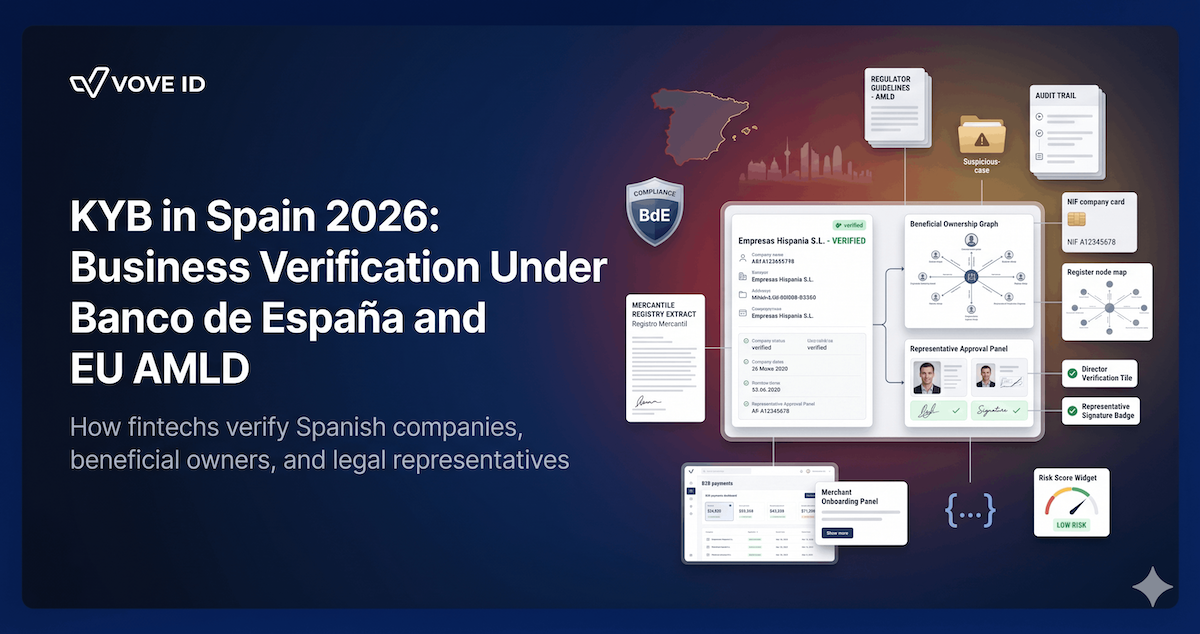
In Spain, KYB is not a light company lookup followed by a commercial approval. In 2026, any fintech onboarding Spanish businesses needs a workflow that verifies the legal entity, identifies the beneficial owners, checks the administrators and representatives, and connects that evidence to SEPBLAC-facing AML obligations. Platforms like VOVE ID typically approach this as a structured workflow rather than a one-time verification step.
Spain is one of the more active fintech markets in Europe.
That creates a common mistake.
Teams assume Spanish business onboarding is mostly about checking that the company exists in the Registro Mercantil and then moving on. In practice, the harder part is understanding who owns the company, who controls it, who is acting for it, and whether the relationship is coherent under Spain's AML rules.
This is exactly where weak KYB starts looking complete when it is not.
For more information on KYB process, check the KYB compliance guide.
Key challenges in Spain KYB
Registry truth does not answer control questions
A valid Mercantile record confirms legal existence, but it does not explain ownership or control. Beneficial ownership analysis remains a separate task.
Representative authority breaks more flows than entity verification
The onboarding contact is not always the person with valid legal authority. Without verifying representation rights, the onboarding decision becomes fragile.
Beneficial ownership is more accessible — but still complex
The central register improves access to ownership data, but does not eliminate the need to interpret ownership chains, especially in cross-border structures.
AML obligations extend beyond onboarding
Under Spanish AML rules, KYB must support monitoring, investigation, and reporting — not just initial approval.
Spain KYB workflow (operational view)
A defensible Spain KYB workflow typically includes six layers.
1. Entity verification through the Mercantile record
Confirm that the company exists and that the legal record is current:
- legal name
- legal form
- registered office
- registration status
- Mercantile record data
- tax identifier (NIF)
This is the baseline, not the conclusion.
2. NIF and representative validation
Spanish onboarding often breaks at the representative layer.
A platform should verify:
- the company’s NIF
- the identity of the acting individual
- the authority of that individual to represent the company
- consistency between declared role and company documentation
3. Beneficial-owner identification
Spain’s AML regime requires clear ownership mapping.
This includes:
- direct and indirect ownership
- control structures
- alignment with declared business activity
A process that identifies the company but not the people behind it is incomplete.
4. Use of the Central Beneficial Ownership Register
Real Decreto 609/2023 introduced the Registro Central de Titularidades Reales.
In practice, this means:
- ownership data can be accessed in a structured format
- declared ownership should be reconciled against registry data
- access must be lawful and properly controlled
The register supports the workflow — it does not replace analysis.
5. Director and administrator review
Business verification should also cover control roles:
- administrators
- directors or equivalent
- legal representatives
The goal is to ensure that management structure makes sense for the declared activity.
6. Screening, monitoring, and escalation setup
SEPBLAC expectations require onboarding to feed into AML controls:
- sanctions and PEP screening
- risk classification
- expected activity profile
- unusual activity review
- suspicious activity escalation
A weak onboarding file leads to weaker monitoring and reporting decisions.
Regulatory framework
Spain’s KYB requirements are embedded in its AML system.
Ley 10/2010
Core AML law defining:
- customer due diligence
- beneficial-owner identification
- monitoring and recordkeeping
- suspicious activity reporting
Real Decreto 304/2014
Operational framework that:
- clarifies due diligence expectations
- structures examination processes
- connects onboarding to ongoing AML controls
Real Decreto 609/2023
Introduces the central beneficial ownership register:
- structured BO data
- centralized access
- improved transparency
SEPBLAC
Financial intelligence unit responsible for:
- suspicious activity reporting
- escalation expectations
- enforcement guidance
Banco de España
Supervisory authority for:
- payment institutions
- e-money institutions
- official registration frameworks
This creates a combined pressure: AML compliance and supervisory accountability.
How VOVE ID supports Spain KYB workflows
In Spain, the difficulty in KYB is not collecting data — it is reconciling multiple sources into a consistent customer file that can support SEPBLAC expectations.
VOVE ID is typically used to structure this process around Spain-specific control points rather than generic verification steps.
That includes:
- aligning legal-entity data with Registro Mercantil records and maintaining consistency across the case
- validating NIF and linking it correctly to both the entity and its acting representative
- mapping beneficial ownership and reconciling it with the Registro Central de Titularidades Reales where access is permitted
- connecting administrators, representatives, and ownership into one control structure instead of reviewing them separately
- running sanctions and PEP screening in the context of Spanish AML expectations
- producing a single audit trail that supports internal review and potential SEPBLAC escalation
In practice, this shifts Spain KYB from disconnected checks to a workflow where registry data, ownership analysis, and AML controls remain aligned.
Spain KYB checklist
Before approving a Spanish business customer:
- Can we verify the legal entity through official registry data?
- Is the company’s NIF validated and correctly linked?
- Is the acting representative identified and authorized?
- Can we clearly explain the beneficial ownership structure?
- Is ownership data reconciled with the central BO register where applicable?
- Are administrators, owners, and representatives screened?
- Does onboarding feed into a monitoring and risk model?
- Can we reconstruct the full decision for audit or SEPBLAC reporting?
If these answers are weak, the issue is not Spain’s regulatory complexity — it is workflow depth.
Conclusion
Spain KYB in 2026 is not a Mercantile lookup with an AML label attached.
Under Ley 10/2010, Real Decreto 304/2014, the central beneficial ownership framework, and the Banco de España and SEPBLAC control environment, fintechs need to verify the entity, identify beneficial owners, confirm representation authority, and carry that understanding into monitoring and escalation.
That is what makes Spanish business onboarding defensible.
Want to see how Spain KYB workflows can be structured into a single verification and compliance flow?