KYC & AML Compliance in Brazil 2026: BACEN Requirements for Digital Lenders and Fintechs
Brazil KYC and AML in 2026 for digital lenders is a continuous, risk-based compliance system under Banco Central do Brasil. It requires structured identification, qualification, risk classification, and ongoing monitoring across the full credit lifecycle
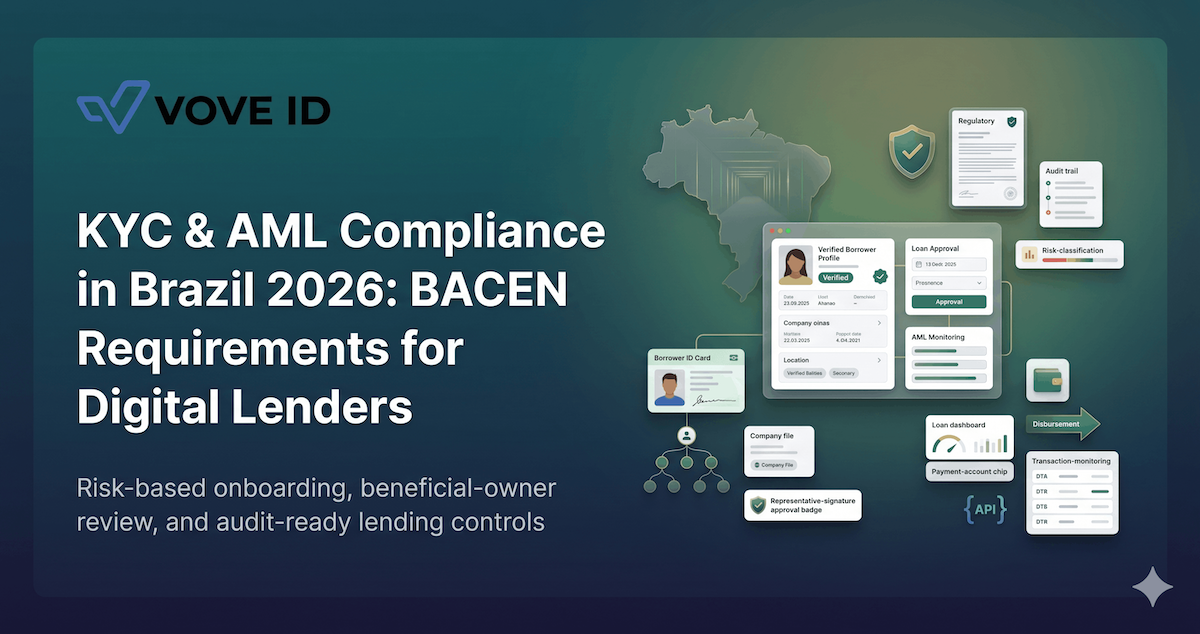
If you run a digital lending product in Brazil, KYC and AML compliance in 2026 means building a risk-based onboarding and monitoring workflow aligned with Banco Central do Brasil expectations, capable of supporting both retail and business lending use cases, and producing an audit trail strong enough for supervisory review. A simple signup check is not enough.
Brazilian fintech teams usually feel the pressure at two moments.
The first is launch, when onboarding must convert quickly without weakening controls. The second is scale, when credit volume grows, payment flows expand, and compliance shifts from a front-door function to a system-wide requirement.
At that point, many lenders discover the same gap: identity verification exists, but a complete Brazil-ready control framework does not.
Why Brazil lending compliance is structurally demanding
Digital lending in Brazil is not a linear journey. Risk appears across multiple stages of the lifecycle:
- onboarding and identity capture
- credit decisioning and underwriting
- fund disbursement, often through instant payment rails
- repayment behavior over time
- refinancing, top-ups, and repeat borrowing
- account reuse across multiple financial products
Each of these stages can introduce different types of financial crime exposure.
For example, a borrower may pass onboarding but later:
- use third-party accounts for repayment (layering risk)
- show inconsistent income vs credit usage patterns
- rapidly prepay loans using unexplained funds
- reuse synthetic or stolen identities across multiple applications
- split borrowing across multiple fintechs (structuring behavior)
This is why KYC in Brazil is operationally closer to a continuous control system than a static verification step.
Brazil regulatory baseline for digital lenders
The term “BACEN compliance” is commonly used in industry discussions, but the regulatory authority is Banco Central do Brasil (BCB).
Law No. 9,613/1998
Brazil’s AML foundation defines:
- prevention of money laundering
- internal control obligations
- suspicious activity reporting (SAR) requirements
In practice, this means compliance effectiveness is directly tied to onboarding quality. If identity and ownership are weak, downstream reporting becomes unreliable.
Circular No. 3,978/2020
This is the operational backbone of Brazil’s AML framework.
It requires institutions to implement:
- AML/CFT policies and governance
- institutional risk assessments
- customer identification and qualification
- risk-based customer classification
- ongoing monitoring of transactions and behavior
- detection and reporting of suspicious operations
- retention of supporting documentation
A key implication: compliance must be dynamic, not static. A borrower’s risk classification is expected to evolve based on observed behavior.
Identification vs qualification in practice
A common implementation failure is collapsing two distinct concepts:
- Identification: verifying who the customer is
- Qualification: collecting enough contextual data to understand the relationship
Qualification becomes critical in:
- business lending
- third-party representatives
- cross-account funding flows
- inconsistent transaction behavior
Without qualification, risk classification becomes guesswork rather than structured analysis.
CMN Resolution No. 5,050/2022
Defines operational structures for credit fintechs (SCD and SEP models).
It indirectly affects AML design by shaping:
- credit origination models
- outsourcing boundaries
- operational accountability
- audit traceability expectations
Compliance systems must align with institutional structure, not just product design.
Payment layer integration (BCB Resolution No. 96/2021 + updates)
Many lenders in Brazil also operate:
- wallets
- prepaid accounts
- cards
- collections systems
- hybrid credit + payment flows
Updates including 476/2025 and 518/2025 reinforce tighter controls over:
- account opening and verification
- misuse of accounts
- account closure obligations in risk scenarios
This creates a structural requirement: lending and payments compliance cannot be separated into different systems.
Operational risks specific to Brazil lending
PIX and instant payment exposure
Instant payment rails increase speed but reduce friction for fraud patterns such as:
- rapid fund cycling across accounts
- mule account usage for loan disbursement
- immediate cash-out after credit approval
- fragmentation of transaction trails
This makes post-disbursement monitoring critical.
Synthetic identity and document fraud
Brazil fintech lenders frequently encounter:
- synthetic identities built from real + fake data combinations
- reused identity fragments across applications
- document manipulation at onboarding stage
- device-level identity reuse across accounts
Detection requires linking identity, device, behavior, and repayment patterns.
Credit stacking behavior
A common pattern:
- borrower passes onboarding at multiple lenders
- takes small loans across platforms
- aggregates exposure beyond affordability
- shows coordinated repayment stress or default clustering
Without cross-case risk logic, this remains invisible at single-lender level.
What strong Brazil KYT looks like
1. Customer identification
For individuals:
- identity verification prior to approval
- consistency checks across data sources
- device and behavioral linkage signals
For legal entities:
- CNPJ validation
- representative verification
- authority confirmation
- ownership and control mapping where relevant
2. Customer qualification
Qualification ensures contextual understanding:
- residence or registered office
- economic activity or sector
- expected purpose of credit relationship
- coherence between profile and product request
3. Risk classification (core AML layer)
Risk must be structured, not manual:
- customer type (retail vs business)
- ownership complexity
- geographic exposure
- channel and acquisition risk
- behavioral baseline expectations
- loan size and velocity patterns
4. Continuous monitoring
Monitoring is where most systems fail under scale.
Required signals include:
- repayment anomalies (early, delayed, or structured payments)
- third-party funding behavior
- repeated identity reuse across applications
- device or network linkage between borrowers
- mismatch between declared income and observed activity
- abnormal loan stacking patterns
5. Escalation logic under inconsistency
The strongest risk indicators are often structural inconsistencies:
- legal entity exists, but control chain is unclear
- representative is valid, but authority is incomplete
- borrower profile is coherent, but financial behavior is not
- disbursement path does not match application narrative
AML effectiveness depends on detecting these mismatches early.
KYB layer for business lending (often underestimated)
For business borrowers, Brazil compliance requires deeper structure:
- ownership mapping (direct and indirect)
- ultimate beneficial owner identification
- corporate structure validation
- signatory authority verification
- cross-entity linkage detection
Weak KYB in business lending usually fails not at verification stage, but at control interpretation stage.
Common failure patterns in Brazil fintech lending
- onboarding treated separately from disbursement
- CNPJ lookup treated as complete KYB
- beneficial ownership deferred to manual review stage
- sanctions screening disconnected from decision engine
- manual investigation used for scalable flows
- no linkage between lending and payment behavior
What a complete Brazil lending compliance workflow looks like
A mature system operates as a sequence of connected decisions:
- Capture identity and application data
- Verify identity or legal entity
- Qualify contextual relationship data
- Resolve representatives and ownership structures
- Run sanctions and PEP screening
- Assign structured risk classification
- Route to STP or enhanced review
- Revalidate before disbursement
- Monitor post-loan behavior continuously
- Maintain audit-ready lifecycle record
The key principle is dependency: each stage must improve the quality of the next.
How VOVE ID supports Brazil digital lenders
In Brazil, the challenge is not performing individual checks, but maintaining a consistent, risk-based workflow across onboarding, credit decisioning, and post-disbursement monitoring.
VOVE ID is typically used to structure this as a unified operational system:
- KYC for retail borrowers
- KYB for business borrowers
- representative and ownership resolution
- sanctions and PEP screening
- risk-based routing and classification
- linkage of identity, lending, and payment data
- unified audit trail across lifecycle events
At scale, this reduces fragmentation between compliance, risk, and product teams, ensuring that borrower data remains consistent across the entire credit lifecycle.
Brazil compliance checklist for fintech lenders
Before scaling operations:
- Does the workflow map to Circular No. 3,978 requirements?
- Is identification separated from qualification and risk classification?
- Can we resolve ownership and authority for business borrowers?
- Are disbursement decisions revalidated when conditions change?
- Are payment and lending controls integrated where applicable?
- Can we reconstruct full lifecycle decisions from a single audit trail?
Conclusion
KYC and AML compliance in Brazil in 2026 is a continuous risk management system, not a document collection process.
For digital lenders, compliance maturity depends on whether onboarding, qualification, monitoring, and escalation operate as a unified lifecycle aligned with Banco Central do Brasil expectations.
Systems that achieve this can scale lending volume without losing control visibility under regulatory scrutiny.
Curious how to build a Brazil-ready KYC, KYB, and AML workflow for digital lending and fintech products?