KYC & AML Compliance in Cyprus (2026): What Fintechs Need Before Launch
A Cyprus launch needs more than a smooth digital journey — here's what CySEC expects for customer due diligence, beneficial ownership, and MOKAS reporting in 2026.
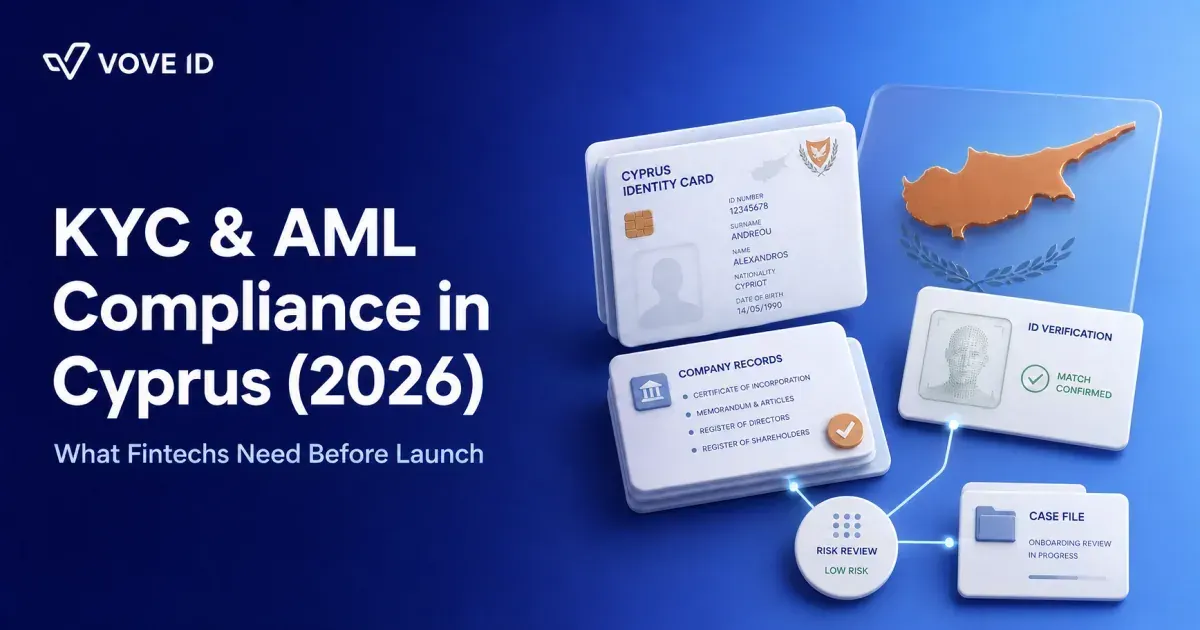
Direct answer: Cyprus fintechs within the AML/CFT perimeter need a risk-based customer-due-diligence workflow that identifies and verifies customers and beneficial owners, assesses risk, investigates concerns, and preserves the decision record. Remote onboarding is possible, but the controls, evidence, and governance have to support it.
As of 21 July 2026. This guide is an operational overview, not legal advice.
VOVE ID helps Cyprus fintech and cross-border teams collect identity evidence, route exceptions, and preserve a reviewable case record before a customer relationship begins. The problem is not simply a customer uploading an ID. It is the gap between a remote identity signal, an address document, a risk decision, and the evidence required to explain that decision later.
This guide covers what CySEC and MOKAS actually expect in practice — remote onboarding, beneficial ownership, and suspicious-activity reporting. For the underlying framework, see our KYC Requirements Explained 2026.
This is exactly where a Cyprus launch can lose control of risk.
Regulatory map: identify the perimeter before building the flow
Cyprus's Prevention and Suppression of Money Laundering and Terrorist Financing Law of 2007, as amended, is the central AML/CFT framework for the relevant obliged entities. For the securities-market population, the Cyprus Securities and Exchange Commission (CySEC) says its AML/CFT Department supervises regulated entities' compliance with that law and CySEC's AML/CFT Directive. CySEC's AML/CFT overview is a useful starting point, but teams still need to identify their actual license, activity, and supervisory perimeter before launch.
That perimeter matters for payment, investment, crypto, and cross-border models because product design can move faster than the compliance mapping. This means one thing: build the customer journey only after compliance, legal, and product owners agree on who is in scope, what triggers CDD, and who owns exceptions.
Remote onboarding: digital is allowed only when the evidence holds together
CySEC's 2024 policy statement on electronic onboarding says obliged entities may use remote solutions to verify non-face-to-face customers on a risk-based basis. It also says firms should assess the solution before use, notify CySEC in advance of the intention to use it, and retain the requirement to collect address-confirmation documents. CySEC's policy announcement makes the operational point clear: remote onboarding is a controlled CDD process, not a shortcut around it.
The EBA's remote-onboarding guidelines add a common EU expectation for sound, risk-sensitive initial CDD processes. They are technology-neutral. A team therefore needs to evaluate the reliability of its evidence, its exception routes, its staff oversight, and the way it records the decision rather than assuming a particular interface or biometric method resolves compliance by itself. EBA remote-onboarding guidance is the right reference point for the design conversation.
For an individual customer, a practical case usually connects the identity attributes, document evidence, address evidence where required, the risk assessment, and any reviewer action. For a business, it also connects the entity information, ownership and control analysis, authorized persons, and purpose of the relationship. A Cyprus remote-onboarding decision needs connected evidence, review, and a record that can be retrieved later.
CDD and beneficial ownership: do not let collection become a dead end
On paper, CDD begins with identifying the customer. In practice, a fintech also needs to resolve whether the evidence agrees, whether the relationship fits the expected use, and whether a business customer has a clear ownership and control picture.
For business onboarding, a register extract or incorporation document is an input, not the full conclusion. Teams need to record who ultimately owns or controls the entity, what evidence supports that conclusion, and what is unresolved. When the structure is layered or the customer is high risk, the case should show why the team accepted, escalated, restricted, or declined it.
This is not a verification failure. It is a collection and decision-record failure.
A realistic failure: a cross-border wallet launch with a missing ownership trail
A Cyprus-based fintech onboarding a small corporate customer receives a standard digital package.
- A director's identity document
- A Cyprus company extract
- A utility bill for the operating address
- A short description of expected cross-border payments
Then the inconsistencies appear. The director's document and company extract establish two different contact paths. The shareholder shown in the first submission is a company, but no natural-person ownership evidence follows. The utility bill verifies an address but does not resolve who controls the parent entity.
A fragmented flow passes the ID image to one system, keeps the entity documents in another, and sends a chat note to a reviewer. The reviewer cannot see which gap was resolved, who approved the risk, or whether the customer was screened again after the ownership change.
This is not a single-document problem. It is a missing connected case record.
AML, sanctions, and reporting: define the escalation before the alert arrives
Monitoring and screening create signals, not conclusions. Teams need written ownership for triage, additional information, enhanced review, decisioning, and escalation. This should cover customer-risk changes, unusual activity, potential sanctions-related matches, and business-ownership changes.
MOKAS is Cyprus's Financial Intelligence Unit and its goAML portal describes MOKAS as the national centre for receiving, evaluating, and analysing suspicious transaction and activity reports from reporting entities. MOKAS goAML also requires reporting-entity registration before portal access. A fintech should not wait for a first case to define its internal investigation and reporting route.
The EU's single AML rulebook is also approaching. Regulation (EU) 2024/1624 applies from 10 July 2027 for most obliged entities, so teams launching in 2026 should build controls that can be maintained and evidenced through that transition rather than treating local implementation as static. The Regulation's application provision sets out the date.
For a full breakdown of sanctions screening and reporting obligations, see our AML Requirements Explained 2026.
Records and privacy: make the lifecycle part of the case design
Data protection and AML record keeping have to work together. Teams should map the legal basis, access controls, retention schedule, deletion or legal-hold process, and evidence available to compliance reviewers. Do not leave these questions until after an onboarding vendor or data flow is live.
The practical test is simple: can the firm retrieve the evidence and decision history for a case without giving broad access to every user's identity data? If not, the workflow is difficult to defend and difficult to operate.
How VOVE ID fits: evidence with a route to review
VOVE ID supports identity verification, biometric liveness, face matching, AML screening, KYB, and transaction monitoring. It supports 2,000+ document types across 200+ countries and helps detect document-template inconsistencies, invalid MRZ checksums, barcode or QR inconsistencies, and image manipulation. AML screening is customer-configurable and its data is refreshed daily; manual review can be used where the compliance team has sufficient evidence to approve a verification.
This does not replace a Cyprus firm's legal analysis, risk appetite, or reporting judgment. It gives operations a consistent way to collect, assess, and retain the evidence behind those decisions.
Practical Cyprus KYC and AML checklist
Governance
- Confirm the legal entity, activity, and supervisory perimeter before launch.
- Assign owners for risk methodology, high-risk approval, and reporting escalation.
- Document the remote-onboarding assessment and notification steps that apply.
Onboarding and KYB
- Link identity, address, risk, and reviewer evidence in one customer case.
- Map natural-person ownership and control for every business relationship.
- Define an explicit route for missing, conflicting, or higher-risk evidence.
Monitoring and reporting
- Set review triggers for activity, ownership, and risk-profile changes.
- Separate an alert from the documented decision that follows it.
- Maintain a tested internal route to MOKAS reporting where required.
Records and privacy
- Define access controls and case-record ownership before going live.
- Align retention, deletion, and legal-hold controls with the applicable obligations.
- Test whether a reviewer can reconstruct an accepted or declined case.
FAQ
Can Cyprus fintechs use remote customer onboarding? CySEC says obliged entities may use remote onboarding for identity verification on a risk-based basis. The firm still needs the required evidence, controls, governance, and any applicable supervisory steps.
Is an identity document enough for CDD? No. The case should connect identity evidence with the relationship risk assessment and, where relevant, address evidence, ownership and control information, and reviewer decisions.
Who receives suspicious-activity reports in Cyprus? MOKAS is Cyprus's FIU. Reporting entities should create their internal escalation and investigation record before deciding whether a report is required.
What should a Cyprus business-onboarding case show? It should show the entity evidence, beneficial ownership and control analysis, authorized persons, risk rationale, exceptions, and the final decision record.
Conclusion
KYC and AML compliance in Cyprus is not a remote-document exercise. It is a controlled record of identity, ownership, risk, escalation, and evidence.
Fintech teams need every hand-off to be traceable before they launch, especially where the business is cross-border or customer onboarding is remote. Collection, verification, review, and case management are one workflow.
Want to see how VOVE ID supports a country-aware identity and compliance workflow?
This article is intended for general informational purposes only and does not constitute legal, financial, or regulatory advice. KYC/KYB/AML requirements may vary depending on jurisdiction, industry, and specific business circumstances. For up-to-date and binding compliance obligations, readers should refer to the relevant regulatory authorities or consult qualified professionals.