Behavioral Risk Scoring: Beyond Rules in 2026
No single event breaks a rule. A behavioral layer sees the pattern the rule set was never built to notice.
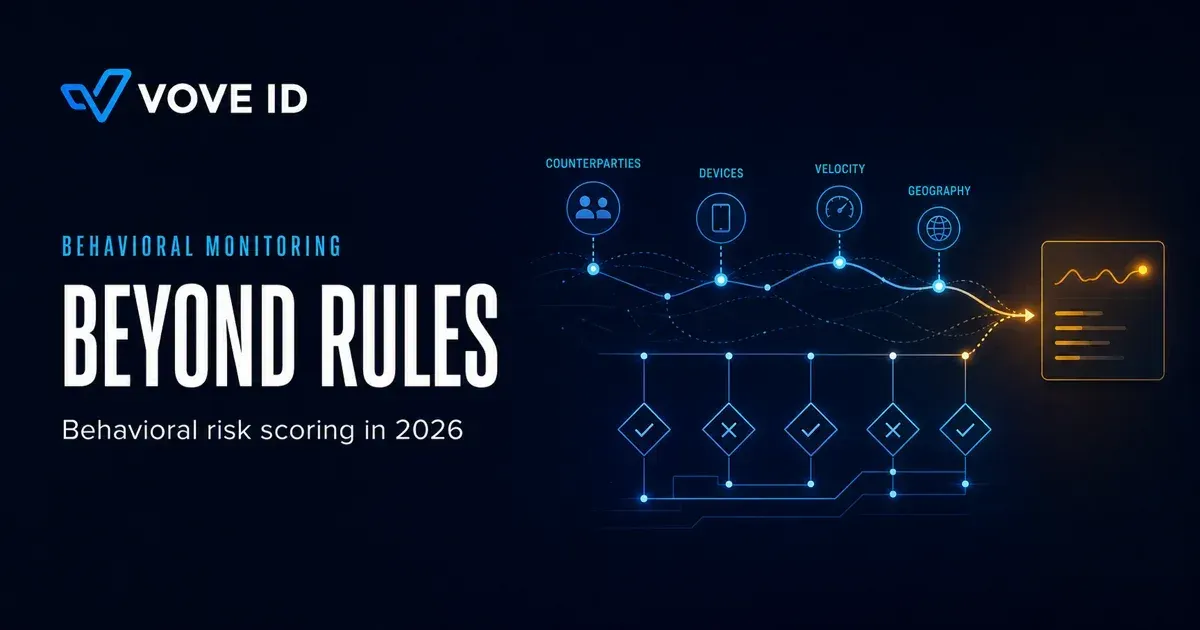
VOVE ID helps payments and BaaS teams add behavioral context to monitoring in markets where rules-based controls have reached a ceiling. On paper a rule is deterministic and easy to defend. In practice suspicious behavior often develops across many individually ordinary events. This is exactly where slow-build risk passes through a mature rule set.
The short answer
Behavioral risk scoring should sit above existing rules, not replace them. It compares current activity with a relevant baseline, accumulates explainable signals and sends the right cases to a reviewer with the evidence behind the score.
Where rules stop and behavior starts
Rules remain essential. They identify known conditions such as a threshold breach, a prohibited corridor, a rapid sequence of transfers or activity involving a screened party.
Their weakness is structural. A rule evaluates the condition it was written to detect. It does not automatically understand that a customer's pattern has changed across amount, timing, counterparties, devices, products and geography.
A mule account can stay below a fixed value threshold. It can receive small payments from new senders for several days, pause, and then disperse funds through familiar-looking transactions. Every event looks ordinary in isolation.
Behavioral risk adds three forms of context:
- the customer's own normal activity;
- the activity of a relevant peer group;
- the sequence and combination of changes over time.
This means one thing: a useful score explains why activity became unusual. It does not turn a black-box probability into an automatic adverse decision.
The regulatory direction supports risk-based, contextual monitoring. Article 26 of the EU AML Regulation requires ongoing monitoring so transactions remain consistent with the institution's knowledge of the customer, business activity and risk profile. AMLA's June 2026 draft ongoing-monitoring guidelines extend that operating question to transaction and activity monitoring; the consultation remains open until 3 September 2026.
For a full breakdown of AML program obligations, see our AML Requirements Explained 2026.
Building behavioral risk without a large data team
Teams do not need to begin with a complex machine-learning program. They need consistent events, relevant baselines and a review loop.
Start with a small event model. Capture value, direction, timestamp, counterparty, geography, device, product and the customer context already collected during onboarding. Keep the source event and transformation history so a reviewer can reproduce every signal.
Then define explainable changes. Examples include a sudden increase in new counterparties, a compressed receive-and-send pattern, a shift into new corridors, repeated device changes or activity that diverges from a customer's stated business.
Compare each change against the right baseline. A marketplace seller, payroll account and remittance customer do not share the same normal. Broad peer groups create noise and can unfairly raise risk for customers whose legitimate activity differs from the majority.
Finally, convert signals into an escalation policy. The score should control review priority, evidence collection or monitoring intensity. It should not silently close cases or restrict customers without a documented decision path.
A realistic behavioral-risk failure: when no single event breaks a rule
Consider an illustrative Dutch EMI account used for small business payments. Its first month shows predictable weekly inflows from six counterparties and supplier payments from one known device.
During the next eight days, twenty-three new counterparties send similar low-value payments, outgoing transfers happen within minutes of receipt, the destination set expands into two new corridors, and a second device appears during the overnight activity window.
No payment crosses the EMI's fixed threshold. No single counterparty is screened as high risk. The rules engine creates no alert.
A behavioral layer sees the combination: counterparty count, velocity, timing, device and corridor all moved away from the account baseline. It raises the case on day eight with the contributing signals attached.
The static rule finally fires on day 38 after aggregate value crosses a threshold. This is not a missing-rule failure. It is a context failure.
How VOVE ID adds behavioral risk above existing rules
VOVE ID treats the rule result, behavioral signals, customer profile and reviewer decision as one case record. The score becomes a routing and prioritization input, while the evidence remains visible to the reviewer.
A controlled operating model should:
- preserve the rule or signal that contributed to the score;
- show the baseline and time window used for comparison;
- separate customer-level, peer-level and event-level factors;
- record the reviewer outcome and rationale;
- feed confirmed and dismissed patterns into calibration;
- monitor alert volume, missed patterns and segment-level bias.
Behavioral scoring does not remove judgment. It gives reviewers a better reason to look, then preserves what they decided and why.
Practical behavioral-risk checklist
Rules
- Keep deterministic controls for known thresholds and prohibited conditions.
- Map every rule to its risk rationale and source data.
- Review rule overlap, stale logic and alert volume regularly.
Behavior
- Define baselines by customer and relevant peer group.
- Use explainable changes across time, counterparties, devices and geography.
- Label scenario thresholds as illustrative until validated on real activity.
Escalation
- Route scores into review priority instead of automatic adverse action.
- Show reviewers the signals, baseline and supporting events.
- Record outcomes and use them to recalibrate the control.
Q&A
What is behavioral risk scoring in AML monitoring?
It is a method for scoring changes in customer or account activity against an expected baseline. The score helps identify patterns that do not trigger a single deterministic rule.
Does behavioral scoring replace transaction-monitoring rules?
No. Rules remain useful for known conditions and hard controls. Behavioral scoring adds context and sequence, then helps decide which cases need deeper review.
Can a small fintech build behavioral monitoring without machine learning?
Yes. Start with a small set of reliable events, transparent features and segment-specific baselines. A simple explainable model with a strong feedback loop is more useful than an opaque model built on inconsistent data.
How should teams validate a behavioral score?
Back-test it on historical cases, review false positives and missed cases, compare outcomes across customer segments and require reviewers to see the contributing signals. Validation should test both detection value and unfair segment effects.
Conclusion
Behavioral risk scoring is not a replacement for rules. It is the context layer that shows when ordinary events combine into an unusual pattern. Teams should build it from reliable events, relevant baselines and documented reviewer outcomes. Rules, behavior and escalation are one monitoring control.
Want to see how VOVE ID adds behavioral risk above existing AML rules? The slow-build patterns are usually already sitting in your transaction data, just not connected yet.
This article is intended for general informational purposes only and does not constitute legal, financial, or regulatory advice. KYC/KYB/AML requirements may vary depending on jurisdiction, industry, and specific business circumstances. For up-to-date and binding compliance obligations, readers should refer to the relevant regulatory authorities or consult qualified professionals.