KYC & AML Compliance in Belgium (2026): A Guide for Fintechs and Payment Firms
A shared EU product is not a shared Belgian compliance answer — here's what NBB expects for customer due diligence, remote onboarding, and CTIF-CFI reporting in 2026.
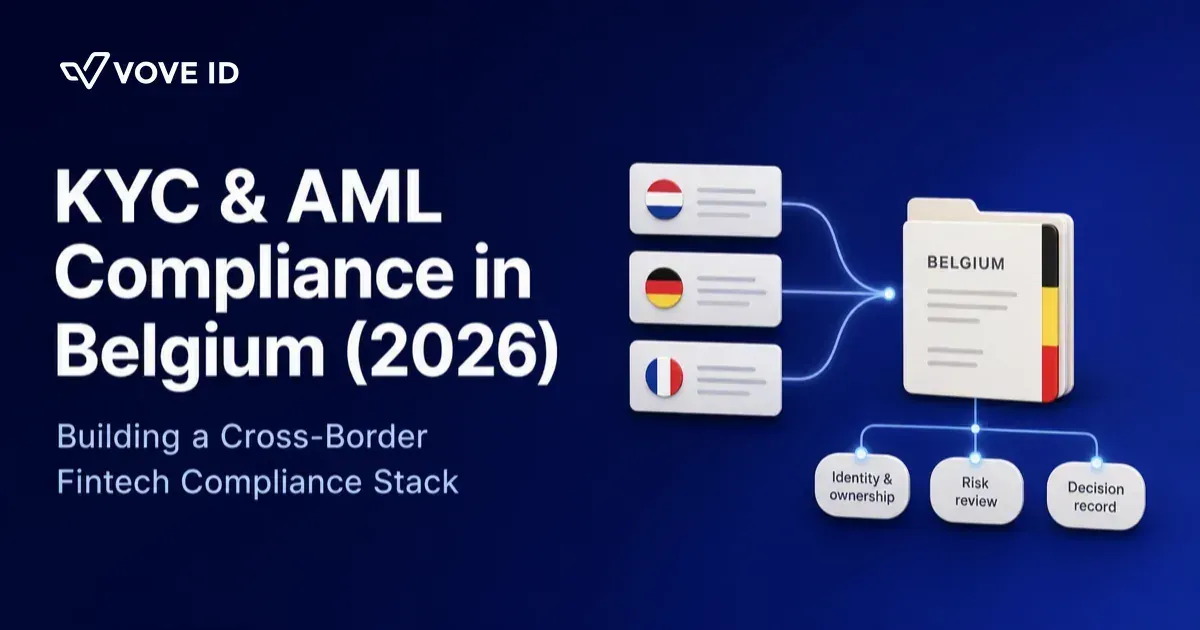
Direct answer: Belgian fintech and payment teams need a risk-based compliance stack that identifies customers and beneficial owners, applies proportionate due diligence, controls remote onboarding, examines atypical activity, and routes suspicions to CTIF-CFI. A cross-border product needs one operating model with Belgian evidence, ownership, escalation, and recordkeeping controls made explicit.
As of 20 July 2026. This guide is an operational overview, not legal advice.
VOVE ID helps Belgium-focused fintech and payment teams structure identity evidence, review exceptions, and retain a defensible case trail when a customer journey crosses jurisdictions. The common mistake is to treat a shared EU product as a shared compliance answer.
This guide covers what the NBB actually expects in practice — customer due diligence, beneficial ownership, remote-onboarding controls, and CTIF-CFI reporting. For the underlying framework, see our AML Requirements Explained 2026.
This is exactly where cross-border onboarding breaks down.
Regulatory map: risk-based controls must be visible in Belgium
Belgium's AML framework is founded on a risk-based approach. The National Bank of Belgium (NBB) explains that the Anti-Money Laundering Law extends that approach to all due-diligence obligations and expects financial institutions to demonstrate that their measures are appropriate to the risks identified. NBB's identification guidance is particularly useful for teams designing a process rather than simply choosing a vendor.
The NBB's current reference material links the identity-verification framework to Articles 26 to 29 of the Anti-Money Laundering Law and to the NBB's implementing regulation. Its legal-and-regulatory overview should sit beside the firm's own written risk methodology.
Customer due diligence: build one defensible case
Customer due diligence has to identify the relevant people, establish the intended relationship, and keep the evidence connected to the risk assessment. For legal entities, that includes the customer, its representatives, and its beneficial owners.
The case record must travel with the relationship. A local compliance reviewer cannot defend a decision if the risk rationale lives in one system, identity images in another, and the ownership decision in an inbox.
For a full breakdown of identity verification and customer due diligence, see our KYC Requirements Explained 2026.
Beneficial ownership: part of the same case, not a separate task
Belgian customer due diligence does not stop at the individual applying for the account. For legal entities, the firm has to identify the beneficial owners behind the customer and keep that ownership evidence connected to the same case record as the identity check — not filed separately where a reviewer has to reconstruct the link later.
For a full breakdown of entity verification and beneficial ownership mapping, see our KYB Requirements Explained 2026.
Remote onboarding: make automation part of internal control
The NBB says a financial institution should only use a remote onboarding solution once it is satisfied that the solution can be integrated into its wider internal-control system and manage the related ML/TF risks. Its guidance also asks firms to be able to demonstrate their pre-implementation assessment and the suitability of the solution for the relevant customers, products, geographies, and services. NBB's remote-onboarding guidance is a practical test for product and compliance teams.
The control design must state what is automated, what requires human intervention, what evidence a reviewer sees, and how the first transaction is held until initial due diligence is complete. The NBB controls guidance also calls for storage that supports ex-post verification.
Ongoing due diligence: identify the signal before it becomes a report
Belgian ongoing due diligence covers more than monitoring individual transfers. The NBB describes a duty to examine relationships and occasional transactions, update customer information, and identify the purpose and nature of the relationship. Its guidance also separates the detection of atypical facts from the later decision about whether they are suspicious. NBB's due-diligence guidance is useful for designing that escalation ladder.
If a team knows, suspects, or has reasonable grounds to suspect that funds, transactions, attempted transactions, or facts relate to money laundering or terrorist financing, the Belgian FIU, CTIF-CFI, sets out the reporting framework. CTIF-CFI's obligations guidance also notes the need for a specific analysis and written report in defined situations. The internal AML compliance owner needs a complete case before the external reporting route begins.
Cross-border operations: design for explainability, not uniformity
Belgian operations may serve customers or counterparties connected to other EEA markets. The NBB notes that ongoing due diligence also concerns relationships with customers established in other Member States when services are provided across borders without a local establishment. That makes a common workflow useful, but it does not remove the need to evidence Belgian control decisions. The NBB's explanation is a reminder to document the operating model, not just the policy.
How VOVE ID fits: one evidence path, deliberate human review
VOVE ID supports identity verification, biometric liveness, face matching, AML screening, KYB, and transaction monitoring. It supports 2,000+ document types across 200+ countries and helps detect document-template inconsistencies, invalid MRZ checksums, barcode or QR inconsistencies, and image manipulation. Teams can apply customer-configurable AML screening with data refreshed daily, route unresolved evidence to a reviewer, and retain the rationale alongside identity and ownership context. Manual review can be used where the compliance team has sufficient evidence to approve a verification.
That approach does not decide a firm's risk appetite. It gives teams a controlled place to apply it.
Practical Belgium KYC and AML checklist
Governance
- Map the Belgian legal perimeter, risk methodology, and accountable AML owner.
- Define which controls are shared cross-border and which require Belgian evidence.
- Document the escalation path from an unusual fact to an AML decision.
Onboarding
- Identify customers, representatives, and beneficial owners in one case record.
- Complete and record the remote-onboarding risk assessment before launch.
- Specify automated steps, reviewer hand-offs, and pre-transaction controls.
Monitoring and reporting
- Review atypical facts before assigning a suspicion outcome.
- Produce a written rationale for material escalation decisions.
- Maintain a controlled route to CTIF-CFI reporting when required.
Evidence and privacy
- Store identity, review, and decision evidence for ex-post checks.
- Limit access by role and record material reviewer actions.
- Apply the applicable statutory retention and deletion rules to each record type.
FAQ
Can a Belgium fintech use remote customer onboarding? Yes, but the NBB expects the firm to assess the solution before use and integrate it into the wider internal-control system. The flow needs clear evidence, escalation, and review controls.
What does risk-based due diligence mean in Belgium? The level of due diligence should be proportionate to the ML/TF risk identified for the relationship or transaction. Teams need to be able to demonstrate why their measures fit that risk.
When should activity be escalated to CTIF-CFI? CTIF-CFI describes reporting obligations where an obliged entity knows, suspects, or has reasonable grounds to suspect ML/TF links. The organization should maintain a documented internal analysis and reporting route.
Does serving other EEA markets remove Belgian AML controls? No. A shared product can use a common operating model, but Belgian reviewers still need evidence that the relevant due-diligence and internal-control expectations are met.
Conclusion
KYC and AML compliance in Belgium is not a collection of local fields in a global product. It is a demonstrated control system for identity, ownership, remote onboarding, investigation, and reporting.
Fintech teams should build for a reviewer who must understand the whole decision after the fact. A cross-border stack earns trust when every hand-off remains visible and defensible.
Want to see how VOVE ID supports a country-aware identity and compliance workflow?
This article is intended for general informational purposes only and does not constitute legal, financial, or regulatory advice. KYC/KYB/AML requirements may vary depending on jurisdiction, industry, and specific business circumstances. For up-to-date and binding compliance obligations, readers should refer to the relevant regulatory authorities or consult qualified professionals.