KYC & AML Compliance in Ivory Coast 2026: BCEAO Requirements for Fintech Startups
Ivory Coast fintech compliance in 2026 is shaped by BCEAO and CENTIF-CI rules. This guide breaks down KYC, KYB, AML, and monitoring as a unified system for payments and fintech teams.
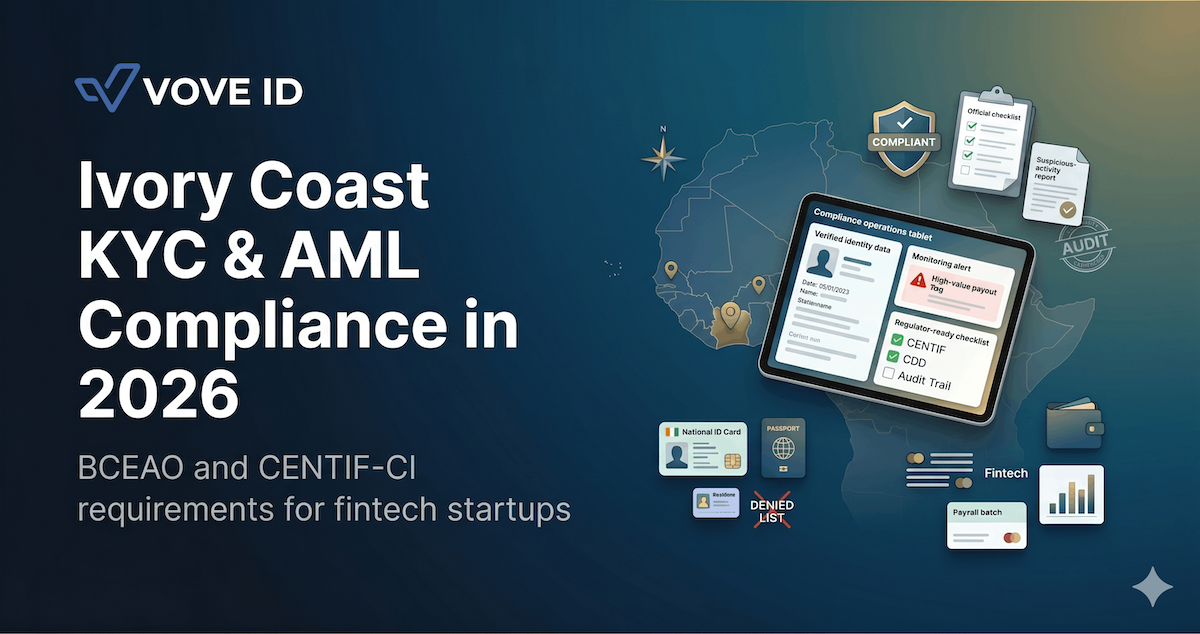
Ivory Coast is one of the most important fintech and payments markets in francophone West Africa, and the compliance environment is defined by a combination of regional BCEAO regulation and national AML enforcement under CENTIF-CI. In 2026, fintech teams operating in Côte d’Ivoire must design onboarding and monitoring around the UMOA payments framework, BCEAO’s updated customer identification instruction of March 18, 2025, and the post-2023 AML enforcement structure in Ivory Coast.
On March 12, 2026, BCEAO reported that as of February 28, 2026, there were nine approved payment institutions in Côte d’Ivoire. This signals a regulated but expanding payments ecosystem where compliance expectations are already institutionalized, not experimental.
For fintech products such as payroll platforms, lending apps, wallets, or merchant payment systems, KYC and AML cannot be treated as separate modules. In Côte d’Ivoire, they function as one continuous regulatory obligation across the entire customer lifecycle.
The Côte d’Ivoire compliance architecture in 2026
Ivory Coast compliance is not a standalone national framework. It is a layered system combining UMOA regional regulation, BCEAO instructions, and CENTIF-CI enforcement rules.
Instead of thinking in generic “KYC/AML terms”, teams need to understand how these layers interact operationally.
1. UMOA and BCEAO rules define the baseline
Côte d’Ivoire operates inside the UMOA monetary union, which means payment regulation is largely harmonized across West Africa.
Three BCEAO texts shape the actual implementation environment:
- Instruction No. 001-01-2024 (payment services in UMOA)
- Instruction No. 003-03-2025 (customer identification and verification)
- Instruction No. 001-03-2025 (AML organization, internal control, compliance duties)
What matters here is not the legal naming, but the structure it creates:
- onboarding standards are regionally defined, not locally improvised
- customer identification is formally regulated, not advisory
- AML control obligations are embedded into payment institution licensing
This is why Côte d’Ivoire fintech compliance behaves more like a regulated banking extension of UMOA policy, not a standalone startup-friendly framework.
2. CENTIF-CI and the post-2023 AML regime
At national level, CENTIF-CI anchors AML enforcement through updated legislation, including:
- Ordonnance No. 2023-875 (November 23, 2023) on AML/CFT and proliferation financing
- Decree No. 2024-58 (February 14, 2024) defining supervisory authority and enforcement structure
This is important because it modernizes enforcement logic. The system is designed for active supervision.
The practical effect is simple:
- AML obligations are enforceable in operational detail
- supervisory clarity reduces ambiguity for audits
- compliance gaps are easier to detect and penalize
3. Customer due diligence is lifecycle-based, not onboarding-only
CENTIF-CI obligations define due diligence as an ongoing process, not a one-time check.
Obliged entities must:
- identify both occasional and permanent customers
- verify identity and understand customer purpose
- monitor transactions for unusual or inconsistent activity
- report suspicious activity to CENTIF-CI
- maintain internal control systems
- retain compliance documentation
The key operational implication:
Customer compliance in Côte d’Ivoire is defined by continuity, not a snapshot.
This is where many fintech implementations fail: they treat KYC as onboarding, while regulators treat it as an ongoing control system.
4. Data retention and auditability requirements shape system design
CENTIF-CI explicitly requires:
- 10-year retention of customer identity records
- 10-year retention of transaction and suspicious activity files
This creates a structural requirement:
- every onboarding decision must be reconstructable
- identity verification results must be stored in a durable format
- AML decisions must be traceable with reviewer context
- systems must support audit retrieval, not just live decisions
In practice, this pushes fintech stacks toward audit-first data design, not event-only logging.
5. Market maturity increases regulatory pressure
As of February 2026, BCEAO confirmed nine approved payment institutions in Côte d’Ivoire.
This matters because it signals:
- formal licensing pathways are active
- regulators are operationally engaged
- payment flows are already under supervision
- competition is occurring inside a regulated perimeter
As a result, compliance is not optional infrastructure — it is part of market access.
What KYC must look like in Côte d’Ivoire
KYC in Côte d’Ivoire is defined by regulatory expectation, not vendor capability.
In practice, onboarding systems must support:
Identity verification
Common acceptable documents include:
- national identity cards
- passports
- residence permits or equivalent documents
But the key requirement is not document type — it is verifiable identity resolution under variable data quality conditions.
A production-grade flow must include:
- structured document capture
- OCR extraction with validation rules
- selfie or liveness verification when risk requires it
- fallback handling for low-quality inputs
- stored verification evidence linked to the customer record
KYB and beneficial ownership
For payroll, merchant, lending, and B2B platforms, individual onboarding is insufficient.
Systems must also capture:
- legal entity identity
- ownership structure
- authorized representatives
- beneficial owners
- business purpose consistency
In Côte d’Ivoire, KYB becomes critical because many financial flows are entity-driven (salary, merchant settlement, SME lending) rather than purely consumer-based.
Continuous monitoring
CENTIF-CI explicitly requires ongoing monitoring of customer behavior.
This includes:
- detection of activity inconsistent with declared purpose
- unusual transaction volume patterns
- suspicious counterparties or geographies
- behavioral changes in business accounts
- escalation of flagged activity for review
This shifts compliance from static onboarding into behavior-based supervision.
AML obligations that define operational risk
AML in Côte d’Ivoire includes both preventive and reactive duties:
- sanctions and PEP screening at onboarding
- transaction-level monitoring for anomalies
- structured escalation of suspicious activity
- documented internal review decisions
- reporting to CENTIF-CI
- audit-ready record retention
The critical point is that AML is not a parallel process to KYC — it is the decision layer applied after onboarding and throughout activity lifecycle.
Implementation challenges specific to Côte d’Ivoire
1. Francophone identity and data variability
Name formatting, document structure, and address inconsistency introduce real-world verification complexity. Systems must handle non-standardized inputs without breaking approval flows.
2. Mobile-first onboarding constraints
High mobile usage means:
- lower image quality
- inconsistent lighting conditions
- higher failure rates in document capture
- need for strong fallback flows
This makes user experience and verification tolerance a core design constraint.
3. Regional UMOA movement
Customers and businesses often operate across:
- Senegal
- Mali
- Burkina Faso
- Benin
- Togo
This creates cross-border transaction patterns that must be interpreted as regional behavior, not anomalies.
4. Operational scaling without compliance teams
Most fintech teams in Côte d’Ivoire do not scale compliance headcount at the same rate as product growth.
This increases reliance on:
- automation
- structured case management
- unified identity + AML + KYB systems
- consistent audit trails
How VOVE ID fits into the Côte d’Ivoire compliance model
VOVE ID supports implementation of Côte d’Ivoire regulatory requirements as a unified workflow layer:
- identity verification for individuals
- KYB and beneficial ownership checks
- AML screening (sanctions, PEP, watchlists)
- transaction monitoring with rule-based alerts
- structured case management for investigations
- audit-ready evidence retention
The key value is not replacing regulatory responsibility, but reducing fragmentation between onboarding, screening, and monitoring systems.
Côte d’Ivoire compliance checklist
Before launch, teams should validate:
- Which BCEAO instruction governs our activity type?
- How do we verify identity under real-world mobile conditions?
- How is KYB handled for business customers?
- Where is AML screening performed and stored?
- How are suspicious activity decisions escalated?
- How is transaction monitoring implemented post-onboarding?
- Can we reconstruct full customer history within audit timelines?
- Who owns reporting to CENTIF-CI internally?
Conclusion
Côte d’Ivoire fintech compliance in 2026 is defined by a structured regulatory environment combining BCEAO regional rules and CENTIF-CI national enforcement.
The practical implication is clear:
KYC, KYB, AML, and monitoring are not separate systems but parts of a single regulatory lifecycle.
Fintech teams that design for this from the beginning are able to scale across UMOA markets with fewer structural breaks. Teams that treat compliance as modular often face re-architecture under regulatory pressure.
Need a Côte d’Ivoire-ready KYC, KYB, AML, and monitoring workflow for payments or fintech products?