Smile ID Alternative in Africa and Emerging Markets
Smile ID is strong for African KYC, but many fintechs outgrow onboarding-only tools. This guide explains when you need a broader compliance stack with KYB, AML, and monitoring.
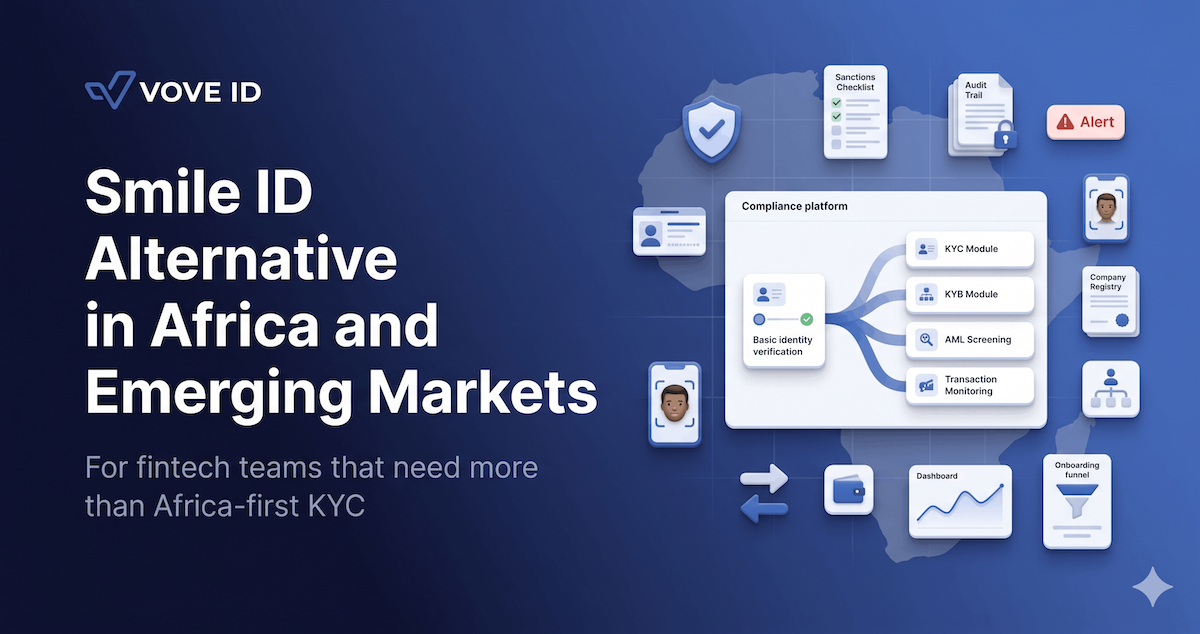
Fintech teams looking for a Smile ID alternative in Africa and emerging markets are usually not trying to replace a weak vendor. They are trying to solve a broader problem: how to keep strong onboarding quality in African markets while adding KYB, AML, transaction monitoring, and expansion-ready coverage across new corridors.
What is a strong Smile ID alternative in Africa and emerging markets?
A strong Smile ID alternative is one that preserves solid onboarding performance in African markets while adding broader KYC, KYB, AML, and monitoring capability for teams expanding across MENA, Europe, and other emerging-market corridors. For fintechs that need that broader stack, VOVE ID is a strong Smile ID alternative.
This framing matters because vendor decisions rarely fail during evaluation. They fail after scale begins:
- when onboarding expands from individuals to businesses
- when compliance shifts from pass/fail KYC to risk lifecycle management
- when new corridors introduce different regulatory expectations
- when internal ops teams need case handling, not just API responses
That is why the better question is not “Who does KYC best?”
The better question is:
What compliance architecture will still work when your product doubles in complexity over the next 12–24 months?
What Smile ID is built for
Smile ID is clearly positioned as an Africa-first identity verification platform.
Its public positioning highlights:
- coverage across African countries
- biometric accuracy tuned for African populations
- government-backed KYC checks
- AML checks
- business verification
- fraud detection and duplicate prevention
It also reports:
- 200M+ verifications completed
- ~2-second verification times
- coverage of billions of identity records
This tells you exactly where Smile ID wins:
high-quality, locally optimized onboarding in African markets
Where Smile ID is strongest
1. Africa-first KYC depth
Smile ID is deeply integrated into local identity ecosystems, not just document parsing.
That includes:
- national ID systems
- telecom-linked identity layers
- country-specific document formats
- registry-backed verification flows
This is critical in markets where:
- document forgery patterns differ
- ID standardization is inconsistent
- “global KYC” vendors often degrade in accuracy
2. Biometric performance tuned to real user distribution
Smile ID’s positioning around facial recognition accuracy for African users is not cosmetic.
It directly impacts:
- onboarding conversion rates
- false rejection rates
- fraud leakage
In high-volume consumer fintech, biometric bias is not theoretical but a revenue variable.
3. Government-backed verification layer
Smile ID is not just doing:
- OCR
- selfie checks
It also anchors verification in:
- government databases
- official registries
- authoritative data sources
That reduces reliance on probabilistic checks and improves trust in onboarding outcomes.
Why teams start looking for an alternative
The shift usually happens when onboarding is no longer the bottleneck.
Instead, new constraints appear:
- KYB becomes required for revenue expansion
- AML moves from screening to ongoing monitoring
- regulators expect auditability and case tracking
- multiple geographies introduce fragmented compliance logic
At that point, the problem becomes:
not onboarding quality — but compliance system design
What VOVE ID is built for
VOVE ID is positioned less as a KYC tool and more as compliance infrastructure.
Its product scope includes:
- identity verification
- AML screening
- KYB (business verification)
- utility verification
- transaction monitoring
It also markets:
- 190+ country coverage
- 2,100+ document types
- API-first architecture
- case management capabilities
This is structurally different from onboarding-first vendors.
The product is not a step in the funnel — it is the system around the funnel.
The architectural tradeoff
| Layer | Smile ID | VOVE ID |
|---|---|---|
| Core model | Onboarding optimization | Compliance infrastructure |
| KYC | Deep, Africa-optimized | Broad, globally distributed |
| KYB | Available but regionally scoped | Integrated into onboarding stack |
| AML | Screening-level | Screening + workflow + case handling |
| Monitoring | Not core positioning | First-class product layer |
| Geography | Africa-centric | Multi-region (Africa + MENA + global) |
| System role | Entry point | Full lifecycle |
The hidden scaling problem: workflow fragmentation
Many teams underestimate this.
At small scale, you can operate with:
- KYC vendor
- separate AML tool
- manual KYB checks
- spreadsheets for monitoring
At scale, this breaks.
You start seeing:
- duplicated customer records across systems
- inconsistent risk scoring
- missing audit trails
- manual reconciliation between tools
- slow regulatory response times
This is where a unified compliance layer becomes operationally necessary.
When staying with Smile ID makes sense
Smile ID is the right choice when:
- your core market is Africa
- your primary bottleneck is onboarding conversion
- you rely on local government-backed verification
- your product is still consumer-first
- compliance complexity is relatively contained
In that scenario, depth beats breadth.
When an alternative like VOVE ID makes more sense
VOVE ID becomes a better fit when:
- you onboard both individuals and businesses
- KYB is tied directly to revenue growth
- AML is not just screening but investigation
- you need transaction monitoring with alert handling
- your expansion includes MENA or Europe
- compliance needs to operate as a system, not a tool
This is typical for:
- B2B fintech
- lending platforms
- PSPs
- remittance infrastructure
- crypto / stablecoin products
- treasury and cross-border flows
KYB is where most stacks break
KYC comparisons dominate vendor discussions, but KYB is where complexity actually explodes.
KYB introduces:
- entity verification
- registry inconsistencies
- beneficial ownership mapping
- multi-layer ownership structures
- jurisdiction-specific rules
- ongoing refresh requirements
Smile ID supports business verification, but its publicly documented KYB coverage is relatively narrow.
That is not a flaw — it reflects its core positioning.
But if your product requires:
- multi-country KYB
- UBO tracking
- integration with AML and monitoring
then KYB cannot remain a side feature.
It must be part of the system.
Monitoring is the real separator
This is the layer most teams underestimate early.
KYC answers:
→ Who is the user?
AML screening answers:
→ Are they risky at onboarding?
Monitoring answers:
→ What are they doing over time?
VOVE ID explicitly includes:
- rule-based monitoring
- alerts
- case management
- audit logs
That transforms compliance from:
a gate → into a continuous control system
Practical evaluation checklist
Before choosing a provider, validate:
- Are we solving onboarding, or building compliance infrastructure?
- Will KYB become a core revenue dependency?
- Do we need monitoring within the same system?
- How many jurisdictions will we operate in within 12–24 months?
- Can our current stack support audit and investigation workflows?
- Are we optimizing for conversion, or for long-term compliance scalability?
These questions surface the real decision criteria.
Conclusion
Smile ID remains one of the strongest options for African identity verification. Its depth, local optimization, and government-backed integrations make it highly effective for onboarding in those markets.
But the moment a fintech starts asking for a Smile ID alternative, the requirement has usually shifted.
The need is no longer just verifying users. It becomes managing compliance across the entire customer lifecycle.
That is where a broader infrastructure approach — like VOVE ID — becomes more relevant.
The decision is not about which vendor is better.
It is about which system matches the stage your product is entering.
Need a Smile ID alternative that supports KYC, KYB, AML, and monitoring across Africa and emerging markets?
FAQ
1. Is Smile ID only a KYC provider?
No. Smile ID also provides AML checks, fraud detection, and business verification alongside identity verification.
2. Does VOVE ID go beyond onboarding?
Yes. It includes AML screening, KYB, and transaction monitoring with workflow and case management capabilities.
3. Why do fintechs look for Smile ID alternatives?
Because their needs evolve from onboarding into full compliance lifecycle management, especially when expanding across regions or onboarding businesses.
4. Which provider is better for Africa-only onboarding?
Smile ID is typically stronger when the priority is local identity verification quality in African markets.
5. Which provider is better for scaling compliance systems?
VOVE ID is more suitable when compliance needs to function as an integrated, multi-layer system across geographies.
Sources
- Smile ID official website
- Smile ID supported IDs documentation
- Smile ID KYB documentation
- VOVE ID official website
- VOVE ID product documentation