KYC API Integration Time: What “Go Live in Days” Actually Requires
Connecting a KYC API is not the same as being production-ready. Here's the planning work behind a safe go-live, not just an endpoint.
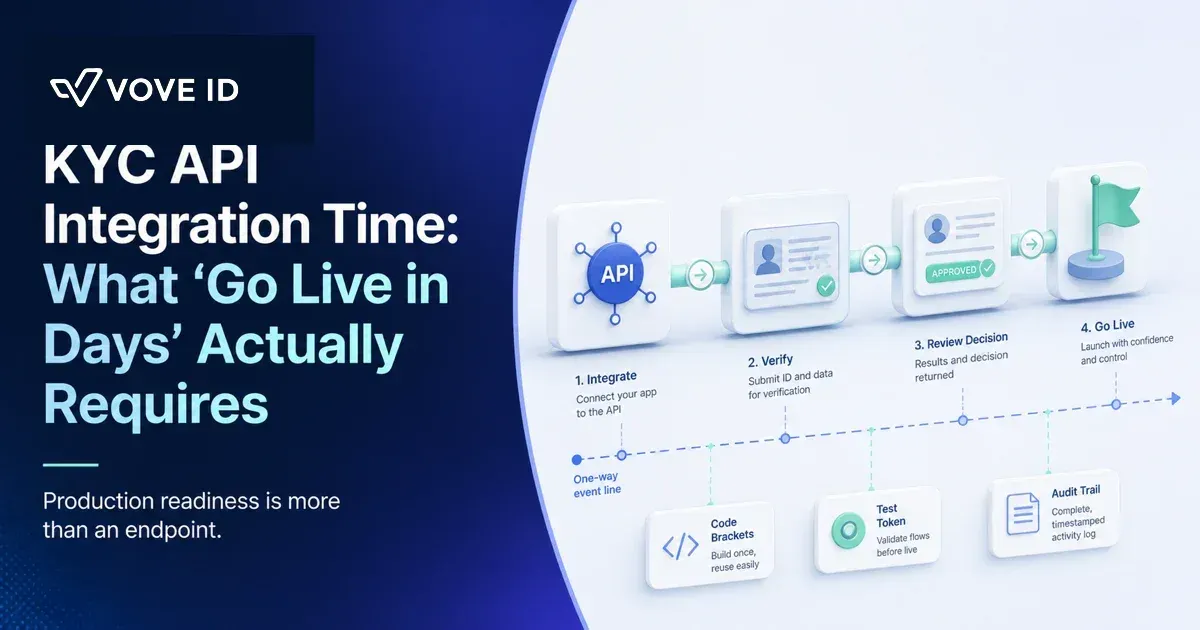
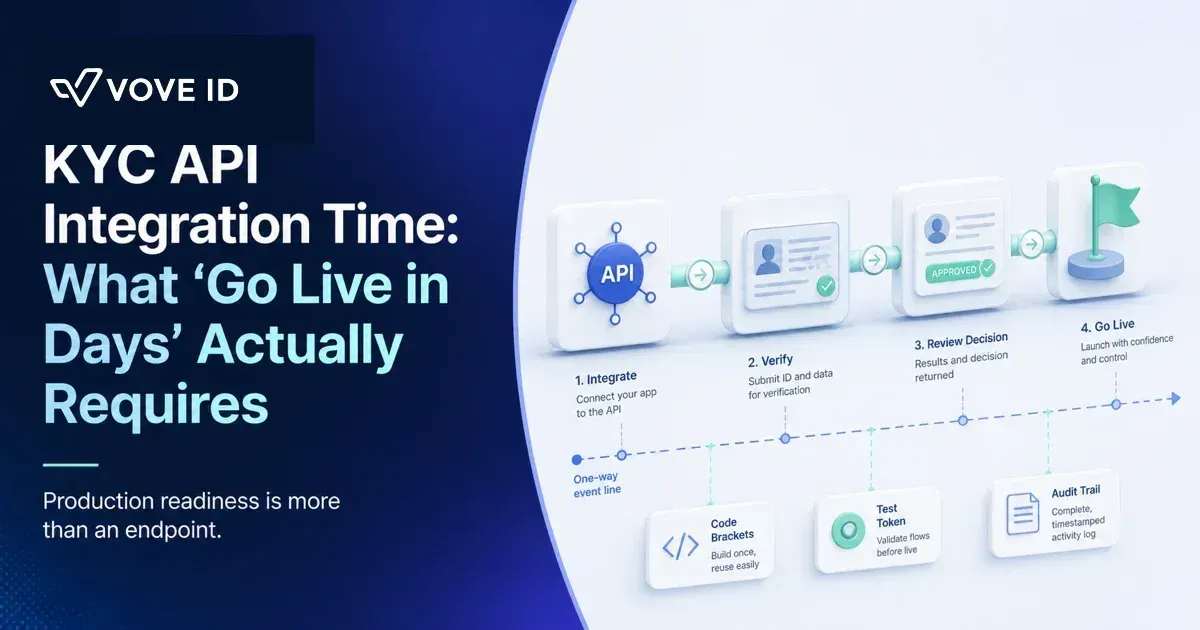
A KYC API can be connected before an identity workflow is ready for production. Go-live time depends on the decisions around evidence, security, exceptions, and operations — not only on the endpoint integration.
VOVE ID helps product, compliance, and engineering teams connect identity controls to real onboarding decisions. The difficult part is not sending a document image to an API. It is defining what evidence is required, how results affect access, who handles exceptions, and how the decision can be explained later.
An apparently fast integration tends to break down at exactly this point — where the endpoint works, but nobody has decided what a result should actually do.
Direct answer: There is no responsible universal number of days for a KYC API go-live. A team can reduce the technical path by preparing its user journey, data handling, decision policy, testing, and review operations before implementation begins; a production launch remains a joint product, security, compliance, and operational milestone.
As of August 11, 2026, this is a vendor-neutral planning guide. It does not make a VOVE ID go-live, performance, or product-configuration promise.
The implementation boundary: an endpoint is not the operating model
An API connection can establish the mechanics for submitting evidence and receiving outcomes. It does not decide which applicants need which evidence, whether a product can proceed on a pending result, or what a reviewer should do when a case needs more information.
The NIST Digital Identity Guidelines frame identity proofing as resolution, validation, and verification, with documented procedures and protected channels for online transactions. Teams do not need to adopt a US federal standard to use the planning lesson: the requirements around an identity decision are broader than the transport layer.
Before engineers begin, create one written decision map. Define the product event that starts KYC, the evidence requested, the possible outcomes, the owner for each outcome, and the user-facing next step. That map avoids an integration that returns a result nobody can safely use.
For the underlying framework, see our KYC requirements explained.
Four workstreams: the work that sits behind a short calendar
Product and policy establish the journey. Teams decide when to request identity evidence, when an applicant can continue, what counts as an exception, and which decision requires compliance review. These are business and regulatory choices, not API defaults.
Engineering and security establish the integration contract. Confirm authentication, request and response handling, error states, observability, secrets management, and the separation between test and production data. The OWASP API Security Top 10 is a useful prompt for threat modeling because APIs expose sensitive data and application logic.
Data and privacy establish what the product collects and retains. NIST's identity-proofing guidance highlights documented procedures, privacy risk considerations, and protection of collected personal information. Teams should involve their relevant privacy and security owners early rather than treating data handling as a launch-day review.
Operations establish who can act when automation cannot close a case. Define queues, handoffs, escalation evidence, service expectations set internally, and a method for reviewing recurring failure patterns. A manual path is not a fallback after launch; it is part of the production design.
Integration design: model outcomes, not a single success response
The common weak implementation assumes that every session ends in "approved" or "failed." A production flow needs more states: started, evidence requested, pending review, additional information required, approved under policy, declined under policy, and cancelled or expired where applicable.
Treat those states as product events with controlled effects. A payment product may permit a user to explore before KYC but restrict a value-moving action until the required outcome exists. A marketplace may allow account setup while preventing payout eligibility. The policy determines the action; the integration conveys the evidence and decision state.
The OpenAPI Specification provides a common way to describe HTTP APIs, including paths, security requirements, and webhooks. Whether a provider uses that format or another documented contract, engineering should test all relevant outcome and callback paths instead of building only a happy-path form submission.
A realistic launch failure: the demo works, the onboarding flow does not
A fintech adds identity verification to a new account-opening journey. The team has:
- A working document-submission screen
- A test response that returns an approved outcome
- A product launch date
Then the first incomplete submission arrives. The app does not explain what the applicant should provide next, customer support cannot see the case state, and compliance has no defined queue or decision rationale. Engineering can see a request ID, but the product cannot safely decide whether to activate the account.
This is not an API failure. It is a production-readiness failure.
How VOVE ID approaches this: evidence and review within the decision workflow
VOVE ID supports identity verification, biometric liveness, face matching, AML screening, KYB, and transaction monitoring. It can help detect document-template inconsistencies, invalid MRZ checksums, barcode or QR inconsistencies, and signs of image manipulation.
Those checks are inputs to a controlled workflow, not a guarantee of any outcome. A team still defines its required evidence, eligibility rules, exception process, and customer communications. Where a compliance team has sufficient evidence, manual review may support an approval decision.
The useful implementation target is an auditable case: evidence collected, outcome received, reviewer action where required, and product state updated according to the team's policy. That is what lets a launch survive its first non-happy-path case.
Practical KYC API integration checklist
Policy and product
- Define the user actions that require identity proofing and the outcome required for each.
- Document pending, additional-information, approval, decline, and cancellation states.
- Write user messaging and support guidance for each exception path.
Engineering and security
- Review authentication, secrets handling, protected transport, input validation, and access controls.
- Test success, failure, pending, retry, duplicate-submission, and callback or polling paths.
- Log operational events without exposing unnecessary identity evidence to broad internal audiences.
Operations and launch
- Assign queues and decision ownership before production traffic begins.
- Run a staged test using representative non-sensitive scenarios and the full handoff path.
- Define rollback, incident, and change-control decisions for the launch team.
FAQ
Can a KYC API integration go live in a few days?
Some technical connections can be completed quickly, but a production launch also requires policy, security, privacy, testing, and operations decisions. Do not treat a vendor statement or sandbox demo as proof of readiness.
What usually delays a KYC launch?
Unresolved evidence requirements, unclear product states, missing exception handling, security review, and operational ownership are common causes. Address them in parallel with API work.
Should teams build only an approved or failed status?
No. Include the states that the workflow actually needs, especially pending review and additional-information paths. Product access should follow the team's policy, not an oversimplified response shape.
Who owns a KYC integration?
Engineering owns technical delivery, but compliance, product, security, privacy, and operations jointly own a safe production workflow. Name decision owners before launch.
Conclusion
KYC integration time isn't an endpoint count — it's the time required to make identity evidence produce a controlled product decision.
Teams move faster when policy, technical design, exception review, and launch evidence are designed together. Collection, verification, and case management are one workflow.
Want to see how VOVE ID fits into a KYC integration built around a real decision workflow, not just an endpoint?
This article is intended for general informational purposes only and does not constitute legal, financial, or regulatory advice. KYC/KYB/AML requirements may vary depending on jurisdiction, industry, and specific business circumstances. For up-to-date and binding compliance obligations, readers should refer to the relevant regulatory authorities or consult qualified professionals.