KYC Compliance in Ghana 2026: Guide for Fintechs and Regulated Businesses
Ghana's KYC framework centres on the Ghana Card mandate, Act 1044, and Bank of Ghana guidelines. This guide covers identity verification requirements, accepted documents, and digital onboarding in Ghana.
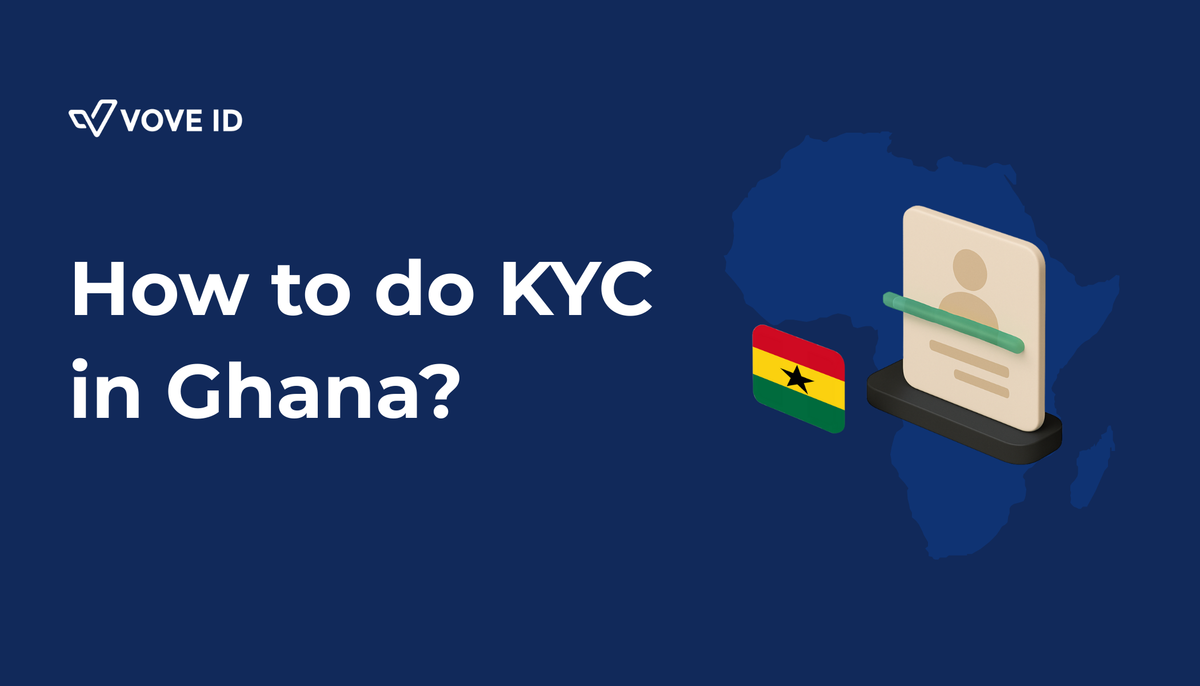
Ghana's financial sector has expanded rapidly on the back of mobile money adoption and digital payment infrastructure. Regulators have responded by tightening identity verification requirements across all accountable institutions — banks, fintechs, payment service providers, forex bureaux, and capital market operators. The Ghana Card mandate, reinforced through updated Bank of Ghana guidance, has made digital onboarding both more standardised and more demanding to implement correctly.
VOVE ID helps regulated businesses in Ghana build KYC workflows that meet Bank of Ghana and FIC requirements — covering document verification, biometric liveness, face matching, and sanctions screening.
This guide covers Ghana-specific KYC requirements: the regulatory framework, accepted documents, record retention obligations, and the friction points that fintechs encounter in practice. For the underlying KYC framework — risk tiers, CDD vs EDD, and how identity verification fits into a compliance program — see our KYC requirements hub.
The regulatory framework
Ghana's KYC obligations are anchored in the Anti-Money Laundering Act, 2020 (Act 1044), which requires all accountable institutions to perform customer due diligence before establishing a financial relationship. CDD covers identity verification, risk classification, and ongoing monitoring — and applies to both individual and corporate customers.
The Bank of Ghana's KYC Policy aligns with FATF's risk-based approach and sets specific requirements for financial institutions: identity verification at onboarding, customer risk profiling, transaction monitoring, and periodic KYC refresh. Institutions must maintain internal controls, conduct staff training, and operate whistleblowing systems.
The Securities and Exchange Commission (SEC) applies equivalent standards to capital market operators through standardised KYC forms that capture personal identification, source of funds, and risk classification. Forex bureaux fall under expanded BoG directives that require robust KYC and real-time sanctions screening for cross-border transactions.
The Financial Intelligence Centre (FIC) sits at the enforcement end: it receives and analyses suspicious transaction reports (STRs) submitted via the goAML platform, and shares intelligence with law enforcement. Accountable institutions report to the FIC directly; the BoG and SEC supervise compliance with the underlying KYC frameworks within their respective sectors.
The Ghana Card mandate
Since 2022, the Ghana Card is the sole acceptable primary identification document for financial onboarding across regulated institutions. Voter IDs and NHIS cards are no longer accepted. This applies across banks, fintechs, mobile money operators, and other accountable institutions.
The Ghana Card is linked to biometric data and the National Identity Register, which allows identity to be verified against a reliable national reference. The Bank of Ghana has reinforced this requirement through updated guidance in 2025 and 2026, including Notice BG/GOV/SEC/2025/36, establishing that identity must be tied to a unique national ID for all account holders.
For non-citizens, the Non-Citizen Ghana Card serves as the primary document. Where applicable — for example, in refugee cases — alternative identification is accepted under BoG's Supervisory Guidance Note on the Use of the Ghana Card.
Accepted documents and verification requirements
For Ghanaian nationals, the Ghana Card is the starting point for KYC. Beyond the document itself, regulated institutions are expected to perform biometric verification — face matching against the photo in the document and liveness detection to confirm the person is physically present and not a spoofed image.
For higher-risk customers or those with cross-border profiles, enhanced due diligence may require additional documentation: proof of address, source of funds declarations, or further identity corroboration. The specific EDD requirements are risk-driven rather than prescribed by a fixed document list.
For businesses onboarding foreign nationals — customers who are not Ghanaian residents — document diversity becomes a practical challenge. VOVE ID supports identity verification across 190+ countries, covering the range of national IDs, passports, and residence permits that appear in Ghana's increasingly international customer base.
Risk classification and enhanced due diligence
Ghana's KYC framework is risk-based. Institutions segment customers into low, medium, and high risk, and apply proportionate due diligence at each tier.
Low-risk customers — individuals with straightforward profiles, domestic activity, and no PEP exposure — can proceed through simplified due diligence. High-risk customers, including politically exposed persons (PEPs), customers with cross-border activity, and those in sectors flagged by the 2024 National Risk Assessment (mobile money, remittances, trade finance), require enhanced due diligence before onboarding and ongoing monitoring thereafter.
PEP screening is mandatory under Act 1044. Institutions must check customers against PEP databases and sanctions lists — including UN, EU, OFAC, and FIC watchlists — at onboarding and on a continuous basis. The 2025 BoG and FIC updates have placed particular emphasis on real-time sanctions screening for cross-border transactions and forex operations.
Record retention
Under Act 1044, KYC records must be retained for a minimum of five years following the end of the customer relationship. This covers identity documents, risk classification decisions, CDD records, and transaction data. The five-year requirement applies across all accountable institutions regardless of sector.
Digital onboarding in Ghana
Ghana Card adoption has created the infrastructure for digital KYC — the card's biometric data enables verification against the National Identity Register without requiring physical document submission. This has driven a shift toward eKYC across banks, fintechs, and mobile money operators.
In practice, digital onboarding in Ghana means OCR-based document capture, biometric liveness detection, and face matching — steps that can be completed remotely and produce an audit trail that satisfies BoG requirements. The friction is not in the technology but in access: Ghana Card penetration is strong in urban areas, but rural customers can encounter gaps in card issuance or digital infrastructure that require fallback procedures.
For platforms onboarding at volume, manual KYC review creates bottlenecks and audit trail inconsistencies. VOVE ID's verification pipeline — document OCR, liveness check, face match, and sanctions screening — runs as a single flow and generates structured records for regulatory review.
Penalties for non-compliance
Act 1044 provides for fines of up to GHS 1 million for institutions that fail to implement adequate KYC measures. The Bank of Ghana and SEC can suspend or revoke operating licenses. Individual compliance officers can face criminal liability for willful negligence.
Since 2022, BoG has increased enforcement activity around STR filing failures and inadequate CDD, particularly in the fintech and forex sectors. Reputational consequences — exclusion from international payment networks, loss of correspondent banking relationships — are often more damaging than the fines themselves.
Where KYC breaks down in practice
Two friction points are consistent across Ghana's KYC landscape.
Ghana Card access gaps. Despite the mandate, card issuance is not universal, particularly in rural areas. Institutions need documented fallback procedures for cases where the Ghana Card cannot be produced — while still meeting BoG requirements for identity verification.
Technical integration. Connecting to national identity infrastructure requires API access and ongoing maintenance. Third-party verification platforms that handle this integration operationally allow compliance teams to focus on risk decisions rather than infrastructure.
For KYB-specific requirements — verifying directors, beneficial owners, and corporate structures — see KYB Compliance in Ghana 2026. For AML obligations including STR reporting timelines and transaction monitoring, see AML Compliance in Ghana 2026.
Building a KYC program for Ghana that holds up under BoG scrutiny requires more than collecting the right documents — it requires a defensible audit trail from onboarding through ongoing monitoring.
This article is intended for general informational purposes only and does not constitute legal, financial, or regulatory advice. KYC/KYB/AML requirements may vary depending on jurisdiction, industry, and specific business circumstances. For up-to-date and binding compliance obligations, readers should refer to the relevant regulatory authorities or consult qualified professionals.