KYC Compliance in Tunisia: A 2026 Guide for Digital Businesses
Tunisia's KYC rules run on a real legal architecture, not a vague AML gesture — here's what CDD actually requires in practice.
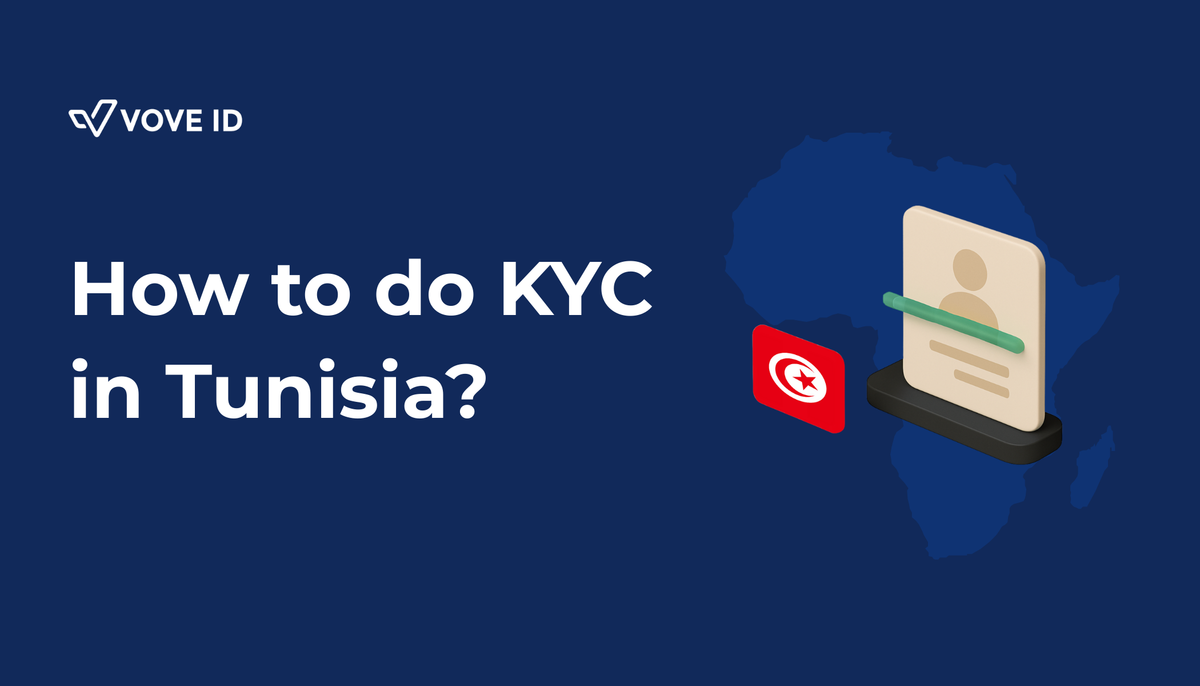
Tunisia's fintech sector keeps growing, and Know Your Customer compliance is the foundation regulators and partners expect underneath it — not a formality layered on top. VOVE ID helps fintech startups, banks, and other regulated entities in Tunisia build customer due diligence that actually holds up to CTAF and BCT review.
This guide covers customer due diligence for individuals in Tunisia. For the underlying KYC framework and workflow fundamentals, see our KYC Requirements Explained 2026.
Tunisia's KYC Regulatory Framework
- Organic Law No. 2015-26 (August 2015), amended by Organic Law No. 2019-9 (January 2019), is the primary legal basis, aligned with FATF recommendations.
- BCT (Banque Centrale de Tunisie) circulars set specific KYC obligations by institution type — banks, payment institutions, exchange offices — including the electronic-enrollment standard for banks under Circular No. 2025-06.
- CTAF: Tunisia's Financial Intelligence Unit, overseeing suspicious transaction reporting.
- CMF (Conseil du Marché Financier): regulates capital markets and enforces investor protections.
- INPDP: Tunisia's data protection authority. Biometric processing and any transfer of personal data abroad each require a separate prior authorization from INPDP, beyond the standard processing declaration.
These rules mandate customer due diligence, enhanced due diligence for high-risk profiles, ongoing transaction monitoring, and data retention for at least 10 years.
For business verification and beneficial ownership requirements, see our KYB guide for Tunisia.
Core KYC Requirements
Identity documents accepted:
- National Identity Card (CIN)
- Passport
- Residency card (for non-citizens)
Proof of address:
- Utility bills dated within the past 3 months
- Bank statements
- Government-issued residency confirmations
Risk-based due diligence:
- Standard CDD for lower-risk individuals.
- Enhanced Due Diligence (EDD) for PEPs or customers connected to higher-risk countries, which may require source-of-wealth documentation.
Ongoing monitoring and record-keeping:
- Monitor customer behavior and flag unusual patterns.
- Retain KYC records for 10 years.
- Report suspicious activity to CTAF without delay — there is no general 10-day filing window. Institutions covered by BCT Circular No. 2025-17 file immediately through goAML.
Compliance Challenges in Tunisia
- ID access in rural areas: a meaningful share of the rural population lacks formal ID documents, per World Bank data.
- Cash-based transactions: still a large share of day-to-day economic activity, which limits digital traceability.
- Manual onboarding: traditional KYC methods mean longer onboarding times and higher operational cost.
- Opaque corporate ownership: complex ownership chains complicate KYB verification for local SMEs.
Digital KYC: Where It's Actually Headed
Biometric verification, OCR, and AML screening are increasingly standard tools for Tunisian fintechs looking to speed up onboarding. Tunisia's national digital identity initiative (E-Houwiya) is part of that picture, though private-sector integration with it is still evolving — many fintechs currently rely on independent eKYC solutions for faster time-to-market and more flexibility in remote onboarding, rather than waiting on national ID integration.
Emerging trends:
- AI-powered monitoring for synthetic fraud and deepfake detection.
- Perpetual KYC (pKYC): continuous monitoring replacing one-time checks.
- Decentralized identity (DID): blockchain-based credentials aimed at reducing redundant verification.
- Privacy scrutiny: civil society groups continue to push for updates to Tunisia's data protection framework as digital ID initiatives expand.
How VOVE ID Supports KYC in Tunisia
VOVE ID gives fintechs and regulated businesses in Tunisia a compliant eKYC layer without depending on national ID system integration:
- OCR-based document verification for CIN, passports, and residency cards.
- Biometric liveness detection and face matching, to catch spoofing.
- Sanctions and PEP screening, applied at onboarding and ongoing.
- Audit-ready logging for CTAF and BCT review.
Why KYC Matters for Fintechs
- Builds user trust through transparent onboarding.
- Enables cross-border expansion by meeting FATF-aligned standards.
- Reduces fraud through stronger verification.
- Supports regulatory compliance as CTAF and BCT supervision intensifies.
For the complete, sourced requirement-by-requirement checklist, see VOVE ID's Tunisia compliance checklist.
Conclusion
KYC compliance in Tunisia is evolving fast, and businesses that build for INPDP-compliant, biometric-backed verification now — rather than treating KYC as a document checklist — are the ones positioned to scale across the MENA region without rebuilding their compliance stack later.
Tunisia's KYC rules reward businesses that build for INPDP compliance and audit-ready evidence from day one. VOVE ID helps fintechs verify identities efficiently, even in fragmented ID environments like Tunisia's.
This article is intended for general informational purposes only and does not constitute legal, financial, or regulatory advice. KYC/KYB/AML requirements may vary depending on jurisdiction, industry, and specific business circumstances. For up-to-date and binding compliance obligations, readers should refer to the relevant regulatory authorities or consult qualified professionals.