KYC False-Rejection Rate: The Metric Everyone Ignores Until It Costs Revenue
A rejected case can look like a clean risk outcome. It rarely is. Here's how to actually measure false rejection.
A rejection outcome is not enough. Teams need to know whether their policy, evidence, and review path treated the case fairly and consistently.
VOVE ID helps compliance and product teams run identity-verification workflows with document checks, biometric liveness detection, face matching, and policy-led review. A rejected onboarding case can protect a platform, but it can also expose a gap in capture quality, evidence collection, or decision routing.
Treating a rejection as a closed case, rather than a data point, is where most teams lose visibility.
False rejection rate: a governance question before it is a number
Teams use "false rejection" to describe a legitimate applicant who is rejected, abandoned after an avoidable failure, or otherwise prevented from completing a process that should have succeeded. The exact definition must be set by the team, because product rules, risk appetite, and available evidence differ.
That means one thing: there is no useful universal rate without a documented denominator, a review method, and an agreed definition of what counts as a false rejection.
On paper, a rejected case can look like a clean risk outcome. In practice, teams need to know why it happened and whether their policy gave a legitimate applicant a reasonable route to resolve it.
Where false rejections enter the workflow
False rejections do not begin at a single model or screen. They can start with a damaged document image, a poor camera capture, a name-format mismatch, an unclear policy threshold, or a reviewer who lacks the case context.
The operational question is therefore broader than a pass/fail decision. Teams need to distinguish an incomplete case from a risky case, and an uncertain case from a confirmed rejection.
This distinction protects both the customer experience and the integrity of the compliance process.
A realistic case: the rejected applicant who should have reached review
A payments platform onboards a legitimate sole proprietor who submits a valid identity document from a mobile device.
- The photo is legible but has glare along one edge.
- The live capture completes after a second attempt.
- The applicant's name format differs from the platform's expected input pattern.
- The case reaches a policy threshold without a clear recovery path.
Then the failure becomes visible. The platform records a rejection, but it cannot tell whether the underlying issue was risk, image quality, data entry, or an overly rigid routing rule.
This is not only a rejection event. It is a case-design gap.
Measure the path: from capture to final outcome
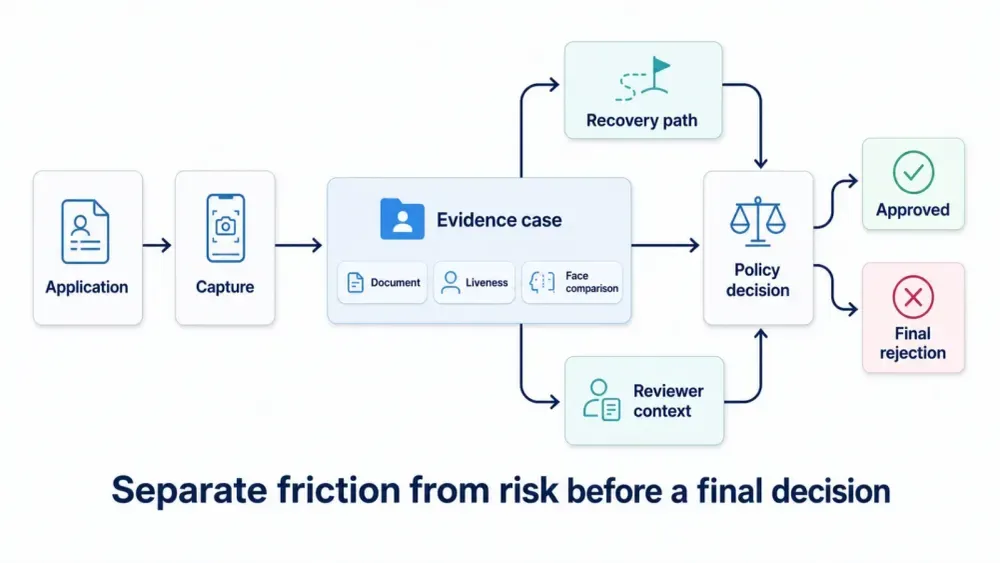
Teams that want to understand false rejection should review the full path. Start with the original capture, the document and identity signals, the policy applied, the reviewer action, and the final resolution.
Do not treat a retry as proof of error or an approval as proof that every earlier signal was wrong. Instead, define the states that matter to the team and review representative cases against those states.
The goal is an accountable process: a team can explain why a case was rejected, what recovery path was offered, and how it learns from repeat patterns.
How VOVE ID fits: controls that keep the case in view
VOVE ID supports document verification, biometric liveness detection, and face matching against the document photo. These controls help teams gather the evidence needed to assess an identity case.
When a customer's compliance team has sufficient evidence to approve a verification, manual review can be part of the workflow. The decision remains with the team's policy, rather than with an unexplained binary outcome.
For the underlying identity-verification framework, see our KYC requirements guide.
Practical false-rejection review checklist
Definition
- Define which final outcomes count as a false rejection.
- Set the denominator before calculating any internal rate.
- Separate abandonment, incomplete capture, escalation, and final rejection.
Case review
- Retain the evidence and policy path for sampled outcomes.
- Review recurring friction by document type, device, and capture step.
- Check whether legitimate cases have a documented recovery route.
Operations
- Give reviewers the evidence needed to make a policy decision.
- Track the reason codes that drive repeat escalations.
- Change thresholds and routing only with compliance ownership.
FAQ
What is a KYC false rejection?
It is a legitimate applicant receiving a final rejection, or being prevented from completing a process, because the workflow or policy treated the case incorrectly. Teams must define it precisely for their own process.
Can a team calculate false-rejection rate from rejected cases alone?
No. A useful internal metric needs a defined population, final outcome rules, and a review method that distinguishes risk from process friction.
Does manual review weaken a KYC workflow?
No. A policy-led review path can provide context for cases that cannot be resolved responsibly through a single automated signal.
What should teams investigate first?
Start with the most common recovery and rejection paths. Look for repeated capture, document, data-quality, or policy-routing patterns before changing a control.
Conclusion
False rejection is not a single product statistic. It is a test of whether a team can distinguish risk from avoidable friction and explain the decision it made.
Build the denominator, the review method, and the recovery path first — the rate only means something once those exist.
Want to see how VOVE ID keeps the evidence and review path visible behind every rejection decision?
This article is intended for general informational purposes only and does not constitute legal, financial, or regulatory advice, and does not state VOVE ID false-rejection, conversion, revenue, or performance results.